Woman survives two cancers after surprising diagnosis: "I feel so lucky"
Bookstore owner Vicky Titcomb had no reason to suspect anything was out of the ordinary when she went to Mass General Brigham for a heart scan in March 2025.
The 72-year-old Cape Cod bookstore owner and great-grandmother felt healthy. The scan was just a routine errand she had to run before traveling to New York City to visit her son. After the test was complete, Titcomb drove to New York. She didn't think about the scan again until she received a call from her internist on the last day of her visit.
The doctor had alarming news: There was an abnormality on her pancreas. Further testing would be necessary, but she likely had pancreatic cancer, one of the deadliest types of cancer.
"I felt like my life just switched in that moment," Titcomb said. "It was a very weird feeling."
But it wasn't Titcomb's first experience with a scary diagnosis. She had been treated for breast cancer in 2012. Then, she had worried. This time, she decided to stay positive. When tests confirmed she had pancreatic cancer, she made the choice not to research the often-deadly diagnosis.
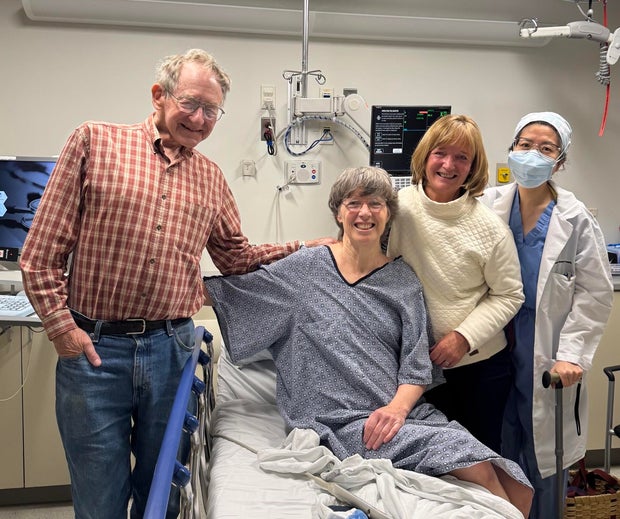
"I saw some terrible, terrible information about it," Titcomb said. "I shut it out pretty much completely, because it was too much to take in."
Developing an aggressive treatment plan
Pancreatic cancer is one of the most deadly forms of the disease, because it is often diagnosed after it has already spread to other organs. The 5-year overall survival rate for the disease is 13%. In its 2026 Cancer Progress Report, the American Association for Cancer Research noted that even as most cancer survival rates climb, pancreatic cancer statistics have seen little improvement despite advances in treatment.
In addition to the pancreatic cancer, Titcomb also had stage 1 breast cancer that needed treatment, and a mass on her ovary. The ovarian mass was handled first: Titcomb had the organ removed, and a test showed the mass was benign.
That left just the breast and pancreatic cancers. Cancer specialists at Mass General Brigham developed a plan to treat as much of Titcomb's disease as possible. It would start with chemotherapy and radiation to shrink the tumors.
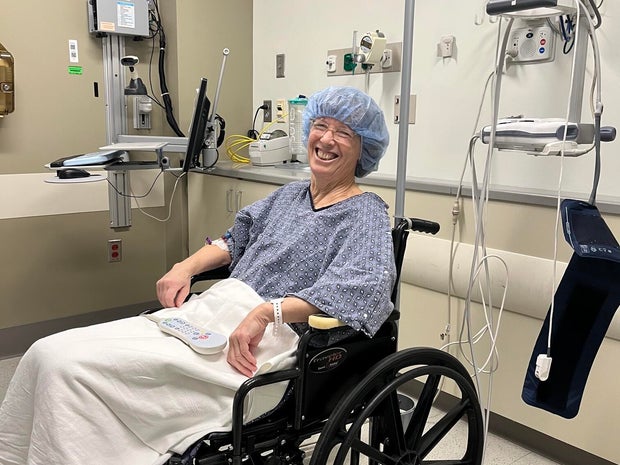
"I was told the size of the (pancreatic) cancer was about the size of a grape. The goal, to me, was trying to make this cancer a raisin," Titcomb said. "That's the way I visualized it."
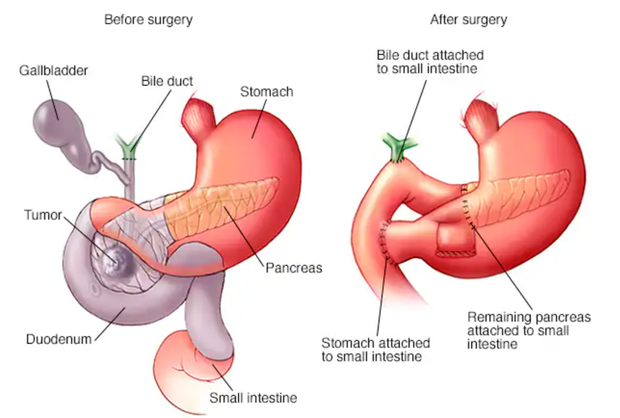
If all went well, Titcomb would undergo a procedure known as a Whipple, during which surgeons remove the head of the pancreas, the first part of the small intestine, the gallbladder, and the bile duct, then rejoin the organs to allow the digestive system to function. The operation is complex, but Titcomb was glad to be eligible for it: Only about 1 in 5 pancreatic cancer patients have disease that can be treated with a Whipple. Titcomb's early diagnosis had made it an option for her.
"If I had not had that scan when I did, the outcome would have been bad," Titcomb said.
Coping with multiple treatments
Titcomb began chemotherapy in June, receiving eight doses over four months. That was followed by three weeks of radiation and more rounds of chemotherapy. Surgical oncologist Dr. Thomas Clancy, who oversaw Titcomb's care, said she tolerated the treatments "very well." The chemotherapy and radiation successfully shrank the cancer, he said, allowing him to schedule her for a Whipple.
On Nov. 4, Titcomb underwent a procedure to treat her breast cancer. Just over two weeks later, Clancy performed the robotic Whipple. The operation is difficult on a patient, Clancy said, though the robotic approach allows for smaller incisions and a faster recovery time. But Titcomb felt confident, because it was scheduled for World Pancreatic Cancer Day.
"I was sure that Dr. Clancy chose me for that day because he felt positive about the outcome, because you don't want somebody to do badly on World Pancreatic Cancer Day," Titcomb joked.
It turned out the scheduling was only a coincidence. Still, the surgery was a success. Titcomb said she was up and walking that night.
After several days in the hospital recovering, Titcomb went home. Two weeks later, she returned for a follow-up appointment. Clancy confirmed she was healing well. But because pancreatic cancer is so aggressive, Clancy recommended she receive two more months of chemotherapy.
"There was a lot going on," Titcomb said. "I just tried to cope with the day-to-day."
"The luck trumps all"
After several more rounds of treatment, Clancy was able to tell Titcomb in March 2026 that she had no evidence of cancer. She will continue to receive scans every three months, but his hope is for her to "spend as little time as possible thinking about this."
"She's living her life. I generally tell patients at this point, 'You're done with therapy ... you go about your days,'" Clancy said. "The goal is to not be thinking about it all the time."
Titcomb said she has been trying to do exactly that. She is getting back into the routine of running her bookstore, which family members helped steer while she was in treatment. She spends time with her children, grandchildren, and great-grandchildren. The ones who are far away inundate her with photos, videos and phone calls.

Titcomb is also working to raise awareness for pancreatic cancer and advancements in treatment. She has spoken to legislators on behalf of the American Cancer Society and is working with the Pancreatic Cancer Action Network to share her own story and uplift others.
"I have benefited from enormous advancements in cancer treatment. People kept telling me that 10 years ago it would have been a different story," Titcomb said. "There are advances being made that people who've worked a lifetime on pancreatic cancer have never seen. I feel so lucky. The luck trumps all."
KioskNews shows a cleaned-up reading view extracted from the publisher’s page — the original always lives on their site, not ours.