KHAMPEPE COMMISSION: Mbeki denies secret deals with apartheid-era generals, blames NPA for TRC prosecution delays
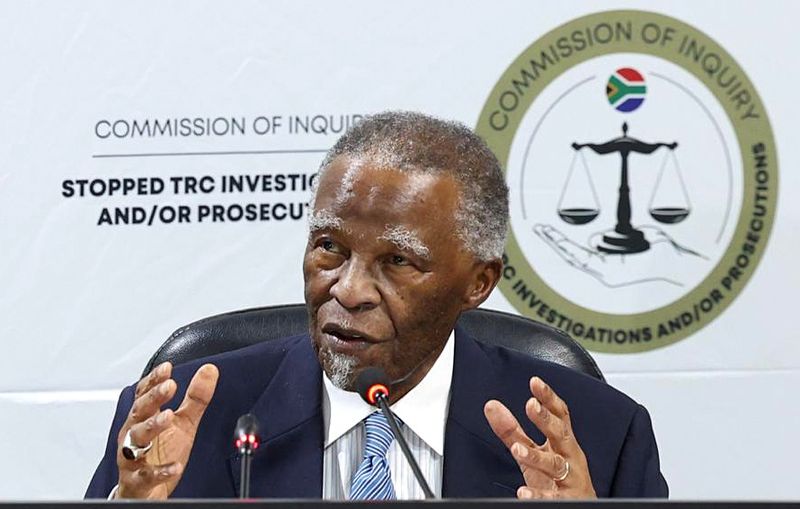
Former president Thabo Mbeki has told the Khampepe Commission of Inquiry into delayed Truth and Reconciliation Commission (TRC) prosecutions that the only occasion he met former apartheid military and police generals was when they had approached the ANC, stating they would not apply for amnesty if then president FW de Klerk and his cabinet did not do so as well.
On the first day of his much-anticipated appearance, the former president denied any secret meetings and testified that former generals approached him in 1996, while the TRC was in progress, to request a meeting with the ANC committee tasked with amnesty applications.
In response to this “grievance” of the former generals, Mbeki said the ANC had offered to approach De Klerk and his leadership colleagues to persuade them to appear.
In the meantime, “to create moral leverage and lead by example, the ANC leadership decided to apply for collective amnesty for its own political leadership”, he told the panel.
President, not prosecutor
Mbeki said the ANC leadership at the time had handpicked members who approached the TRC to apply for amnesty.
This had been done, he said, “taking into account individuals who would have been in relevant leadership positions during the period in question. None of them had committed any specific act of gross human rights violations as required by the TRC Act,” he noted.
Mbeki said he had been one of the “Group of 37”, as it came to be known, and while at first the TRC had granted amnesty to the group, this was later overturned by the courts.
“This put an end to the ANC’s attempt to set an example for the apartheid cabinet. Had our application succeeded, it would have given us the moral authority to call on the apartheid cabinet to do likewise,” Mbeki recalled.
With regard to allegations of later executive interference, Mbeki said that he had been “President of the Republic of South Africa and not prosecutor”.
It was expected, he said, that the National Prosecuting Authority (NPA) would deal with post-TRC prosecutions.
The 2003 speech
Led by advocate Ngwako Maenetje, Mbeki told the commission that his speech to Parliament in April 2003 had made it clear that he was dealing with matters not dealt with by the TRC and this had not been an attempt at political interference.
“The establishment within the NPA of a specialised prosecutorial capacity capable of pursuing these matters is difficult to reconcile with the suggestion that my purpose shortly hereafter was to signal that those cases should be suppressed,” he said.
The unit was established in March that year, and advocate Anton Ackermann was appointed to head it, he said, adding that “selective” quoting from his speech was “disingenuous and misleading”.
He denied allegations that the NPA required permission from the government before pursuing cases referred to it by the TRC.
Pardon powers
With regard to the matter of presidential pardons for those who had not applied, Mbeki said that “for the relevant pardon cases it was desirable to replicate the processes of the TRC 1993 [amnesty] unit” which had since been disbanded.
In the interests of the National Reconciliation and TRC Acts, he said, while the NPA continued its normal work, it was encouraged to collaborate with intelligence agencies “for those who sought to disclose the truth to enter into arrangements with the NPA”.
He said his statement had made it clear that the government’s approach had been not to grant immunity or general amnesty, but to “encourage truth telling”.
“My reference to the NPA working with intelligence agencies simply underscored the need for cooperation between state institutions that offences were politically motivated. It did not mean intelligence needed to control information. It was aimed at sharing information,” said Mbeki.
This arrangement, he said, had been purely “operational” as the government remained concerned that hidden arms caches and secret networks and structures established during the apartheid era “could pose a continuing threat”.

In response to criticism surrounding post-TRC prosecutions, he said the government had decided to establish “a more structured and transparent framework for evaluating future pardon requests” as announced by his then minister of justice Bridget Mabandla in January 2007.
He emphasised that the presidential pardon powers applied strictly to those who had already been convicted of an offence in a court of law.
He stressed that exercising “pardon powers” for convicted criminals was “conceptually and legally distinct from instructing prosecutors or suppressing NPA investigations against unconvicted persons”.
No backdoor escape
The former statesman said an accusation by the Calata Group, representing the families and survivors of various apartheid-era atrocities, that his special dispensation had adopted the “political solution” that had been sought by the apartheid security forces of an admission of crimes without full disclosure, was untrue.
The proposal by the generals required a special plea legislation which had never been approved nor enacted. He added that his special dispensation had “contained no directive or authorisation requiring the NPA to refrain from investigating or prosecuting anyone who had not received TRC amnesty or had not yet been convicted”.
Who shall grant amnesty?
Mbeki described the pre- and post-TRC process earlier as a giant jigsaw puzzle or chess game and that each component had to be treated in its context at the time.
One of the most crucial pieces was how to deal with those who had committed human rights violations as defined in the TRC Act, who did not approach the amnesty committee, which had completed its work when the TRC shut down.
Mbeki set out for the commission the dilemma of dealing with these people in the absence of the TRC, which would grant this amnesty.
He said that in cases where people applied for pardon to the president, and whatever they did was consistent with what was stated in the National Reconciliation Act, the government needed to find “some other instrument”.
This is how the Inter-ministerial Task Team came into being to assist the NPA to deal with post-TRC matters. Maenetje noted that Mbeki’s speech had been clear – “you leave it to the NPA subject to the need for engaging with intelligence” – and that the NPA had adopted this policy.
Secret meetings
Mbeki denied allegations that beginning in 1998 (first as deputy president and later as president), he had initiated and participated in secret talks with SADF generals aimed at avoiding past conflict prosecutions.
He confirmed the approach by the generals to him about the amnesty matter, but explicitly denied entering into any agreement that would prevent the National Prosecuting Authority (NPA) or South African Police Service (SAPS) from investigating or prosecuting former security force members.
Concerning consultations with Namibian businessman Jürgen Kögl in 1998, Mbeki said these talks had been with “various Afrikaners and had nothing to do with past criminal liability”. The talks, he said, had been about a “possible white Volkstaat”.
Mbeki concluded his testimony, denying that his administration had ever adopted policy or made any attempts to “halt, delay, or suppress the investigation and prosecution of TRC cases”.
He said that throughout his tenure as president, he had “consistently affirmed prosecutorial independence”.
He placed the blame squarely at the door of the NPA and said it would not be able to bring evidence that the national executive had ever obstructed cases. DM
KioskNews shows a cleaned-up reading view extracted from the publisher’s page — the original always lives on their site, not ours.