Jensen Huang’s exit tests Nvidia’s supply chain clout, ability to bankroll AI buildout
For years, Jensen Huang was more than Nvidia’s CEO – he was a key figure driving the artificial intelligence boom, parlaying close ties with Asian chip foundries and aggressive financial backing into an unprecedented global buildout of data centres.
Following his sudden resignation, the industry is confronting two immediate questions: without Huang’s personal relationships in Taiwan and South Korea, can Nvidia defend its priority access to scarce chipmaking and memory supply? And will it continue using its financial might to bankroll customers’ infrastructure ambitions?
Nvidia announced on Thursday that Huang had resigned as president, CEO and a board member, ending 33 years at the helm. Chief financial officer Colette Kress took over as interim CEO.
While the leadership shake-up sent Nvidia shares down 4.3 per cent to US$166.19 on Thursday – and dragged cloud partner CoreWeave down nearly 7 per cent – company leaders and Wall Street analysts moved quickly to reassure the market that existing projects were safe.
Board chairman Harvey Jones said he expected Nvidia to honour its client commitments and keep product road maps on track.
Goldman Sachs analysts echoed that view, pointing to an order book stretching 12 to 24 months, though they cautioned that Nvidia could find it harder to rally partners for massive new investments without Huang’s deal making clout.
At the heart of the industry’s concerns is the supply-chain diplomacy that kept Nvidia ahead of rivals.
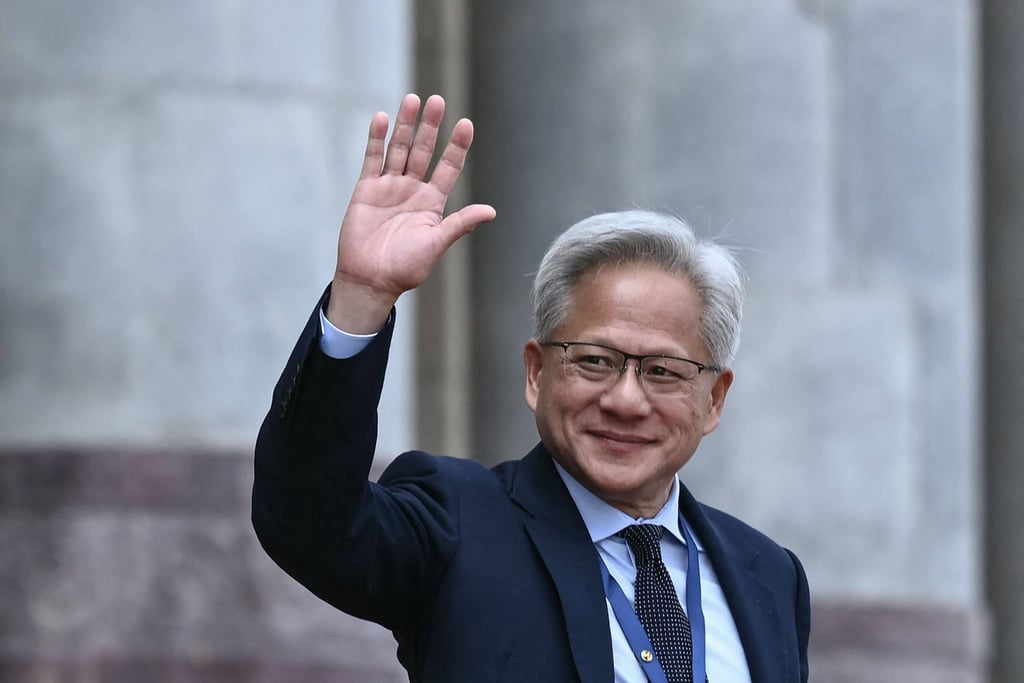
Research firm SemiAnalysis said Huang’s personal relationships were instrumental in securing chipmaking slots in Taiwan and access to high-bandwidth memory in South Korea. If suppliers gave Nvidia less priority under new leadership, competitors could gain an opening in future capacity negotiations.
To lock in that supply, Nvidia’s commitments for components and manufacturing surged to US$279 billion in July, up from US$119 billion the previous quarter, largely to secure memory and fabrication capacity, according to company filings.
Even so, broader market momentum may insulate Nvidia in the short term.
Speaking at a media round table on Friday, JPMorgan analysts said demand for AI computing power remained “very strong” and would likely outstrip supply for the next 12 to 18 months, limiting the near-term chip market fallout from Huang’s exit.
In China, meanwhile, domestic hardware was projected to handle a substantial share of AI inference workloads – the process of running trained models – next year, despite lingering bottlenecks in chip manufacturing and memory, JPMorgan said.
Local AI developers were adapting their models to run on home-grown semiconductors, with DeepSeek among the most active in pursuing domestic alternatives through its close work with Huawei Technologies, the bank added.
While most Chinese AI labs still relied on Nvidia’s CUDA software ecosystem to train their models, JPMorgan noted, local alternatives were narrowing the gap as domestic hardware and software improved.
Industry observers in China said Huang’s departure underscored deeper structural shifts reshaping the global chip landscape.
Zhang Guobin, founder of Chinese semiconductor news website eetrend.com, said the real question was not Huang’s personal crisis, but who was redefining the rules of the US AI industry and vying for control over next-generation infrastructure.
Zhang said Nvidia’s industry dominance was already facing mounting pressure as graphics processing units were no longer the only option for AI computing, and software made it easier to shift workloads across rival chips. National security was also increasingly shaping tech competition.
“Huang’s departure may just be the most striking turning point in this transformation,” he said.
Huang’s resignation came after The New York Times reported on Wednesday that he had engaged in an affair with Kimberly Powell, Nvidia’s vice-president of healthcare.
Huang had already admitted to another affair over the weekend, reportedly with the businesswoman Alice Huang, whom US officials suspect of being a Chinese operative – an allegation that Beijing has repeatedly denied.
Investors will get their first formal chance to hear Kress’s strategy on Tuesday, when Nvidia reports quarterly earnings, as scrutiny mounts on Nvidia’s dual relationship with cloud provider CoreWeave, to which it both supplies chips and from which it buys computing capacity.
Under a 2025 deal initially valued at US$6.3 billion, Nvidia agreed to buy unsold CoreWeave cloud capacity through April 2032. The chipmaker also invested US$2 billion in CoreWeave in January. Research firm SemiAnalysis said such commitments helped smaller cloud operators secure better borrowing terms to build data centres using Nvidia chips.
Nvidia has also provided major lease backstops for hyperscale infrastructure.
In August, the company agreed to conditional lease guarantees of up to US$105 billion for the initial 4.25 gigawatts of capacity at an Ohio data centre campus SB Energy was building for OpenAI.
Nvidia holds an option to back an additional 3.78 gigawatts, though OpenAI will need to find another guarantor if Nvidia declines to extend its support by a contractual deadline, according to an SB Energy filing.
KioskNews shows a cleaned-up reading view extracted from the publisher’s page — the original always lives on their site, not ours.