The Guardian view on Russian parliamentary elections: glimpses of weakness behind the facade | Editorial
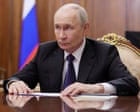
Vladimir Putin’s authoritarian powers are not constrained by elections, but he is alert to the danger that his rule would look illegitimate without them. That creates a tension, which is resolved through “managed democracy” – a euphemism for fraud and repression camouflaged with ritual ballots, held under a constitution that notionally guarantees political freedoms but in reality serves only the president.
Russians are invited to elect a new Duma, the lower chamber of parliament, later this week, but they know in advance that United Russia, the official party of Putinism, will win a majority.
Engineering that outcome is not without risk for the ruling regime. The mechanics of stealing an election are simple enough. Ballots can be stuffed, official media are pliant. But too blatant a theft can be counterproductive. If the results are wildly divergent from most people’s sense of the real public mood, an authoritarian leader risks advertising his fear of a genuine democratic consultation. It is a sign of weakness.
To an extent, this has happened already. Last month, the supreme court blocked Yabloko, an old and marginal liberal party, from appearing on Duma ballot papers. The case was spurious to the point of absurdity.

Yabloko is not one of the pseudo-opposition “system” parties that provide a pretence of pluralism in parliament, but nor does it pose a serious challenge to the regime. If it did, it wouldn’t have survived this long. It was last represented in the Duma in 2007, although it still sends deputies to local and municipal legislatures.
It is also opposed to the war in Ukraine. This Duma ballot is the first parliamentary poll since the full-scale invasion in 2022. Yabloko’s single-sentence manifesto calls for a ceasefire, diplomacy and peace. A decision not to let the bearers of that message participate even in a rigged ballot suggests nervousness about the popularity of a “special military operation” that was supposed to last weeks but is now well into its fifth year, with no end in sight.
Ukraine’s use of long-range missiles and drones to attack infrastructure deep inside Russia has made it hard for Moscow to downplay the scale of the war on their doorstep or shield civilians from its consequences. The reality of fuel shortages and inflation penetrates the wall of propaganda. So does loss of life.
The true number of Russian casualties is hard to know, but is thought to be about 1.5 million, with hundreds of thousands of fatalities. In the absence of volunteers, army recruiters are increasingly turning to coercion, press ganging or tricking people into signing up. There are rumours, denied by officials, that a mass mobilisation of reserves – unwilling cannon fodder – is coming once the election is out of the way.
So it is hardly surprising that the Kremlin has abandoned what was left of its flimsy pretence of permitting dissent. The machinery for delivering an election result to the president’s satisfaction is well oiled. There is no reason to think that it will fail this time. That doesn’t make the vote irrelevant. Mr Putin’s brutal record proves that he doesn’t care about the wellbeing of ordinary Russians, but he cares about the appearance of being supported by them. The harder the Kremlin is seen to work at constructing electoral proof of that support, the less confident it looks.
KioskNews shows a cleaned-up reading view extracted from the publisher’s page — the original always lives on their site, not ours.