Netflix’s ‘queen of screens’ hid a secret about her past. When it came to light, she froze
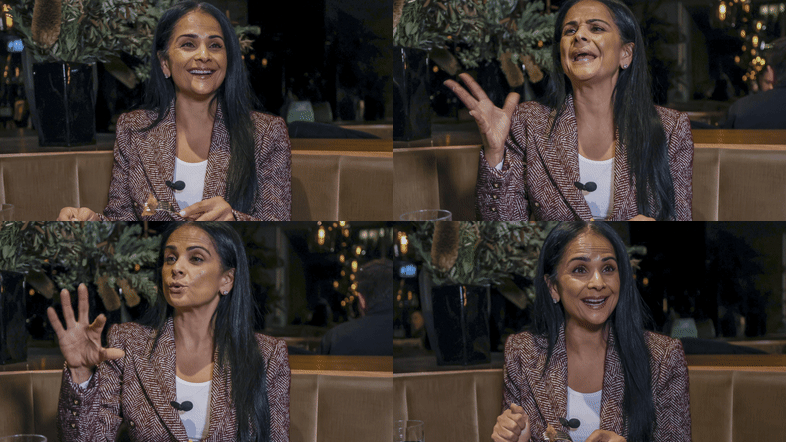
When I gingerly broach the topic of Bela Bajaria’s time at Universal Television, she brushes aside my polite euphemisms and gets to the point. “Which part of [my time at] Universal?” asks Bajaria, whose role as Netflix’s global chief content officer makes her one of the most powerful people in Hollywood. “The getting fired part?”
In 2011, Bajaria joined the television studio arm of NBC, then known as Universal Media Studios, which had been gutted by a previous regime. Her success in rebuilding it resulted in her promotion to president in 2015. But her success in creating and selling programs to rival platforms – also a key part of her job – became a sticking point.
Among the hit series Bajaria helped bring to fruition at Universal are The Mindy Project and Brooklyn Nine-Nine for Fox, and Unbreakable Kimmy Schmidt and Master of None for Netflix.
“I always felt the decisions I made were best for the creator and best for the studio,” says Bajaria, in an exclusive interview with this masthead. “When you are the studio to a sister network and you sell outside to other places – and if those shows are successful – it causes tension.”
Things came to a head in 2016, when Bajaria was sacked. At the time, it made no sense. After all, she’d created a slew of hit shows, treated people fairly and made what she believed to be the right decisions for the business.
“Then you realise that it’s not so simple,” she says. “There are definitely tensions and personality clashes and lots of other things that happen.”
Cliches about learning from failure, she adds, “look nice stitched onto a pillow”. But they do not preclude the self-doubt that comes with being dismissed from a high-profile dream job.
“The reason I talk about the firing part is that some people look at me and my job now and go, ‘Oh, it’s all just great,’” Bajaria says. “But there were these big, huge lessons along the way. I definitely learned more from getting fired than I learned at any other time professionally. It gives you a sense of perspective about who you are and what you’re made of.”
During her subsequent “summer of soul-searching”, Bajaria had a conversation with Ted Sarandos, now the co-chief executive of Netflix with Greg Peters. He told her not to take another job without speaking to him first. Soon, he offered her a role as head of licensing, co-productions and unscripted content.

“I’ve worked in scripted TV for 20 years,” she told him. “You’re offering me a job, but I have no experience in any of those things.”
“I just hire smart people,” Sarandos replied. “You’ll figure it out.”
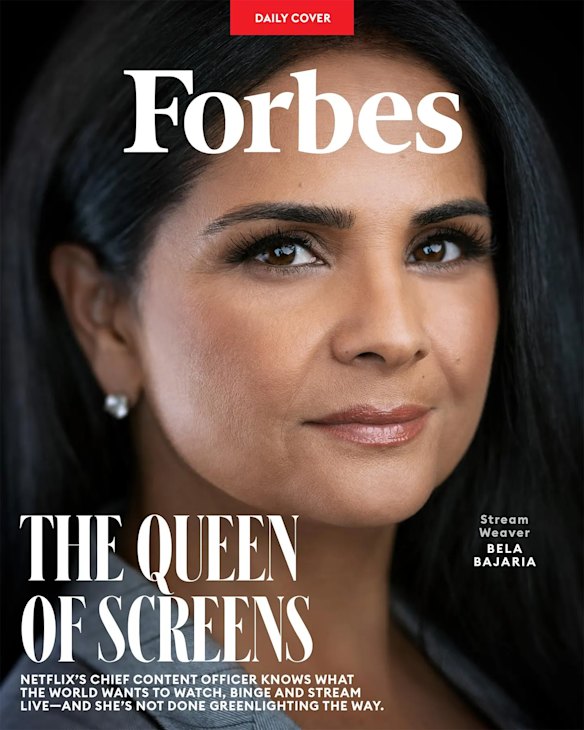
It’s safe to say that Bajaria impressed her new boss: in 2023, she succeeded Sarandos as Netflix’s global chief content officer. According to the London Telegraph, she is “the woman who decides what the world is watching on TV”, while Forbes magazine labelled her “Netflix’s Queen Of Screens”.
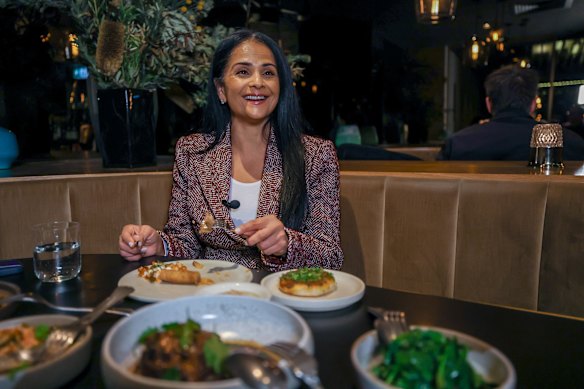
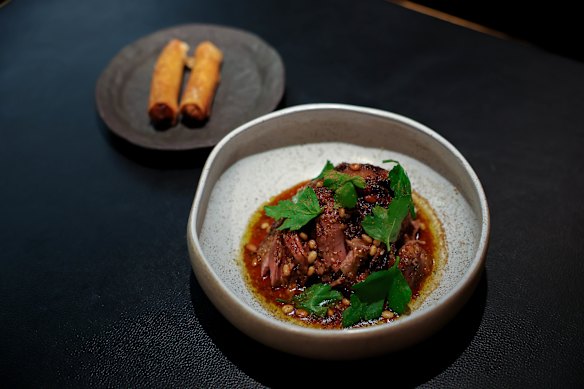
Bajaria and I are ensconced in a leather-upholstered booth at Maha, a moody, subterranean restaurant described by The Age Good Food Guide as Melbourne’s “gilded tiger of Middle Eastern fine dining”. We share several dishes including Turkish beef dumplings; roast zucchini and burnt red peppers; steamed warrigal greens with an olive oil and mustard dressing; and house flatbread with sumac butter and smoked hummus. The highlight is the slow-cooked lamb shoulder marinated in garlic sumac and cumin, so tender that it falls apart as we spoon it onto our plates.

Despite an impressive drinks menu, we opt for water – in part because Bajaria is on a flying visit to Australia, to promote the first American National Football League regular season game played in this country. The match between the Los Angeles Rams and the San Francisco 49ers drew 100,000 fans to the MCG, many of whom travelled from the United States. It was streamed live on Netflix and ESPN, and broadcast on Channel Seven.
‘When someone brought it up in an interview, I felt like some deep, dark secret was out.’
Bela Bajaria
For Netflix, it marks a further dissolution of the once-solid boundaries between broadcast television and subscription video on demand. When the streaming giant launched in Australia in 2015, it trumpeted its high-end, ad-free original programming (House of Cards, Orange Is the New Black, BoJack Horseman) as its point of difference. Meanwhile, free-to-air networks played to their strengths: live sport, news and local programming.
These days, it’s harder to tell the difference. Netflix now offers discounted subscriptions to viewers willing to watch ads, while investing heavily in reality shows, sport and other live events. In response, Australian broadcasters have beefed up their on-demand platforms. Two months before Netflix’s debut, Nine launched Stan, a direct rival that invests heavily in premium Australian programming. (Nine is the owner of this masthead.)
Globally, Netflix has more than 325 million subscribers, although household account sharing means its total number of users is significantly higher. While the company intends to increase its subscriber base, it can no longer rely on the rapid rate of growth it enjoyed in its early days – a situation made trickier by an international cost-of-living crisis.
This has prompted Netflix to seek revenue from other sources, such as games, short-form video and podcasts (all of which are more amenable to daytime use, allowing Netflix to move beyond its reputation as evening-based entertainment).
With all this in mind, would Netflix consider making a play for major Australian sports such as the NRL or AFL? Bajaria is not ruling it out.
“I love that people in Australia love sports so much,” she says, pointing out that the immense popularity of World Baseball Classic in Japan – the only country in which Netflix has the rights to the tournament – could provide a model for other markets. “If there was [a sport] in Australia that was ‘right-sized’ in that way, we’re always going to look at it. It doesn’t have to be global.”
Much has been written about Bajaria during her 30-year career. But there was one element of her past she vowed to conceal: her stint as a beauty pageant queen. Having already won Miss India LA and Miss India USA, she was crowned Miss India Worldwide in 1991.
“I hid it very deeply because I thought there would always be misconceptions about my work ethic, drive, ambition and intellect,” she explains. “When someone brought it up in an interview, I felt like some deep, dark secret was out.”
She re-enacts the wide-eyed, frozen-in-fear expression that overcame her during that conversation. But as her career progressed – and she continued to defy the lazy stereotypes about pageant winners – she embraced her Miss India accomplishments.
Bajaria was born in 1970 in London, a city with established South Asian communities. When she moved to LA at the age of nine, it was a huge culture shock.
“There was definitely racism against Indian people in London,” she says. “But in Los Angeles at the time, there just weren’t any Indian people, so it was even weirder.”
Her British accent amplified the unwanted attention, so she rid herself of it by studying popular American TV programs, from I Dream of Jeannie to Dallas.
“I grew up with very Eastern, Indian values of community and village versus the hyper-individualism of LA,” she says. “And [other children in LA] had a much more casual relationship with their parents … TV really helped me learn about American culture... it also showed me the power of film and television because we watched the same shows, which connected me with the kids at school.”
Competing in the Miss India contests, she now realises, allowed her “to become Indian on my own terms … I embraced my culture not just through my parents, but by meeting these Indian women from all around the world. I found my voice and learned to own my ‘Indian-ness’. By the time I entered the workplace, I’d already been out there in the world, being interviewed on stages. It ended up being an asset.”
Her work ethic is also informed by the sacrifices her parents made, including establishing a car wash business in LA while she lived with her grandparents in London, in a flat above their corner grocery shop. “As a kid, it was amazing,” she recalls. “You’d run downstairs any time you wanted candy or an ice cream.”
In the mid-1990s, Bajaria joined CBS as an assistant. She took it upon herself to read every script she could get her hands on, even providing feedback in the form of “notes”: a task way above her pay grade. She also spent hours in the broadcaster’s basement video library, watching old telemovies and miniseries.
“[As an assistant], you can either just pass through or you can be a sponge and absorb everything,” she says.
When CBS executive Michael Healy (not to be confused with the Nine TV director of the same name) accepted a job at Disney, he recommended Bajaria as his replacement. “You mean the assistant?” his stunned colleagues asked. Bajaria was equally surprised.
“I had no idea he even knew I existed,” she says. “But he [said to the other executives], ‘She read every one of my scripts and gave notes on every project; she could start tomorrow because she knows the material.’ I wasn’t doing it to be acknowledged – I just wanted to learn – but the lesson is that you never know who’s watching you.”

At the start of this year, Amdanda Duthie (who has held senior positions at SBS, the ABC and Stan) took the reins as Netflix’s head of content in Australia and New Zealand. In her first few weeks, she had hundreds of meetings with producers. “We wanted to open the doors and windows and say, ‘Come and talk to us about your projects’,” Duthie said.
If Bajaria were to offer one piece of advice to those pitching to Netflix, it’s this: do not market your series as “an international show”.
“What does that even mean?” she says. “Whether it’s Amanda in Australia [or her equivalents] in India or Mexico, we want each show to be really culturally specific, because that will resonate more than trying to do it through a US or global lens.
“Take Boy Swallows Universe or My Brilliant Career, which is No. 2 in so many countries, or shows that we’ve licensed like Fisk, which is so clever and well done. Look at Squid Game: it was made in Korea, by Koreans, for Koreans. If you try to make something for everyone, you make it for no one.”
Read more great conversations over lunch
- ‘I’m very emotional’: Good Food great Roslyn Grundy reflects on 34 years of restaurants and recipes
- A little over half of women accept a free mammogram. Cassandra’s rare form of breast cancer wouldn’t have been detected without it
- ‘No one in your corner’: Sarah fears for what Sydney’s alleged sexual assault victims are about to endure
- Why this science writer will escape to a farm in WA if bird flu strain mutates
- ‘It’s a common complaint’: Even at lunch, Neil Armfield can’t help but direct things
KioskNews shows a cleaned-up reading view extracted from the publisher’s page — the original always lives on their site, not ours.