Sarawak hydrogen market viability still unproven, says analyst
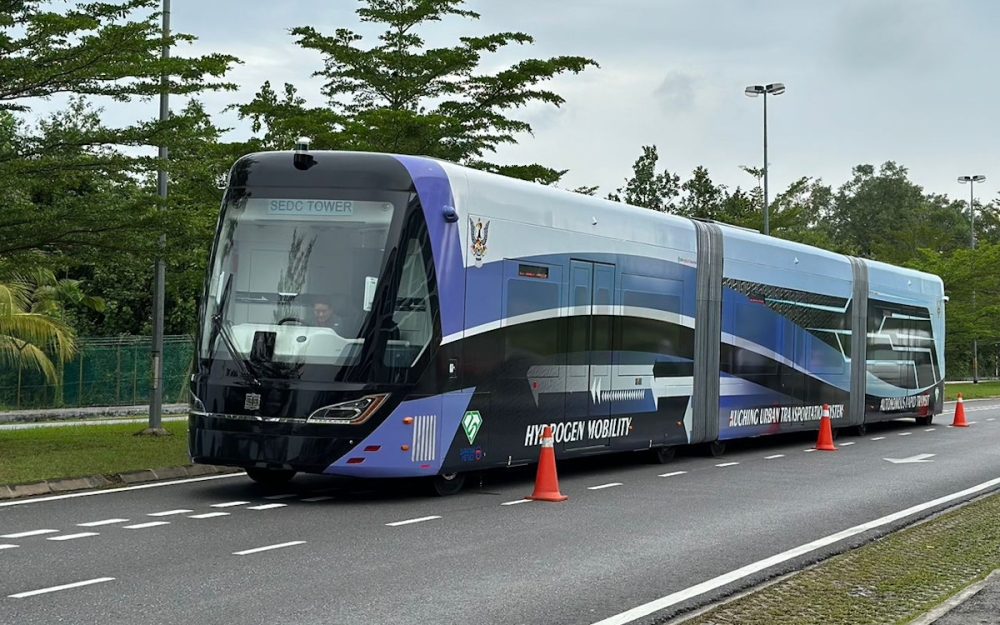

Sarawak is trying to boost domestic demand through publicly backed entities, specifically the Kuching Urban Transportation System. Pictured here is Sarawak’s hydrogen powered bus. — SoyaCincau pic
First Published: Wednesday, 30 Sep 2026 5:33 PM MYT
PETALING JAYA, Sept 30 — Putrajaya should think twice about extending incentives to Sarawak’s hydrogen sector when it has yet to prove that there are enough buyers willing to pay commercially viable prices, according to an analyst.
Samirul Ariff Othman from Global Asia Consulting said the concern was particularly relevant after Sarawak sought more Budget 2027 support for clean energy and other high-value industries, in a meeting this week between deputy premier Awang Tengah Ali Hasan and investment, trade and industry minister Johari Ghani.
He said the basic problem with hydrogen was not Sarawak’s ability to produce it, but whether anyone wanted to buy enough of it at a price that made the business sustainable.
“You can build the plant and produce the hydrogen. But if you do not have customers willing to pay the price, you do not yet have a business. A production advantage matters only if enough of it survives delivery.”
The Energy Industries Council previously reported that Sarawak’s flagship export-oriented H2biscus and H2ornbill projects were scaled down following weak demand signals and uncertainty over securing buyers, while the state later acknowledged that the projects were also facing financial constraints.
The problem was particularly clear in the proposed Japanese market.
SEDC Energy chairman Abdul Aziz Husain said hydrogen could be produced in Sarawak for below RM20 per kg, but compression, cooling and transport pushed the delivered cost in Japan to around RM50 per kg. He said the original proposal to export all the hydrogen to Japan was therefore not viable unless support such as subsidies was provided in the buyer country.
Samirul said incentives made more sense where they helped an otherwise viable investment get across the line.
“If there is already a customer, an investor and a project that makes commercial sense, an incentive can help Malaysia win that investment. But if the market itself is not there yet, the government has to be much more careful because taxpayers are effectively taking the demand risk.”
As for domestic demand, Samirul noted that in August 2025, the Darul Hana hydrogen facility had a stated capacity of 150 kilogrammes a day and supplied ten fuel-cell vehicles. SEDC Energy’s chief executive acknowledged it was “uneconomical” to leave an operational plant underused.
According to Samirul, Sarawak is trying to boost domestic demand through publicly backed entities, specifically the Kuching Urban Transportation System. KUTS is expected to have around 38 hydrogen-powered ART vehicles and 55 hydrogen feeder buses.
“KUTS gives the hydrogen plant a buyer, but essentially the state is buying from itself,” he said.
“The state backs the producer, the state backs the transport operator and public money pays for the infrastructure. That may be useful to get the technology going, but it does not tell you whether other customers would choose hydrogen at that price.”
He added that this model also does not establish value for money.
“If a publicly backed producer sells hydrogen to a publicly backed transport operator, the financial assessment must cover both organisations. Revenue received by one may be expenditure supported by the state in another.”
Samirul said this did not mean Putrajaya should reject Sarawak’s request for clean-energy incentives altogether, such as in renewables.
“Some of these technologies and projects already have customers and proven economics. But for others, it would be better to see real buyers, binding offtake agreements and a clear idea of when the industry stops depending on the government to create demand before more support goes in.”
He added that even hydrogen, ammonia and methanol involve different processing requirements and markets. Each requires its own business case.
Returns on investment
Samirul said the wider question is how Sarawak converts resource wealth into lasting productive capacity. The 2026 state budget, for instance, allocated RM1 billion for ART infrastructure and systems.
“Sarawak receives substantial revenue from oil and gas, and that has given the state much more money to invest. So once you start putting that money into a new industry, the obvious question is: what are Sarawakians getting back?”
Samirul said emerging industries did not necessarily have to make an immediate profit, but governments should still be able to show why the investment was better than alternative uses of the same money.
“There has to be a credible path to a return. If the same ringgit could go into power, infrastructure or another industry where there are already customers waiting, then hydrogen has to show why it deserves that ringgit instead,” he added.
“Capital has alternative uses. So does electricity. Hydropower allocated to hydrogen could potentially serve other industries, households or electricity sales.”
He added that the evidence available supports disciplined experimentation and fuller disclosure.
“It does not establish that Sarawak’s hydrogen strategy has failed. Equally, strategic promise cannot substitute indefinitely for demonstrable results.”
KioskNews shows a cleaned-up reading view extracted from the publisher’s page — the original always lives on their site, not ours.