US Congress releases list of Chinese firms seeking Nvidia chips
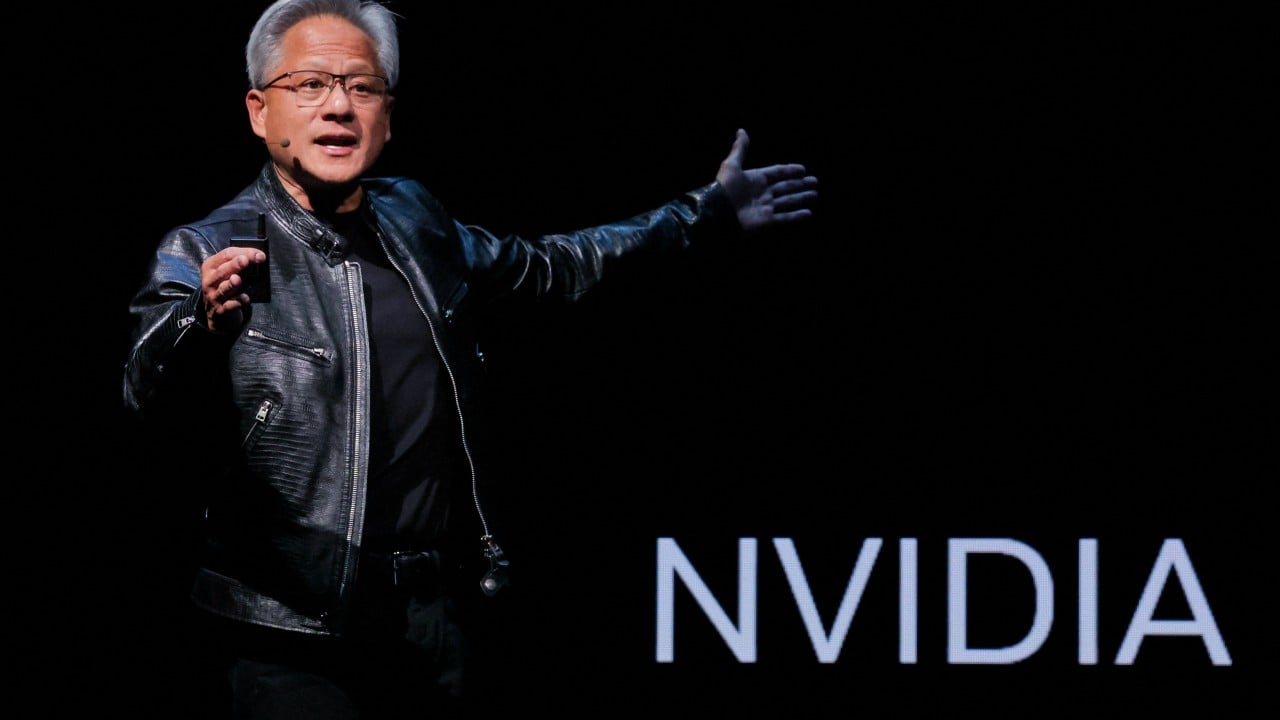
A US House committee on Thursday released confidential licence applications from Chinese companies seeking to buy advanced artificial intelligence chips from Nvidia and AMD, information normally protected under US export-control law.
Brian Mast, a Florida Republican and chair of the House Foreign Affairs Committee, used his authority under the Export Control Reform Act to make public the details of Nvidia and AMD licence applications to sell AI chips to China.
“[The Committee] determines that the withholding of the following information is contrary to the national interest,” the released document said.
The disclosure draws on a summary from the US Commerce Department’s Bureau of Industry and Security (BIS) as dated May 11. At that point, BIS had received applications to export 3,444,160 chips to Chinese companies and approved 879,868 across 21 licences.
00:50
‘I love China,’ says Nvidia’s Jensen Huang during Beijing summit tour
The advanced chips are Nvidia’s H200 and AMD’s MI325X chips, and none of the approved shipments had been sent at the time of the summary.
The document release comes amid scrutiny of Nvidia following former CEO Jensen Huang’s resignation after reports of extramarital affairs, including an alleged relationship with Alice Huang, a businesswoman US officials reportedly suspect of having ties to Chinese intelligence. The allegations have fuelled concerns over the potential diversion of advanced Nvidia chips to China.
According to CNBC, the committee voted on Thursday to release the documents. Ranking member Gregory Meeks, a New York Democrat, said BIS “has failed to enforce the rules” and that the US Congress must conduct “rigorous oversight”. He said the public “has the right to know how these decisions were made”.
Who are the buyers?
Alibaba Group and its subsidiaries sought 948,950 chips. BIS approved 75,000 under an application Nvidia filed on December 16, 2025. BIS returned the remaining requests, including one for 610,000 chips, without action.
Alibaba is the owner of the South China Morning Post.
Other approved applicants included Tencent Holdings and its subsidiaries, with 150,000 chips; ByteDance and its subsidiary, also with 150,000; Baidu, with 43,000; and JD.com, with 41,300.
Pending applicants included Meituan, which sought 75,000 chips; Geely, 2,280; Kuaishou, 40,800 under a second application; and electric vehicle maker Nio, 4,800. The list also named the Hong Kong University of Science and Technology, which sought 12,240 chips, and several smaller Chinese technology firms.
The document showed only one rejection: an AMD application to export 75,000 chips to UCloud.
The document said several companies named in the applications, including Alibaba, were later added to the Pentagon’s list of Chinese military companies operating in the US, known as the Section 1260H list, which was updated in June 2026. However, the applications, filed between December 2025 and April 2026, predated Alibaba’s inclusion.
Alibaba has denied that its commercial retail and cloud platforms have military ties and sued the US Department of Defence in federal court in California in late June 2026 to be removed from the list. In October 2026, a federal judge in San Jose temporarily blocked enforcement of a related restriction targeting firms that lobby for Alibaba while the broader case continues.
SCMP Plus is a new premium news platform that gives you an
all-inclusive edge to stay ahead on China news.
To access our exclusive content you’ll need to subscribe.
Already a subscriber?
LOG IN
The House Foreign Affairs Committee said every application described the proposed transfer as posing a “low” risk of diversion.
Some applications covered Chinese companies’ operations outside China, including Alibaba Cloud and a ByteDance unit in Malaysia.
BIS also granted Lenovo two licences covering various chips, including the H200. The licences prohibit shipments to China but allow Lenovo to use the chips overseas to build servers and conduct research and development on products such as data-centre racks.
KioskNews shows a cleaned-up reading view extracted from the publisher’s page — the original always lives on their site, not ours.