Renault’s plan for Chinese EV motor assembly in small French town sparks job loss fears
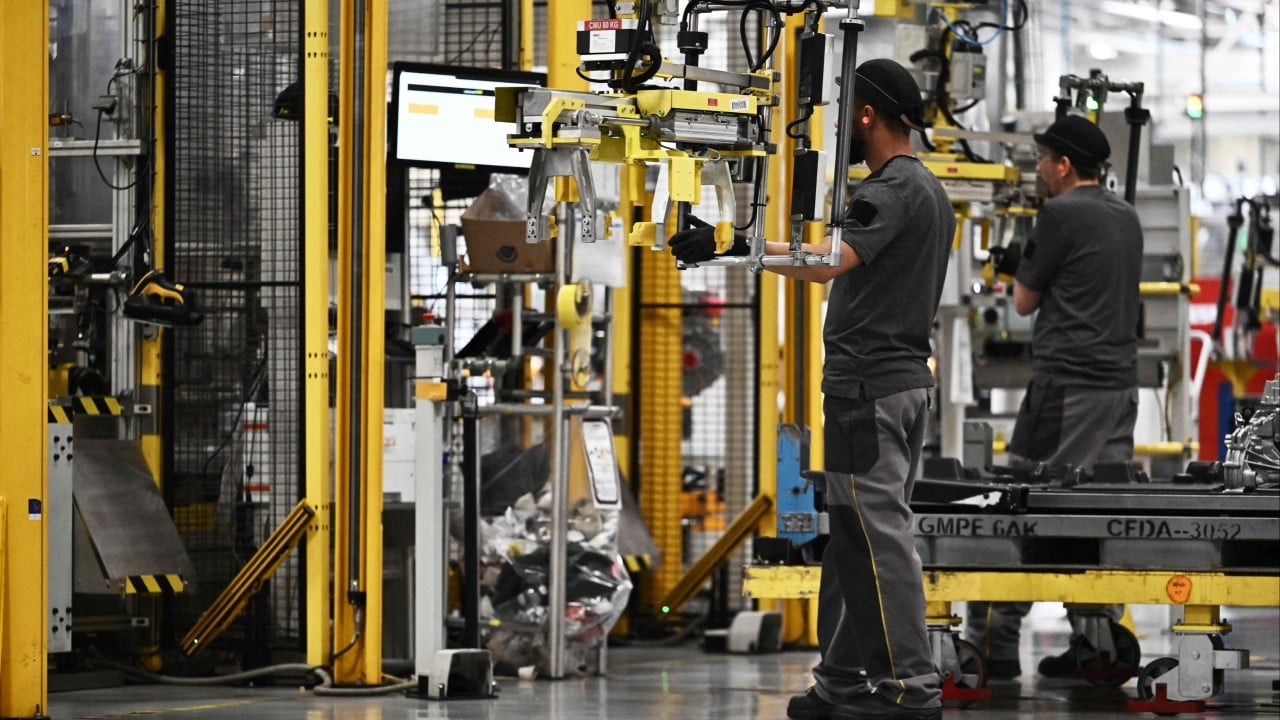
In the industrial heartland of Normandy, more than 100km (62 miles) away from Paris, lies the small town of Cleon.
Home to fewer than 5,000 residents and a Renault factory, the town and its environs are a near-perfect reflection of the current state of France’s rust belt, where economic activity and jobs are dwindling – the factory’s workforce has shrunk from almost 5,000 to 3,124 in 10 years.
Yet the planned arrival of an assembly line from Chinese firm Shanghai E-Drive next year, in collaboration with Renault to produce EV motors, drew a mixed reaction.
While Renault hailed it as an example of the group’s dedication to the factory, some workers voiced concerns: the assembly line would create only a handful of jobs, they said, and its products could directly compete with the plant’s other wares, risking further unemployment.
The politician who helped foster the deal also urged stricter made-in-France policies to encourage Chinese firms to bring more production to France to save jobs.
As the EU and China head into another round of talks to address their trade imbalances, with the loss of European jobs in the automotive sector being a major concern for Brussels, the Cleon plant is a sign of the tough reality of creating employment in an industry that analysts said is bound to shrink, even with Chinese investment.
This is why some argue only stricter made-in-EU rules can save what remains.
“It will only create 27 jobs in total across all teams … it’s an assembly line and it works without workers; unfortunately there is no longer the need for many people,” said Will Audoux, secretary of the factory’s branch of the General Confederation of Labour (CGT), one of the country’s largest trade union federations.
Like many of the other electric motor assembly lines the workers had already seen, this one would be highly automated, they said, adding robots would be soon to arrive.
09:10
Can the Middle East war turbocharge China’s global EV ambitions?
The situation is further complicated by the fears of many workers that the new assembly line would be making parts for a model that competes directly with the 6AK, a vehicle the factory manufactures from start to finish.
Therefore, the arrival of Chinese motors could paradoxically be putting more jobs at risk at the factory, according to David Bellanger, chief of the factory’s CGT branch.
SCMP Plus is a new premium news platform that gives you an
all-inclusive edge to stay ahead on China news.
To access our exclusive content you’ll need to subscribe.
Already a subscriber?
LOG IN
Production of the 6AK model involves seven workshops and around 350 workers – from foundry and machining to winding and assembly – while the Shanghai E-Drive model will only be assembly, with some logistics, according to Bellanger. All things considered, he said, the new line might cost more jobs at the plant than it brings.
In a statement to the South China Morning Post, Renault declined to confirm the number of jobs the assembly line would bring and maintained that the two models would meet different customer needs.
Alma Dufour, the local member of parliament from the left-wing La France Insoumise (France Unbowed) party, helped foster the deal, even going so far as to visit the Chinese embassy and ask for help. But even she agreed this was far from enough, and certain protectionist policies needed to be put in place to incentivise Chinese firms to produce more in France.
The issue, according to Dufour, was the rubric France uses to decide whether an EV qualifies for its purchase subsidy. She said it was not fine-grained enough, as the parts that make up the motor are not really taken into account.
“In my view, it will depend on the regulations … if the regulations get tougher, Shanghai E-Drive will follow on component manufacturing here. I don’t see any particular obstacles for them,” Dufour said. She went to visit Shanghai E-Drive’s headquarters in China in May and met the group’s executives.
“They made me understand that their strength was precisely to take advantage of tariff barriers or protectionist measures to set up early, and so benefit from the market ahead of competitors who would arrive later,” she said, adding that from the company’s point of view, France’s policy to shut out made-in-China EVs from receiving state subsidies gave the firm an edge compared with its other Chinese competitors.
The problem is you have all this fixed cost, you have these fixed factories, all this tooling and all these people … you basically do not need them any more
France currently uses a system that calculates the environmental score of each EV model. As it takes into account the carbon footprint of a model’s production and shipping, including where the car and its battery were made, the criteria favour cars made in Europe.
Nevertheless, even with tougher made-in-Europe policies, analysts warned that the continent’s automotive industry would be likely to shrink given that the EV revolution has transformed the industry, which no longer needs as many components or workers.
An internal combustion engine car has 3,000 parts, while an EV has fewer than 1,000 parts, which means the industry has less need for parts and people and lowers added value across the supply chain, according to Harald Hendrikse, European head of autos research at Citi.
“The problem is you have all this fixed cost, you have these fixed factories, all this tooling and all these people … you basically do not need them any more,” he said.
If Europe wants to keep some level of employment in the automotive sector where jobs are bound to shrink, it needs some kind of made-in-Europe law, according to Hendrikse.
For him, technology transfer was not important from a job-saving perspective, because European carmakers had access to Chinese technologies through their branches and partners in China.
The point was for the EU to accept a level of inefficiency in exchange for maintaining a certain level of industrialisation in the bloc.
“Either way clearly there will be fewer people employed in the industry … but the ones that we do keep, we need to keep in Europe,” he said.
KioskNews shows a cleaned-up reading view extracted from the publisher’s page — the original always lives on their site, not ours.