When two families try to claim the same body: Singapore officers help identify Nepal flood victims
SINGAPORE – When two Nepalese families tried to claim the same body after the Aug 26 flood, Singaporean fingerprint specialist Yong Heng Wei was called to resolve the situation.
Both families identified the body as their next of kin based on characteristics such as clothing and physical features.
However, the fingerprint comparison conducted by Yong and his colleagues showed that the body did not belong to either family.
Yong, who is with the Home Team Science and Technology Agency (HTX), was part of the 35-member Operation Vanguard contingent deployed to Nepal from Sept 1 to 18 to support Nepal’s disaster relief efforts.
The contingent, deployed at the request of the Nepali authorities, was made up of officers from the police, the Health Sciences Authority (HSA) and HTX.
The efforts of the contingent, as well as that of the more than 100 personnel involved, were recognised at a welcome home reception at HomeTeamNS Bedok Reservoir on Sept 26. Minister for Law Edwin Tong attended the event as the guest of honour.
The floods, which swept through parts of Tibet and Nepal, have claimed more than 1,450 lives. Over 5,700 are still missing, including nine Singaporeans.
The Singaporean contingent was involved in post-mortem examinations and fingerprint recording and identification. They also helped to train officers from the Nepal Police and Armed Police Force in drone operations.
Recounting the experience in Nepal, Yong, who is the officer-in-charge of HTX’s fingerprint examination team, said he and his colleagues had already returned to base, but were called back due to the urgency of the situation.
He said: “We compared (the deceased’s fingerprints) to the documents both families brought along, but unfortunately the body didn’t belong to either family.”
Yong said he had to use fingerprints that were recovered from the bodies, and match them with available records such as passports and missing persons records.
“It was quite challenging because not all bodies come with a usable set of fingerprints due to the damage done by the flood. Some bodies might also not have all fingers intact.”
Assistant Superintendent of Police Corelle Tan, who is a senior investigation officer in the criminal investigation department, was part of the team involved in lifting fingerprints from the bodies found.
“When we arrived, it had already been about a week since the disaster. So a lot of the bodies and remains were in an advanced state of decomposition, as some of them were soaked in water and mud.”
As a result, Tan said they had to adapt, as some of the methods they learnt during their training could not be used.
It was also her first time being deployed overseas for a mission, and her first time encountering decomposed bodies on a large scale.
“There was definitely a lot of sensory overload, and I was operating in an unfamiliar environment. So that required constant self-regulation and focus.”
Another member of the contingent, forensic pathologist Benjamin Kuek from HSA, was involved in doing post-mortem examinations of the bodies.
This process involves documenting and examining the bodies for any distinguishing features which could help identify the deceased. This includes traits such as gender, estimated age, tattoos moles and scars.
“One of the challenges was the scale and the condition of the bodies, which had differing degrees of decomposition and trauma, which can make the identification process difficult,” Kuek said.
Besides identifying unique characteristics of each body, DNA samples are also collected, and the deceased’s teeth are also examined by a forensic dentist.
“The reconciliation process happens after we have the full complete postmortem data, and information from the family. There’s also additional information from the DNA analysis team and the fingerprint team.
“We need all this information together before the Nepali authorities can perform the reconciliation process,” he said.
The reconciliation process is where the deceased’s fingerprints or DNA is matched with their next-of-kin.
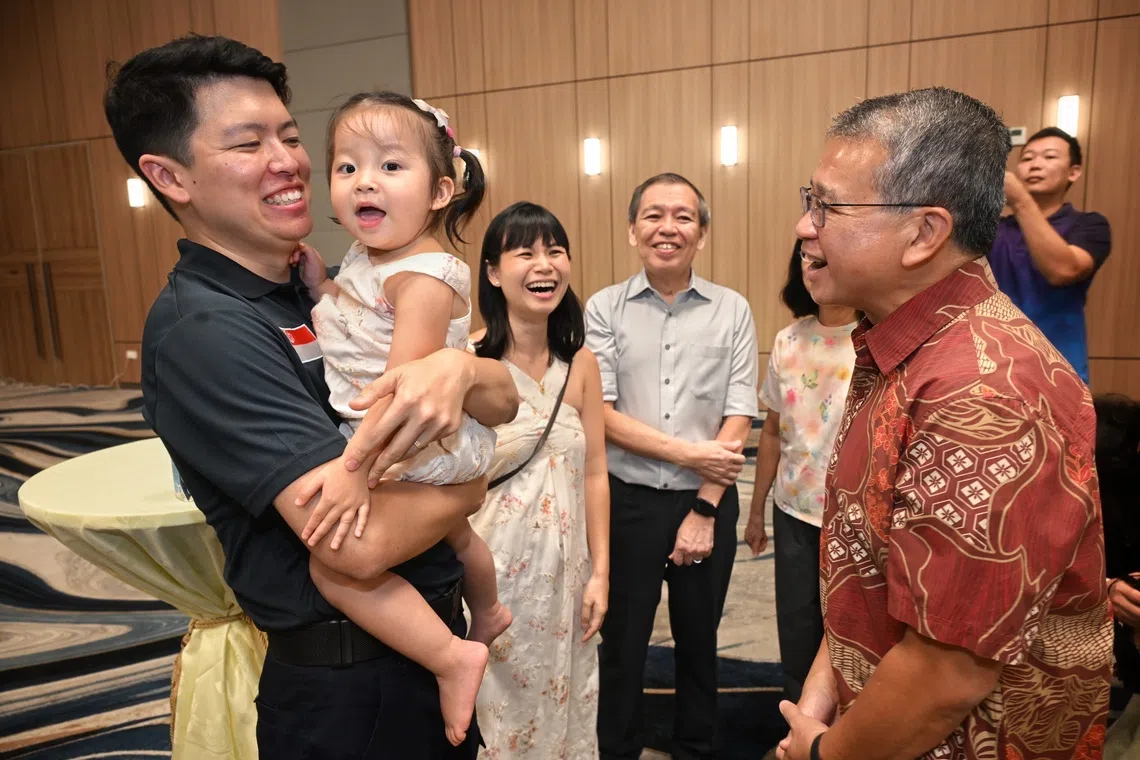
Law Minister Edwin Tong (right) mingling with fingerprint specialist, HTX Integrated Forensics Service Yong Heng Wei (left), and his family at the Welcome Home Reception for the Operation Vanguard Contingent on Sept 26.
ST PHOTO: CHONG JUN LIANG
Senior Staff Sergeant Hasrin Hasmoon from the police, was one of the trainers who taught the Nepalese how to operate drones for search and rescue operations.
Hasrin and three other trainers conducted training lessons for 20 Nepalese officers, teaching them how to use the drones, and how to make use of its capabilities to locate flood victims.
The police also donated six drones to the Nepal police.
Hasrin said the drones are used in areas where rescue personnel cannot reach by foot.
He said that one of the challenges was navigating drone operations in a different environment compared to Singapore, as they were flying the drones 1,300 meters above the sea level, which resulted in stronger winds.
In Singapore, drones typically cannot be flown more than 60m above sea level.
He also had to navigate the language barrier when sharing his expertise on the drones.
“(The Nepalese officers) were very determined to learn, and we managed to communicate eventually,” he said.
At the reception, Minister for Law Edwin Tong thanked the officers for their service.
He said: “To all our 35 deployed officers — you’ve really represented Singapore with tremendous distinction. You left home at short notice and worked tirelessly in very unfamiliar and very challenging conditions, but carried out your duties with professionalism, with resilience, and with compassion.”
KioskNews shows a cleaned-up reading view extracted from the publisher’s page — the original always lives on their site, not ours.