Yogendra Yadav writes | Babasaheb and Bapu are now friends, and for all of us, that is a reason for hope
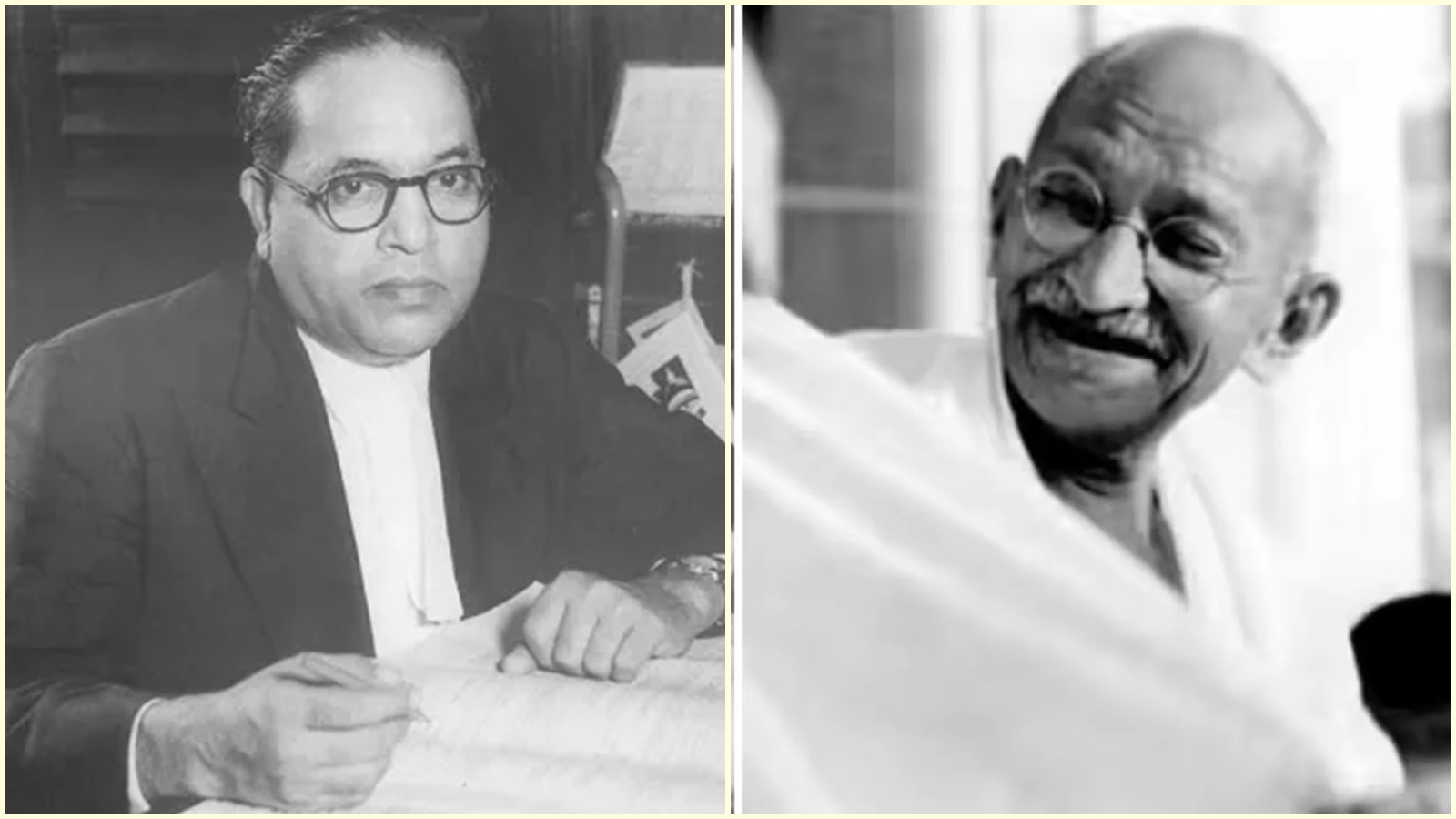
M K Gandhi and B R Ambedkar were not friends. The two were, at once, too close in their time and cause and too far apart in their social and political location to be friends. But Babasaheb and Bapu are now friends. At least for those who care for the future of our republic. And possibly, of our earth.
This friendship has not been easy in the making. In his recent book Arguments with Gandhi, Ramachandra Guha traces the history of “The Life and Afterlife of the Gandhi-Ambedkar Debate”. The afterlife of their debate passed through two difficult phases. The first three decades were marked by the omnipresence and deification of Gandhi while Ambedkar was erased and diminished. In 1982, as a postgraduate student of Political Science at JNU, I did a course on Modern Indian Political Thought that did not even mention Ambedkar, nor Lohia or Periyar for that matter.
His birth centenary in 1989, around the same time as the rise of the BAMCEF and the collapse of the Soviet Union, signalled a resurrection of Ambedkar both in the world of ideas and politics. Gradually, Ambedkar was the new icon, and Gandhi was suspect. While Babasaheb’s images went up in millions of homes, the political race to appropriate him often led to another kind of deification. This prepared the ground for the vilification of Gandhi, simultaneously as the enemy of Hindus and as the wily defender of the Hindu caste order.
Both these phases ruled out a friendship. Yet, a recalibration of their respective statuses had prepared the ground for a dialogue of equals. And, away from the political limelight, saplings of friendship were being planted.
Lohiaites served as the first bridge between Gandhi and Ambekar. Rammanohar Lohia’s call of “jati todo” resonated with Ambedkar’s Annihilation of Caste. At the same time, as a self-proclaimed kujaat (outcaste) Gandhian, who believed in satyagraha against all forms of injustice, Lohia offered resources for the ideological fusion of the Gandian and Ambedkarite streams. It did not happen in Lohia’s lifetime. Ambedkar passed away just before their proposed meeting. But some offshoots of Lohiaite politics like the Samata Sangathan, Socialist Front of Maharashtra, Samajwadi Jan Parishad and Sarvodaya Karnataka Paksha prepared the political ground for this unity.
Yet this friendship faced a huge obstacle — Gandhi’s perceived position on caste. Guha registers the contradictory nature of the reception of Gandhi’s views on the caste question: “Ambedkar saw Gandhi as a hesitant reformer, not willing to go fast and far enough to frontally challenge the structure of the caste system. On the other hand, conservative Hindus saw Gandhi as a dangerous radical, out to destroy their faith by undermining its core beliefs and essential underpinnings.” In the afterlife of Gandhi, the conservative Hindu fear has turned into an underground whisper campaign led by the RSS. But suspicion of Gandhi as the defender of the caste order had gained ground in the anti-caste political and intellectual circles.
Over the years, several reassessments of Gandhi’s views on caste have opened up a fresh conversation. It took someone from the weaver community, D R Nagaraj, to use Gandhi and Ambedkar as warp and weft in order to drape radical politics in new clothes. His iconic essay, “Self-Purification versus Self-Respect: On the Roots of the Dalit Movement” (The Flaming Feet, 1993), offered the stunning thesis that both Gandhi and Ambedkar had transformed each other. Ambedkar pushed Gandhi beyond his critique of untouchability as a moral failing to confront the caste system, while Gandhi made Ambedkar appreciate the need for moral and spiritual regeneration. A little-noticed essay by Mark Lindley (“How Gandhi Came to Believe Caste Must be Dismantled by Intermarriage”, 1997) brought to light the radical Gandhi of the 1940s. Around that time, Raosaheb Kasbe had begun an Ambedkarite reappraisal of Gandhi in several Marathi writings, which culminated in his Gandhi: Parajit Rajnitigya Aur Vijayi Mahatma (2020).
Nishikant Kolge’s book Gandhi Against Caste (2018) was a landmark in this respect. He offered the first meticulous chronological outline of the five phases in the evolution of Gandhi’s views on caste, from an early defence of varna and caste to a radical position against caste injustice. For him, Gandhi was a gradualist in his approach, largely due to the strategic necessity of keeping conservative Hindus with him in the freedom struggle. This led Kolge to defend Gandhi against critics like Arundhati Roy, whose reading of Gandhi’s text overlooks the context of his actions. In a similar vein, Kolge has also defended Ambedkar against criticism for his “anti-tribal” remarks.
Shashi Bhushan Upadhyaya nuances this reading in his recent book Gandhi and the Caste Question in Colonial India (2025). Instead of a simple story of evolution and radicalisation, Upadhyaya offers an analytical narrative of three separate strands in Gandhi’s position on the “caste” question: Untouchability, to which his opposition was absolute and non-negotiable; jati, on which he remained ambivalent; and varna, to which he was positively inclined, though for varying and conflicting reasons. For him, Gandhi’s defence of varna and ambivalence on jati was not simply a political strategy. He recognises a deeper moral and intellectual reason in Gandhi’s quest for a community in opposition to the Western model of atomised individuals.
This scholarship does not and need not resolve the deep differences between Gandhi and Ambedkar. But it removes the stumbling block of antagonism. The life of the Gandhi-Ambedkar debate was controlled by these two strong-willed persons. But its afterlife belongs to us. We can write and rewrite it. We can remain stuck in the past and keep fighting over the specifics of a bygone era. Or, to borrow a phrase from Kannada writer Devanoor Mahadeva, we can “drink the spirit” of their ideas and practices.
That is what the street protest of the youth has already done. The images of Babasaheb and Bapu on the stage and the slogans of “Jai Bhim” along with Gandhi’s quotes on placards during the July kranti have already signalled a new future. Babasaheb and Bapu (and hopefully Bhagat Singh) are now friends.
The writer is member, Swaraj India and national convenor, Bharat Jodo Abhiyaan
KioskNews shows a cleaned-up reading view extracted from the publisher’s page — the original always lives on their site, not ours.