Opinion: Blog | We All Need A Toilet. But Who Pays The Price For Keeping Them Clean?
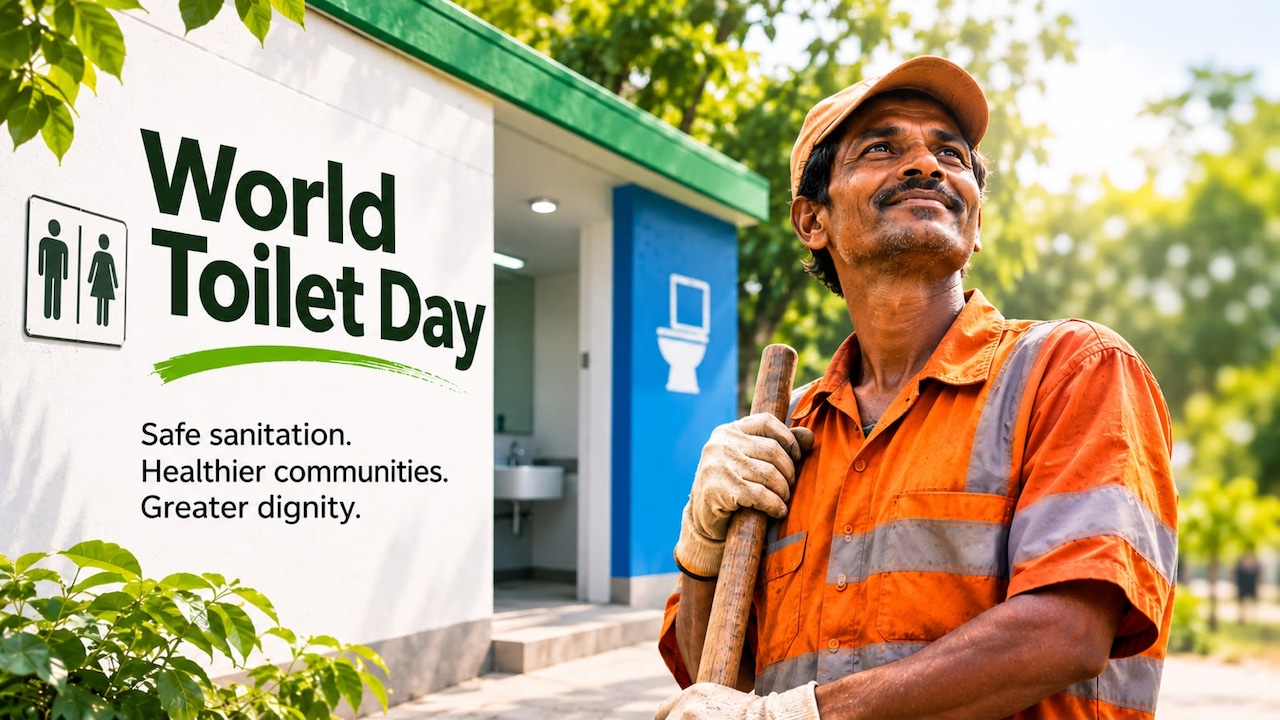
On World Toilet Day, we often talk about toilets, sanitation and hygiene. But behind every sanitation system are workers whose health, safety and dignity are frequently overlooked.
Let's be honest. Toilets are not exactly the subject most of us choose to talk about. We joke about them, find the subject awkward or simply take them for granted.
But think about it, each one of us depends on a toilet. It is one of the most basic necessities of human life. We cannot imagine a day without it.
And yet, behind this everyday convenience lies an entire system of work, responsibility and risk that most of us rarely see.
This World Toilet Day, our focus was not just on toilets or sanitation infrastructure. It was on the people who make sanitation possible and the enormous gap between the convenience we experience and the lives they lead.
Over the years, I have spoken to so many sanitation workers. I have heard about workers going into gutters and drains, sometimes barefoot, entering spaces where toxic gases can be deadly. I have heard about the dangers of handling waste, the illnesses they are exposed to, the injuries, and the very real risk of death.
I have also spoken to family members who have lost someone doing this work. And those conversations are not easy to forget. I remember going to meet a family a few years ago, while the rest of us were celebrating Diwali. They had lost their son on Diwali day.
While homes were lit up, families were celebrating and the city was bursting with festivities, this family was living with an unimaginable loss. I went to meet them, and that is one of those stories that stays with you long after the camera is switched off, long after the reporting is done.
And what has struck me equally, over the years, is something beyond the physical risks. Sanitation workers have spoken about being looked down upon, about being excluded from society, about the discrimination they face because of the work they do.
Imagine doing work that society depends on every single day, yet being treated as though you are less deserving of respect because you do it. Now that is a contradiction we need to confront.
The Life-Expectancy Gap Is Real And Alarming
Our World Toilet Day, NDTV Dettol Banega Swasth India Campaign brought this issue into focus through a report by Reckitt and IIPS Mumbai, titled "Bridging the Life Expectancy Gap of Sanitation Workers in India: Evidence → Action → Measurable Life Gains."
The Findings Are Deeply Concerning
The study shows that sanitation workers live 11.4 years less than professionals and 9.6 years less than agricultural and manual workers.
Think about what that means. A person's occupation should not determine how many years of life they lose.
The report also highlights the dangers sanitation workers face from occupational exposure:
Nearly 30% of recorded deaths among sanitation workers are attributed to poisoning, compared with 5.4% across other occupational groups.
Occupational hazards account for an estimated 128 deaths annually among 5.5 million workers aged 15-59.
The economic cost of inaction is estimated at ₹3.40 trillion annually, equivalent to 1.03% of India's GDP.
These are not just statistics. Behind every number is a person, a family, a life cut short, a livelihood affected, and often a story that may never be told.
And there is another troubling reality: the deaths and health consequences of sanitation work may not always be fully captured or counted. If the risks are underreported, the true burden could be even greater.
Sanitation work can expose workers to hazardous gases, toxic substances, pathogens and unsafe environments. Entering drains, sewers or confined spaces can be particularly dangerous, especially when workers are not equipped with the right safety measures or protective gear.
The dangers are not limited to sudden accidents. Repeated exposure, physical strain, infections, injuries and other occupational health risks can affect workers over years.
And when we speak about deaths, we must remember that not every occupational death necessarily makes it into the data. Some workers may be lost without adequate documentation or recognition of the occupational circumstances that contributed to their death.
This is why the report matters. It moves the conversation beyond anecdotes and puts evidence behind what sanitation workers and their families have been telling us for years.
There lies a gap between our convenience and their reality For most of us, sanitation is invisible when it works. We walk into a clean toilet. We expect our waste to be removed. We expect our neighbourhoods, offices, roads and public spaces to remain clean.
But what happens after we flush? Who handles the waste? Under what conditions? With what protection? And what happens to their health?
There is a gap between the sanitation we expect and the conditions in which sanitation workers live and work.
That gap is not just about infrastructure. It is about safety, dignity, discrimination, access to healthcare, protective equipment, mechanisation, training and social protection.
And ultimately, it is about life expectancy.
Sanitation workers need safer working conditions, appropriate protective equipment, training, access to healthcare, regular health monitoring, social protection and dignity at work.
Hazardous work must be mechanised wherever possible. Workers should not be forced to enter dangerous spaces without appropriate safety systems, equipment and safeguards.
Training initiatives are also critical. Programmes such as Harpic World Toilet College have worked towards building skills and improving awareness among sanitation workers. But training must be supported by systems that make safe work possible in reality not just on paper.
If sanitation is about health, then the health of sanitation workers must be at the centre of the conversation. If we want cleaner cities, we cannot measure success only by the number of toilets built or waste collected. We must also ask- Are the people doing this work safe? Are they protected? Are they healthy? Are they treated with dignity? Are they living as long as they should?
World Toilet Day may sound like an unusual day to mark. It may even seem like a subject we would rather laugh about than discuss seriously.
But sanitation is deeply connected to health, safety, dignity, equality and human rights.
Every one of us uses a toilet. Every one of us depends on sanitation systems. And every one of us has a responsibility to think beyond our own convenience.
The next time you walk into a clean public toilet or take the sanitation around you for granted, remember that there are people behind that cleanliness. Their work should not be invisible. Their health should not be expendable. Their dignity should not be negotiable.
And the families who have lost someone doing this work should not be forgotten.
Because a toilet may be a basic necessity for us, but ensuring that it is clean and safe should never come at the cost of someone else's life, health or dignity.
(Ambika Singh is the Deputy Editor & Senior Anchor with Special Projects NDTV)
KioskNews shows a cleaned-up reading view extracted from the publisher’s page — the original always lives on their site, not ours.