Remembering Jogen Chowdhury: An artist and dreamer of institutions
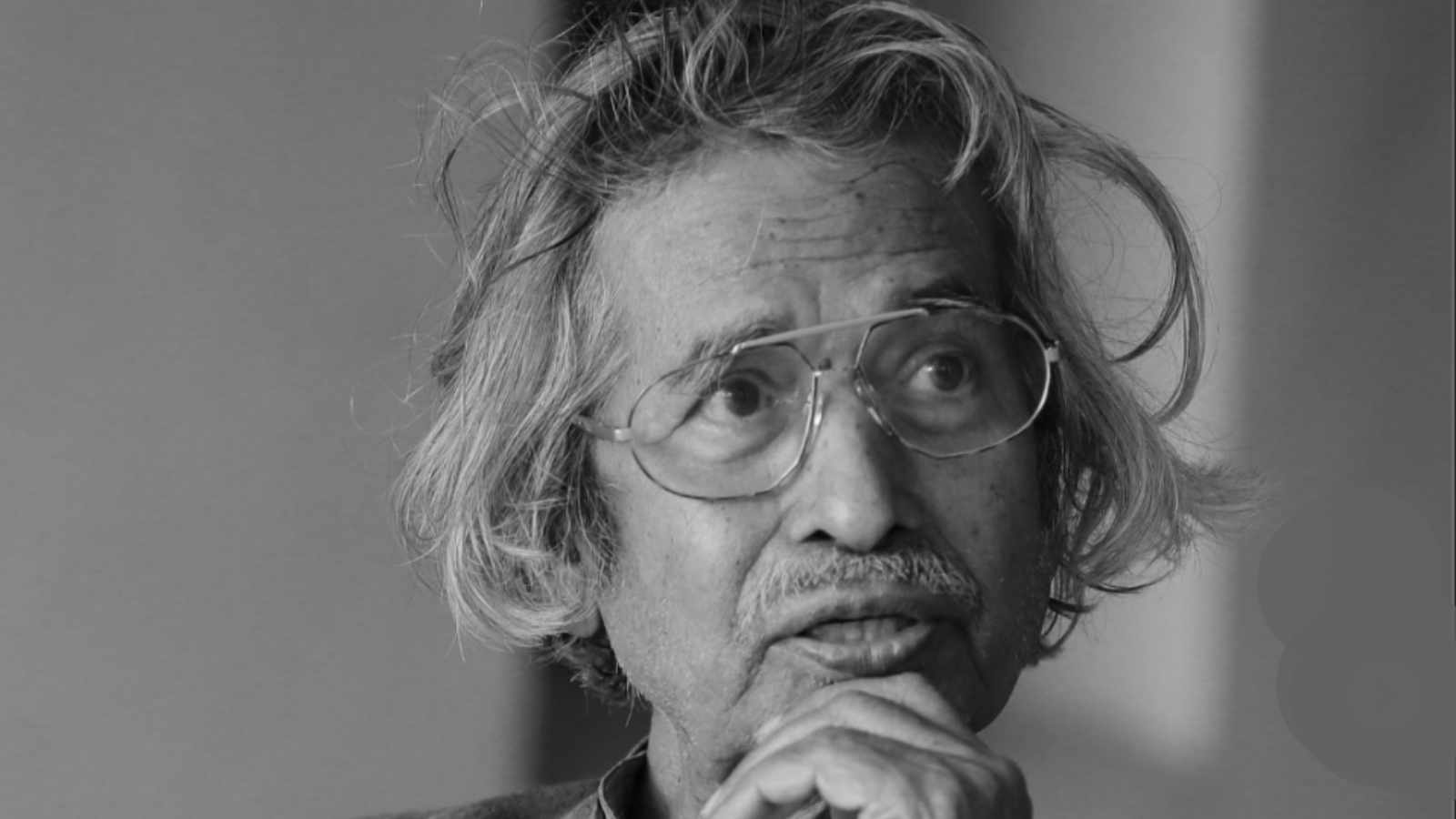
Jogen Chowdhury, who died this morning after battling cancer for over a year, was one of a small group of important painters from Bengal who came onto the Indian art scene in the 1960s. He had carved out a distinct niche for himself. Born into a landed family in pre-Partition East Bengal, he experienced a great reversal of fortune and became a post-Partition refugee in Calcutta. This early experience left a deep mark on him and profoundly shaped his art and personality.
Trained at the government art college in Calcutta and later travelling to Paris on a scholarship, he saw the pre-modern academic and modern art practices up close. But he chose to tread a path of his own. Back in India and working at the Weavers Service Centre in Madras, he developed a personal idiom, drawing on his early memories of the embroidery (kantha) and ritual floor graphics (alpona) practised by women in the villages in Bengal. He imbibed their sinuous lines and textural intricacy without mimicking them and combined the decorative with the expressive.
With this, he created a language that far exceeded the simplicity of its means in subtlety and expressiveness. And he travelled a long distance with it. Initially, he used it to explore the subterranean intricacies of his own mind, throwing up suggestive images of desire and disquiet. When he moved to Delhi as the Keeper of the collection at Rashtrapati Bhavan in 1972, he left the personal and the subliminal behind. He began to observe the political world closely and, while commenting on its players through his art, his paintings acquired a satirical edge. A further shift happened when he joined the art college at Santiniketan in 1987. He moved from the political to the social, and his paintings became a subtle tongue-in-cheek critique of middle-class life, especially in Bengal.
With each shift, he added a new register to his language, making it flexible enough to work at the personal, political, and social levels. In his hands, with a small twist, simple everyday objects took an uncanny turn. A large flower with a fish floating on a dark screen evoked suppressed desire, a bolster suggested a decadent corpulence, the slight grimace invoked corruption, a displaced drapery or a small gesture opened up a crack on the wall through which a story spilt out, and all this without changing the formal structuring or economy of his language.
His early years in Calcutta as a refugee were extremely trying, but the suffering did not demoralise him; it made him aware of the need for looking beyond the personal and engaging with the collective. When he left Delhi for Santiniketan at the height of his personal success as an artist, he had this in mind. As a professor of painting at Santiniketan, he threw himself into mentoring young artists, enthusiastically reenergising the institution. But this was not enough for him. Seeking to bring art into society, he led a group of younger colleagues in founding the Santiniketan Society of Visual Art and Design. This artist-run centre provides working space for young artists and a place for the community to meet. In all this, he was inspired by Tagore, who, besides being a great poet and a multifaceted creative person, devoted great energy to teaching and founding institutions.
In 1999, he took voluntary retirement from Visva-Bharati and expanded his activities in Kolkata as part of his effort to revitalise the art scene in Bengal. He undertook a study of the provisions for art education in schools and drew up an elaborate plan to strengthen it. He even waded into politics in the hope that it would help. It brought him a term in the Rajya Sabha, but little else. During the same period, he set up Charubasona, another centre for art activities in the city, started the art magazine ArtEast, and served as chairman of the state art academy. Setting up a museum of modern art in Kolkata was another dream for which he devoted considerable time and energy, but it remains unrealised.
Jogen Chowdhury was a remarkable artist and a dreamer of institutions. He had the resources to realise the first; the second needed wider support, which was not always forthcoming. But he was a die-hard optimist and never gave up dreaming and hoping.
KioskNews shows a cleaned-up reading view extracted from the publisher’s page — the original always lives on their site, not ours.