The 6 Best Science Fantasy Books Released Since 2020, Ranked

Sign in to your Collider account
You can spend ten minutes arguing over whether a book contains sufficiently rigorous technology to count as science fiction, then somebody summons a demon through an interstellar civilization and the whole conversation becomes wonderfully pointless. The books I love most in this space behave like they have better things to do than ask permission because honestly, science fantasy is where genre labels start feeling a little childish.
These six are exactly that kind of trouble. They throw necromancy into space, biotech into pirate cities, djinn into cyberpunk, Faustian bargains into violin lessons, and anthropology into what looks suspiciously like a medieval quest. Yet the weirdness comes with substance and doesn’t ask for permission. It all fits just right in and so if that’s your piece of cake, have at it with these 6 finest science fantasy books released since 2020.
6 'Cyber Mage' (2021)

Cyber Mage follows Marzuk, a teenage hacker in a climate-ravaged 2089 Dhaka, whose life in virtual worlds collides with mercenary Djibrel, powerful AIs, advanced nanotechnology, and ancient djinn as a much larger conspiracy begins closing around them. Marzuk is brilliant online and painfully less impressive whenever actual human beings enter the equation, which immediately gives the book more personality than the usual teenage-tech-prodigy fantasy.
Saad Z. Hossain’s future is the real drug here. Dhaka survives extreme climate conditions partly because biological nanotech is embedded across millions of bodies, while nations have blurred into corporate entities and supernatural beings exist alongside absurdly advanced computation. The combination should feel overloaded. Somehow it feels gleefully alive. Djinn, hackers, gaming culture, feral AI, swords, satellites, and teenage arrogance all occupy the same world without politely separating into genres. Read this when you want a book that keeps pulling stranger ideas out of its pockets and somehow still has one more.
5 'The Dawnhounds' (2022)

The Dawnhounds follows Yat Jyn-Hok, a former thief turned police officer in the living biotech city of Hainak, who is murdered by fellow officers after discovering a corpse, resurrected by a mysterious power, and forced to flee with pirates while a deadly plague spreads through the city. That is a lot for one premise sentence, and the actual book gets weirder.
Hainak is the reason I would push this at somebody who complains fantasy cities all start resembling one another. Its buildings, weapons, and clothing are alive, the city carries the scars of an earlier war, and biology has basically become infrastructure. Yat’s resurrection then turns the whole place uncanny from the inside because she starts manipulating life force while the institution she served is hunting her. The pirate crew gives the chaos warmth. The corruption gives it teeth. And beneath all that biotech strangeness is a woman discovering that surviving your own murder can seriously rearrange your opinion of authority.
4 'Elder Race' (2021)

Elder Race follows Lynesse, a young princess who seeks the help of an ancient “sorcerer” to stop what her people believe is a demon, unaware that the sorcerer is actually Nyr, an anthropologist from an advanced civilization who has been ordered to observe her society rather than interfere with it. That one misunderstanding is enough to power the entire book.
Lynesse sees relics, enchantment, and an immortal wizard. Nyr sees technology, fieldwork, and a civilization he is ethically prohibited from manipulating. Both descriptions can be accurate at the same time because knowledge changes the vocabulary, not the event. Adrian Tchaikovsky gets enormous mileage out of letting the same world exist as science fiction to one character and fantasy to another. Then he gives Nyr a depression-management system that literally helps him compartmentalize his emotions so he can function, which suddenly makes the supposedly godlike elder race feel painfully human. It is only around two hundred pages. I still wish I could make people read it by physically handing it to them.
3 'Nona the Ninth' (2022)

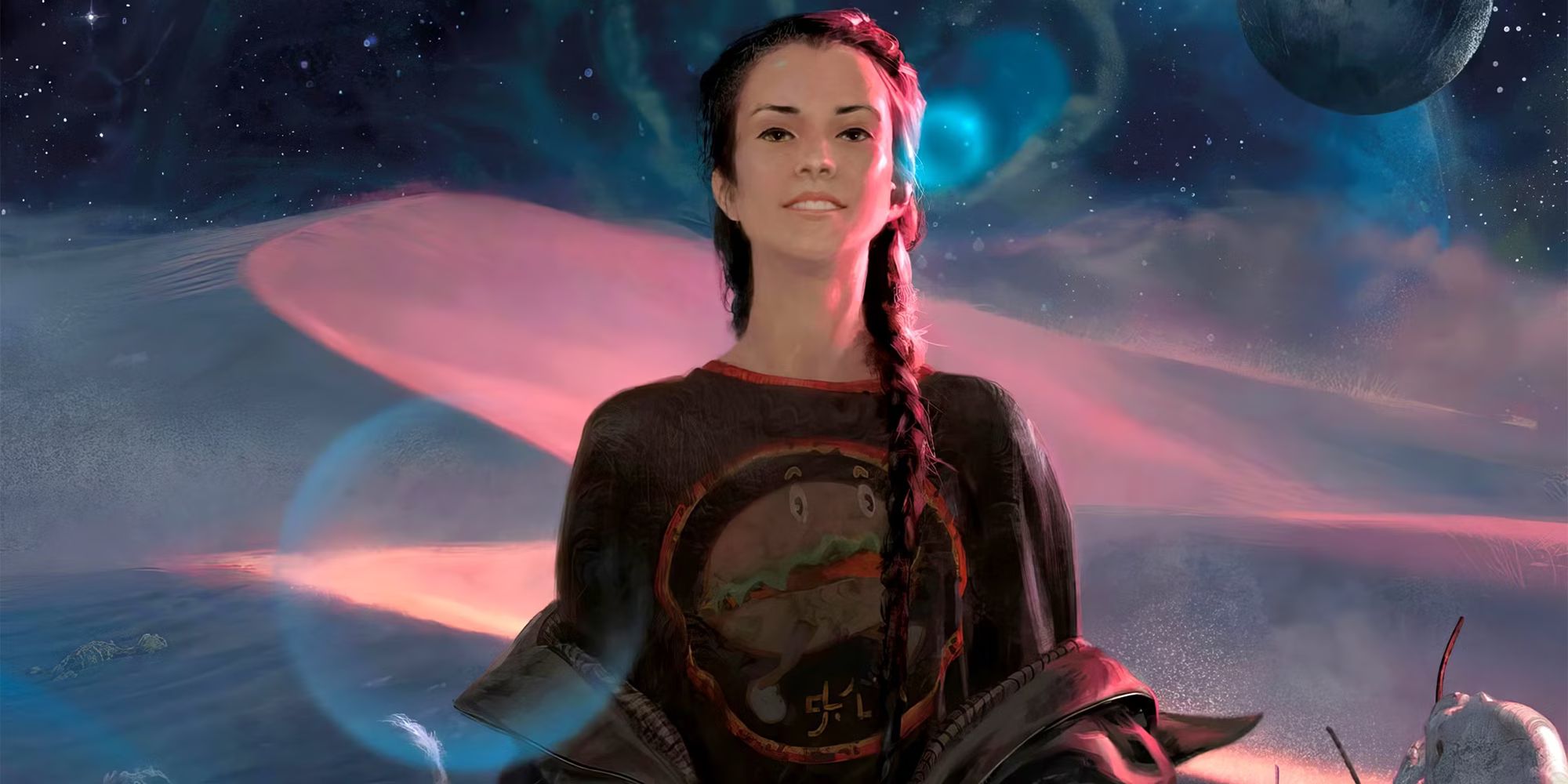
Nona the Ninth follows a cheerful young woman who woke six months ago inside somebody else’s body, lives with Pyrrha, Camilla, and Palamedes in a city under siege, and would much rather attend school, love dogs, and celebrate her birthday than become the mysterious weapon several warring factions believe she might be. If you have read the earlier Locked Tomb books, that premise is immediately terrifying for reasons Nona herself barely understands.
And Nona is a miracle. The book comes from Tamsyn Muir who surrounds her with necromantic politics, planetary catastrophe, body-sharing, resurrection, imperial war, and enough Locked Tomb lore to fuel several conspiracy boards. Nona mainly wants everyone she loves to stop being sad. That innocence changes the entire temperature of the series. The city is collapsing, a monstrous blue sphere hangs over the horizon, and Nona keeps noticing children, food, affection, language, and dogs. You begin by wondering who she really is. Eventually you become much more frightened by the possibility that finding out will mean losing the person she has become.
2 'Light from Uncommon Stars' (2021)

Light from Uncommon Stars follows violin teacher Shizuka Satomi, who must deliver one final prodigy’s soul to a demon to escape her own damnation, teenage runaway violinist Katrina Nguyen, whom Shizuka chooses as that final student, and Lan Tran, a retired starship captain hiding on Earth with her family while running a donut shop. Yes, all three of those stories really do belong in the same novel.
The astonishing thing is how quickly the premise stops feeling like a stunt. Katrina’s relationship with music carries the book emotionally because playing is one of the few places where she can feel fully herself after years of abuse and rejection. Shizuka begins with a moral calculation involving one last soul and gradually has to look at the actual girl inside that calculation. Lan brings literal interstellar history into the San Gabriel Valley and somehow a warm donut can feel as important as a spaceship. The book comes from Ryka Aoki who understands that genre can become a form of hospitality. Demons, aliens, cursed violins, queer romance, family, and food all get invited to the same table.
1 'Harrow the Ninth' (2020)

Harrow the Ninth, which also comes from Tamsyn Muir, follows necromancer Harrowhark Nonagesimus after she becomes a Lyctor and joins the immortal Emperor aboard his haunted space station, where her memories are badly damaged, her version of previous events no longer matches what actually happened, and an apocalyptic Resurrection Beast is coming for them. That is the clean explanation. Reading the book feels like discovering somebody has tampered with the clean explanation while you were asleep.
I adore this thing for having the confidence to make confusion part of the emotional experience. Harrow remembers people who should not occupy certain memories. Entire relationships seem to have been rewritten. She receives sealed instructions apparently written by herself and cannot fully explain why she needed them. Muir asks you to keep reading while your understanding of the first book is being actively vandalized, and somehow the eventual pattern feels earned rather than smug. Underneath the necromancy, cosmic monsters, theological weirdness, and structural games is grief so severe that Harrow has altered the way she can perceive her own life. That is why it sits at number one. The puzzle is brilliant. The reason the puzzle exists is heartbreaking.
Collider Exclusive · Sci-Fi Survival Quiz Which Sci-Fi World Would You Survive? The Matrix · Mad Max · Blade Runner · Dune · Star Wars
Five universes. Five completely different ways the future went wrong — or sideways, or up in flames. Only one of them is the world your instincts were built for. Eight questions will figure out which dystopia, galaxy, or desert wasteland you'd actually make it out of alive.
💊The Matrix
🔥Mad Max
🌧️Blade Runner
🏜️Dune
🚀Star Wars
01
You sense something is deeply wrong with the world around you. What do you do? The first instinct is often the truest one.
02
In a world of scarcity, what resource do you guard most fiercely? What we protect reveals what we believe survival actually requires.
03
What kind of threat keeps you up at night? Fear is useful data — if you're honest about what you're actually afraid of.
04
How do you deal with authority you don't trust? Every dystopia has a power structure. Your approach to it determines everything.
05
Which environment could you actually endure long-term? Survival isn't just tactical — it's physical, psychological, and very much about where you are.
06
Who do you want in your corner when things fall apart? The company you keep is the clearest signal of who you actually are.
07
Where do you draw the line — if you draw one at all? Every survivor eventually faces a moment that tests what they're actually made of.
08
What would actually make survival worth it? Staying alive is one thing. Having a reason to is another.
Your Fate Has Been Calculated You'd Survive In…
Your answers point to the world your instincts were built for. This is the universe your temperament, your survival instincts, and your particular brand of stubbornness were made for.
The Matrix
You took the red pill a long time ago — probably before anyone offered it to you. You're a systems thinker who can't help but notice the seams in things.
- You're drawn to understanding how the system works before figuring out how to break it.
- You'd find the Resistance, or it would find you — your instinct for spotting constructed realities is the machines' worst nightmare.
- You function best when you have access to information and the freedom to act on it.
- The Matrix built an airtight prison. You'd be the one probing the walls for the door.
Mad Max
The wasteland doesn't reward the clever or the well-connected — it rewards those who are hard to kill and harder to break. That's you.
- You don't need comfort, community, or a cause larger than the next horizon.
- You need a vehicle, a clear threat, and enough fuel to outrun it — and you're good at all three.
- You are unsentimental enough to survive that world, and decent enough — just barely — to be something more than another raider.
- In the wasteland, that distinction is everything.
Blade Runner
You'd survive here because you know how to exist in moral grey areas without losing yourself completely.
- You read people accurately, keep your circle small, and ask the questions others prefer not to answer.
- In a city where humanity is a legal designation rather than a feeling, you hold onto something that keeps you functional.
- You're not a hero. But you're not lost, either.
- In Blade Runner's world, that distinction is everything.
Dune
Arrakis is the most hostile environment in the known universe — and you are precisely the kind of person it rewards.
- Patience, discipline, and political awareness are your core strengths — and on Arrakis, they're survival tools.
- You understand that the long game matters more than any single victory.
- Others come to Dune and are consumed by it. You'd learn its logic and earn its respect.
- In time, you wouldn't just survive Arrakis — you'd begin to reshape it.
Star Wars
The galaxy far, far away is vast, loud, and in a constant state of violent political upheaval — and you wouldn't have it any other way.
- You find meaning in being part of something larger than yourself — a cause, a crew, a rebellion.
- You'd gravitate toward the Rebellion, or the fringes, or whatever pocket of the galaxy still believes the Empire's grip can be broken.
- You fight — not because you have to, but because standing aside isn't something you're capable of.
- In Star Wars, that willingness is what makes all the difference.
KioskNews shows a cleaned-up reading view extracted from the publisher’s page — the original always lives on their site, not ours.