23 Years Later, Russell Crowe's War Epic Is Still One of the Best Ever Made

Anthony Crislip has always loved movies and television, and has been published in outlets such as SlashFilm and Ultimate Classic Rock. While working as a film programmer or judge at a film festival, he has striven to develop interest in underseen films. He is a particular fan of digging deep into forgotten corners of film history.
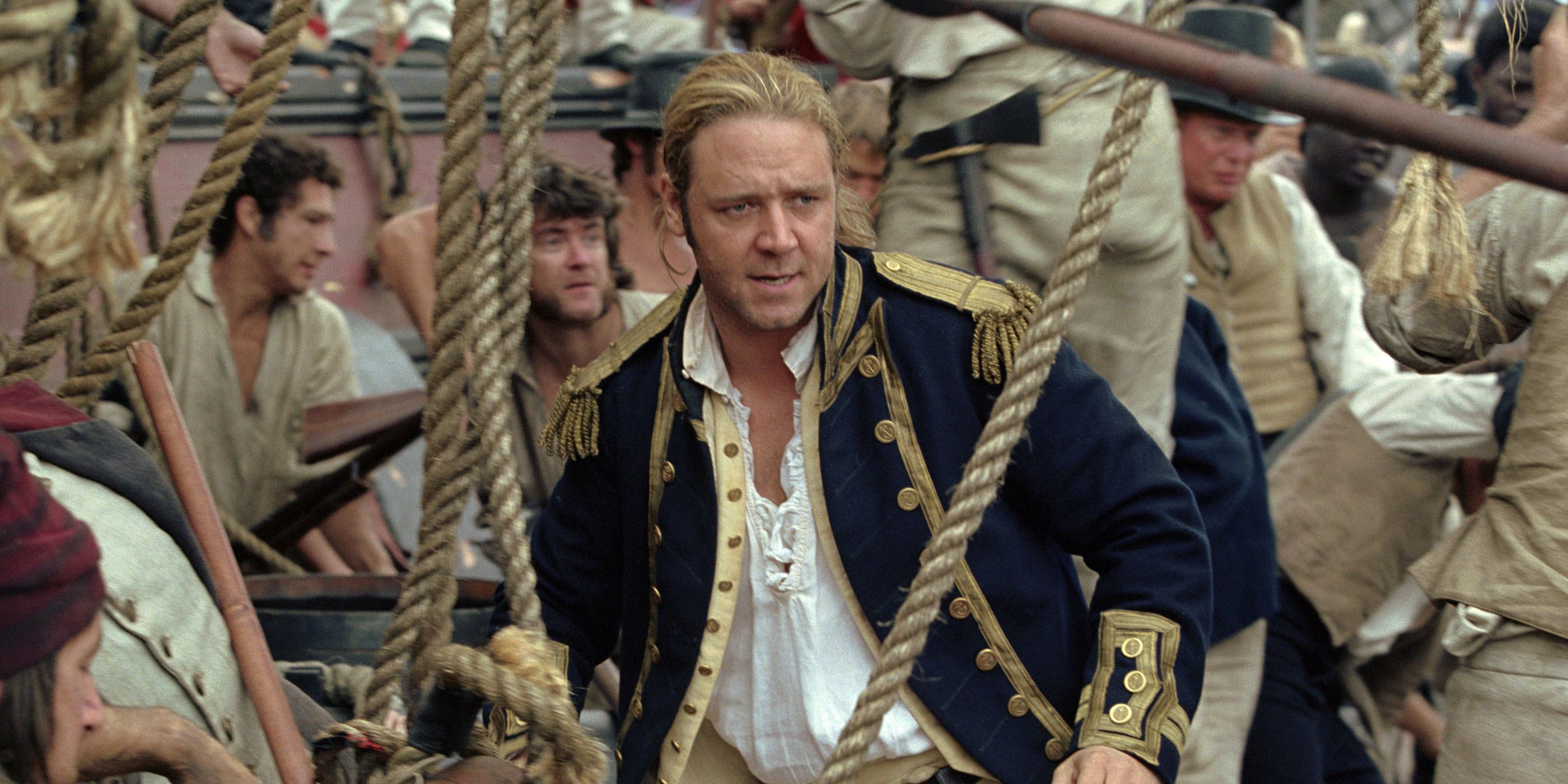
While 2003’s Master and Commander: The Far Side of the World may not have won the same big awards as Russell Crowe’s 2000 vehicle Gladiator, it has since developed a reputation as one of the best period epic war movies of all time. Coming from Truman Show director Peter Weir and based on the historical novels of Patrick O’Brian, the movie follows a skirmish between ships of the French and British navies during the Napoleonic Wars (where “oceans are now battlefields”, as the movie’s iconic opening title says). Master and Commander’s great strength is its balance of massive war scenes with an immersive and realistic procedural sensibility, placing you directly on a British man-of-war alongside clashing personalities and grisly violence. Rather than a simple action movie, it is also a story of the complex relationship between Captain Aubrey (Crowe) and the ship surgeon Maturin (Paul Bettany).
The two men debate methods, collaborate with no small amount of tension, and play music together, with Weir consciously (but not overtly) weaving in the subtext of the class differences between the leaders of the ship and the lower-class elements. After an early ambush, the ship undergoes repairs and eventually makes landfall in the Galápagos Islands, where Maturin’s desire to study the wildlife puts him at odds with the captain. Weir’s direction creates a tense, tactile, and epic environment that was unique for blockbusters then and is especially hard to find now. Compare it with the same year’s Pirates of the Caribbean: Curse of the Black Pearl, and while the sense of scale is similar, the tone could not be more different. The thematic depth, personality, and epic spectacle make it a modern classic — as well as a massive hit on Apple TV, where it has been among the top 10 most-watched films for over a month.
Russell Crowe Is a Swashbuckling Action Hero in 'Master and Commander'

Master and Commander begins with a clear task: the British HMS Surprise must apprehend the significantly faster French privateer Acheron. But they are attacked first, in a scene of 19th century naval warfare that is maybe the most intense and tactile of its kind. Cannonballs, smoke, and confusion defy any conventional sense of heroism, with Weir lingering on the human cost of the violence in between all the splintering wood. It calls to mind the opening scene of Martin Scorsese’s 2002 film Gangs of New York (albeit without the slow-mo and Peter Gabriel music). But it also immediately establishes the philosophical and dramatic differences between Aubrey and Maturin, with the captain’s almost swashbuckling quest for the Acheron, a ship seemingly always on the distant horizon, clashing with Maturin’s more sensible ambivalence and curiosity.
As “Lucky Jack” Aubrey, Russell Crowe works well within the tradition of Errol Flynn’s swashbucklers, like 1935’s Captain Blood or 1941’s The Sea Hawk. His ability to withstand the pressures of the Acheron’s pursuit suggests a psychological fortitude, and Crowe, hanging off the ropes during a stormy battle, gets to be cool and charismatic. Tasked with maintaining ship morale in the uneven chase, he must be pragmatic and honest about the ship’s survival chances while still responding to the call of duty. Maturin, meanwhile, has his doubts, and for all the movie’s massive and terrifying naval battle scenes, it's never better than when Aubrey and Maturin are privately discussing matters in candlelight. Among the elites of his crew, Aubrey must be confident, singing songs and drinking, but Maturin can bring out his more philosophical side.
'Master and Commander' Was One of Peter Weir's Final Films — and His Best
While Russell Crowe and Paul Bettany are both great in Master and Commander, with Aubrey and Maturin each having one personality that they play up for the crew and a separate one revealed only around each other, Crowe was said to have created difficulties on set for director Peter Weir. Ethan Hawke, the star of Weir’s classic coming-of-age drama Dead Poets Society, cited Crowe to IndieWire as a reason for the director’s retirement shortly after the creation of Master and Commander, a charge Weir admitted to finding “puzzling” to the Sydney Morning Herald. But it’s not difficult to imagine the movie’s making being a tense situation. Filming on old man-of-war ships and shooting off the Galápagos Islands might have given the movie a beautiful sense of realism (unlike Gladiator), but it also presented numerous challenges.
Master and Commander is an old-world story of duty, what it means to project an image of strength, and the slow end of centuries of European imperial systems. While Aubrey is committed to the centuries-old imperial directive, Maturin is ultimately more progressive and curious, a dynamic best explored in a flogging scene that markedly keeps its perspective away from the wounds of the victim. When Maturin explains that he “understands” what might cause a mutiny, Aubrey can barely bear to look at him, but the movie’s exploration of these two ideals makes it one of the greatest films of both Crowe and Weir’s careers.
KioskNews shows a cleaned-up reading view extracted from the publisher’s page — the original always lives on their site, not ours.