AMD, Broadcom poised to gain from scandal roiling Nvidia
Nvidia Corp’s leadership turmoil is boosting potential beneficiaries, with Advanced Micro Devices Inc (AMD) and Broadcom Inc gaining on bets they may win business from the chip giant.
Shares of AMD moved higher in New York early yesterday after reports that Nvidia’s board is preparing to oust chief executive officer Jensen Huang (黃仁勳), who led its rise to become a key driver of the artificial-intelligence (AI) boom. Broadcom also advanced, while Nvidia tumbled.
Nvidia’s selloff followed reports about Huang’s extramarital affairs and intensified after the Wall Street Journal said the board was preparing to remove him. The chipmaker is working with an outside firm to identify potential replacements for Huang.
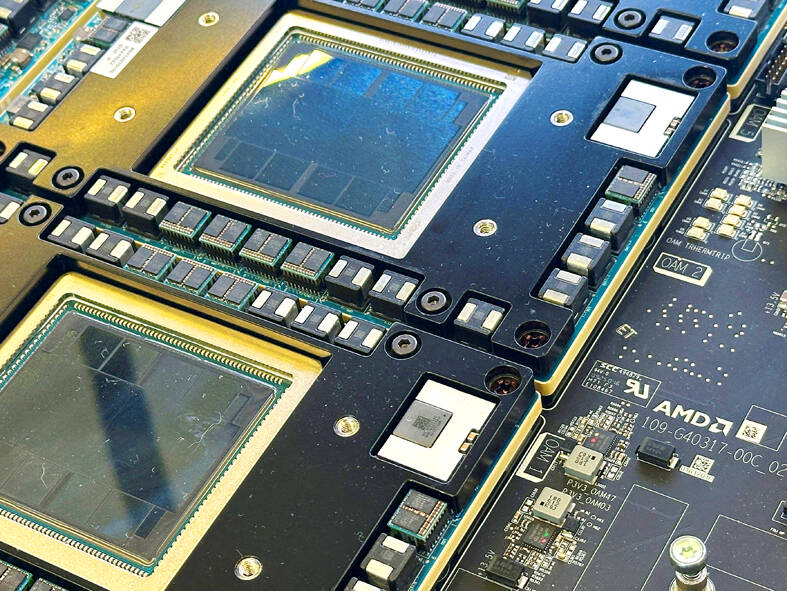
An Advanced Micro Devices Inc (AMD) MI350 series artificial intelligence chip is displayed at the San Jose McEnery Convention Center, in San Jose, California, on June 12 last year.
Photo: Reuters
With Huang’s job on the line and no clear succession plan in place, investors are wagering a shakeup atop Nvidia would provide an opening for its top rivals to catch up. Nvidia chips accounted for more than 60 percent of total AI computing power supply in the second quarter, according to estimates from Epoch AI, more than double the share of runner-up Alphabet Inc.
“This is where competitors like AMD, like Google tensor processing units (TPUs) and Amazon will probably have a chance to improve their market share when it comes to that accelerator market that Nvidia dominates,” Bloomberg Intelligence global head of technology research Mandeep Singh said. “There is no doubt that Nvidia won’t be as aggressive as they have been in the past two to three years when it comes to setting goals and overachieving them.”
Huang’s potential replacement will likely be “quite conservative” in company leadership, given the recent developments, he added.
DIRECT RIVALS
AMD and Broadcom stand to likely gain the most if Nvidia’s leadership issues disrupt its customer relationships. AMD is Nvidia’s closest rival in AI graphics processing units (GPUs) and striving to loosen its grip on the market, while Broadcom has a growing role in custom AI chips and networking.
While a Nvidia leadership shakeup may push customers to rethink their reliance on a single supplier, competitors like AMD and Broadcom are already pursuing business in AI accelerators, custom silicon and networking.
“AMD as a direct competitor, and Alphabet and Broadcom in the TPU space, are natural beneficiaries in the short term,” Floodlines Research investment strategist and founder Anna Wu said. “Huang’s scandal has raised public doubts about Nvidia’s commercial secrets and its product edge.”
Alphabet’s TPUs are custom-built for AI, while GPUs are multi-purpose chips originally made for gaming. TPUs can’t replace GPUs across the board, and moving AI workloads away from Nvidia is slow and costly, she added.
Alphabet announced this week plans to roll out a broader array of AI chips, aiming to capitalize on its rapid rise as a major challenger to Nvidia in a market worth hundreds of billions of dollars. The company is introducing two new variations of its TPUs.
Nvidia’s manufacturing partners appear largely insulated from the turmoil, given they also supply its rivals. But Samsung Electronics Co may have more to gain if the uncertainty at Nvidia leads to a shake-up in supplier relationships.
Samsung has forged increasingly close ties with AMD, while SK Hynix Inc remains Nvidia’s primary supplier of high-bandwidth memory. During AMD chief executive officer Lisa Su’s (蘇姿丰) visit to Seoul in March, Samsung agreed to collaborate with the US chipmaker on next-generation AI memory and computing technologies.
“A potential leadership change at Nvidia could create a strategic opening for Samsung,” Fibonacci Asset Management Global Pte Ltd CEO Jung In Yun said. “If Jensen Huang were to leave, new management could reassess supplier relationships and place greater emphasis on diversifying its supply chain, giving Samsung an opportunity to deepen its partnership with Nvidia.”
Beyond the memory giants, a number of South Korean start-ups — including AI chipmaker FuriosaAI and Samsung-backed MangoBoost — are also seeking to chip away at Nvidia’s dominance with alternative technologies.
CHINA SUBSTITUTES
The scandal could also benefit Chinese companies working to replace Nvidia in their home market, as stricter export rules in the US intensify scrutiny of chip sales to China.
Any resulting tightening would provide a tailwind for local chipmakers such as Cambricon Technologies Corp (寒武紀科技), Hygon Information Technology Co (海光信息) and Semiconductor Manufacturing International Corp (中芯).
China’s tech selloff began much earlier than in the US, and investors may be eyeing cheap Chinese tech stocks as a potential hedge if the US market downturn worsens, Wu said.
“But structurally, unless Chinese tech found a fix for advanced chips, I’d say it is difficult to penetrate Nvidia’s market share,” she said.
KioskNews shows a cleaned-up reading view extracted from the publisher’s page — the original always lives on their site, not ours.