Memory crunch goes on: Nanya
ONGOING BITE: Nanya is expecting soaring profits as the DRAM supply crunch continues, fueled by the insatiable appetite of the AI sweeping the globe
By Lisa Wang / Staff Reporter


DRAM chipmaker Nanya Technology Corp (南亞科技) expects memory prices to remain on an upward trajectory this quarter due to an acute supply crunch and strong artificial intelligence (AI) demand, boosting the company’s gross margin outlook.
A 60 percent sequential surge in the average selling prices sent the company’s gross margin to 85.7 percent last quarter, an all-time high, Nanya Technology said.
Net profit skyrocketed to NT$87.63 billion (US$2.75 billion) from NT$1.56 billion in the same period last year, soaring 60.8 percent from NT$50.19 billion the previous quarter, the company said. Earnings per share advanced to NT$25.4 from NT$0.5 a year ago and NT$14.66 a quarter earlier, it said.
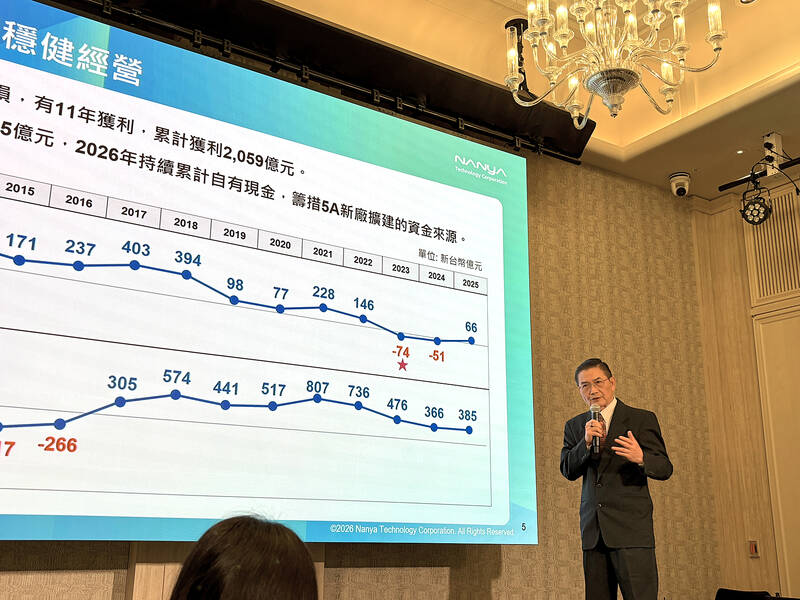
Nanya Technology Corp president Lee Pei-ing speaks at a news conference in Taipei on March 4.
Photo: Lisa Wang, Taipei Times
“From our perspective, [average selling prices] will continue to increase in the fourth quarter... The DRAM supply crunch remains severe,” Nanya Technology president Lee Pei-ing (李培瑛) told a media briefing yesterday.
“The surging momentum of AI-related products has left a widening supply-demand gap,” Lee said. “Supply for conventional applications, such as PCs and smartphones, is also constrained due to capacity squeezes.”
Given the favorable price trend, the company anticipates further gross margin expansion this quarter, he said.
Nanya Technology expects AI-related DRAM to command a larger portion of its revenue through 2029, up from 20 percent last quarter, amid accelerating DRAM integration in AI infrastructure including AI servers, networking and storage, Lee said.
Market researcher TrendForce Corp (集邦科技) projected prices of standard DRAM chips would rise 10 percent to 15 percent sequentially this quarter on a contract basis.
Long-term agreements cover about 50 to 70 percent of Nanya Technology’s capacity, compared with 50 percent estimated three months ago, the company said. Numerous customers have requested to extend contracts from three months to three years or even longer, it said.
The company said capacity expansions across the industry would not avert supply constraints soon, as new capacity is designed to match long-term customer demand. Besides, longer tool lead times and advanced process technology migrations would keep supply-demand dynamics in check, it said.
Nanya Technology does not expect significant capacity growth by 2028, as its new plant is to ramp up production at the end of next year, the company said. The new plant’s installed capacity is expected to grow to 50,000 12-inch wafers a month in 2030 from 30,000 wafers in 2028, it said.
The company plans to build an advanced 3D wafer packaging and testing plant in Pingtung County for high-capacity and high-bandwidth memory modules used in AI-related chips, Nanya Technology said. The plan is expected to enter volume production in the second half of 2028, it said.
Rapid infrastructure development in Pingtung would allow for a faster production ramp-up than at other sites, Lee said.
The company plans to distribute larger third-quarter employee bonuses than in the second quarter due to strong performance in net profit and gross margin, Lee said. The company has implemented a policy for over 20 years that up to 12 percent of pre-tax profits can be distributed as employee bonuses on a quarterly basis, he said.
KioskNews shows a cleaned-up reading view extracted from the publisher’s page — the original always lives on their site, not ours.