Chinese start-up says it is developing country’s first home-grown new-energy business jet
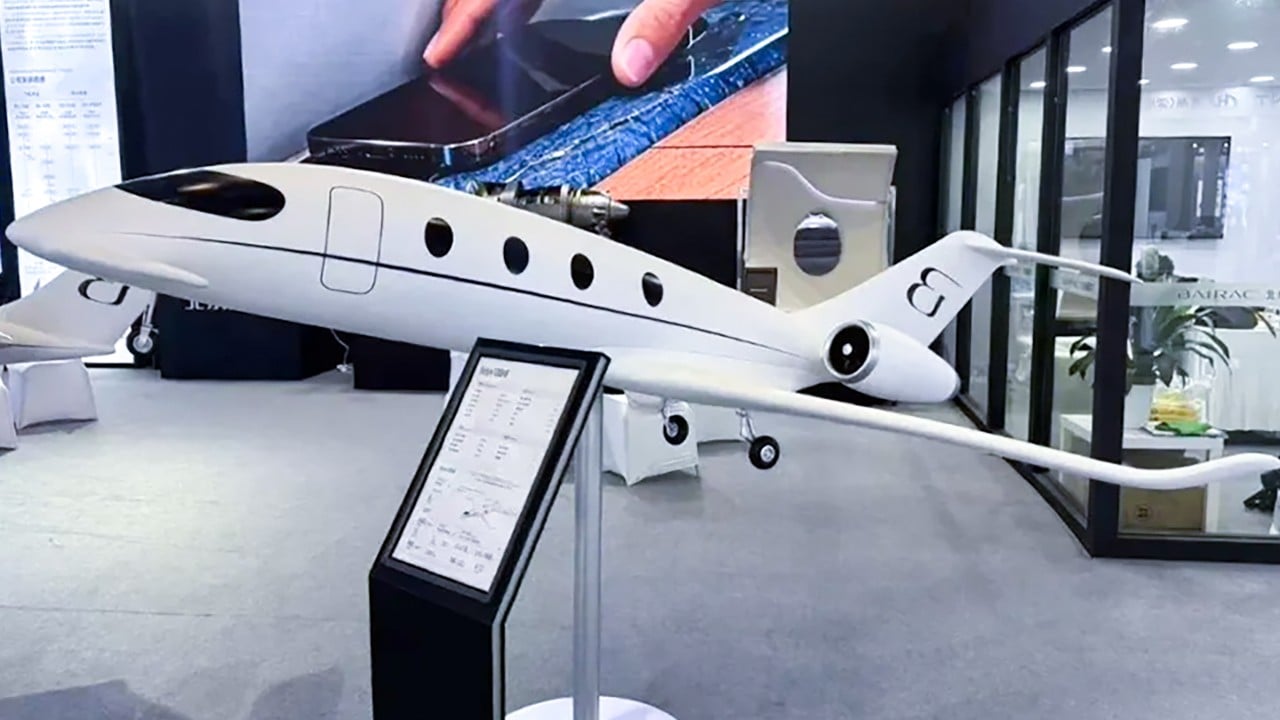
A newly established Chinese start-up is developing what it describes as the country’s first home-grown new-energy business jet, adding to China’s efforts to cut aviation emissions.
Beijing Airlink Aircraft, a Chinese private aircraft manufacturer founded in March, unveiled scale models of two variants of its Belyn 100 series at the Nanchang Aviation Industry Expo on Saturday.
The company said its core team was drawn mainly from Tsinghua University’s school of aerospace engineering and China’s aviation industry.
One of the variants, the Belyn 100HF, would use a parallel hybrid system that combines a conventional engine with electric propulsion, targeting faster and longer-range business flights.
The other variant, the Belyn 100HP, would use a series hybrid system, in which an engine generates electricity to power the aircraft’s electric propulsion system, with a focus on efficiency and flexible operations.
The project remains at an early development stage, and Airlink has yet to announce when it plans the first test flight. However, it said in June that it aimed to complete market validation of its core model within three years.
The company displayed 1:5 scale models at the expo and said it planned to present a full-size model at the Zhuhai air show next month, which would be an opportunity to meet potential customers, suppliers and investors.
The Belyn 100 aircraft are designed to carry up to 12 passengers, with the 100HF planned to have a range of 3,500km (2,175 miles), while the 100HP is expected to fly up to 1,200km, according to an article Airlink published on Taibo.cn, a Chinese industry news platform.
The company said global aviation was moving towards lower-carbon operations and regional markets were seeking aircraft better suited to different routes, passenger demand and operating conditions.
Airlink is backed by Xinding Capital, a Beijing-based private-equity firm that invests in hard technology and growth-stage companies, although the investment amount was not disclosed.
Xinding’s portfolio includes Chinese electric-vehicle makers Seres and Xpeng, autonomous-driving technology company Horizon Robotics, artificial-intelligence chipmaker Cambricon Technologies, and enterprise AI specialist 4Paradigm.
China is not alone in pursuing hybrid-electric aircraft. US-based Ampaire and France’s VoltAero are developing similar technologies, while Daher, Safran, Collins Aerospace and Ascendance have formed a French consortium to study hybrid-electric propulsion for six- to 10-seat aircraft.
SCMP Plus is a new premium news platform that gives you an
all-inclusive edge to stay ahead on China news.
To access our exclusive content you’ll need to subscribe.
Already a subscriber?
LOG IN
Ampaire has completed more than 48,000km of flight testing with its hybrid-electric systems and began regional passenger and cargo operations in Utah this year.
KioskNews shows a cleaned-up reading view extracted from the publisher’s page — the original always lives on their site, not ours.