As tracks pierce isolated red region, Chhattisgarh’s Abujhmad finds a route to progress
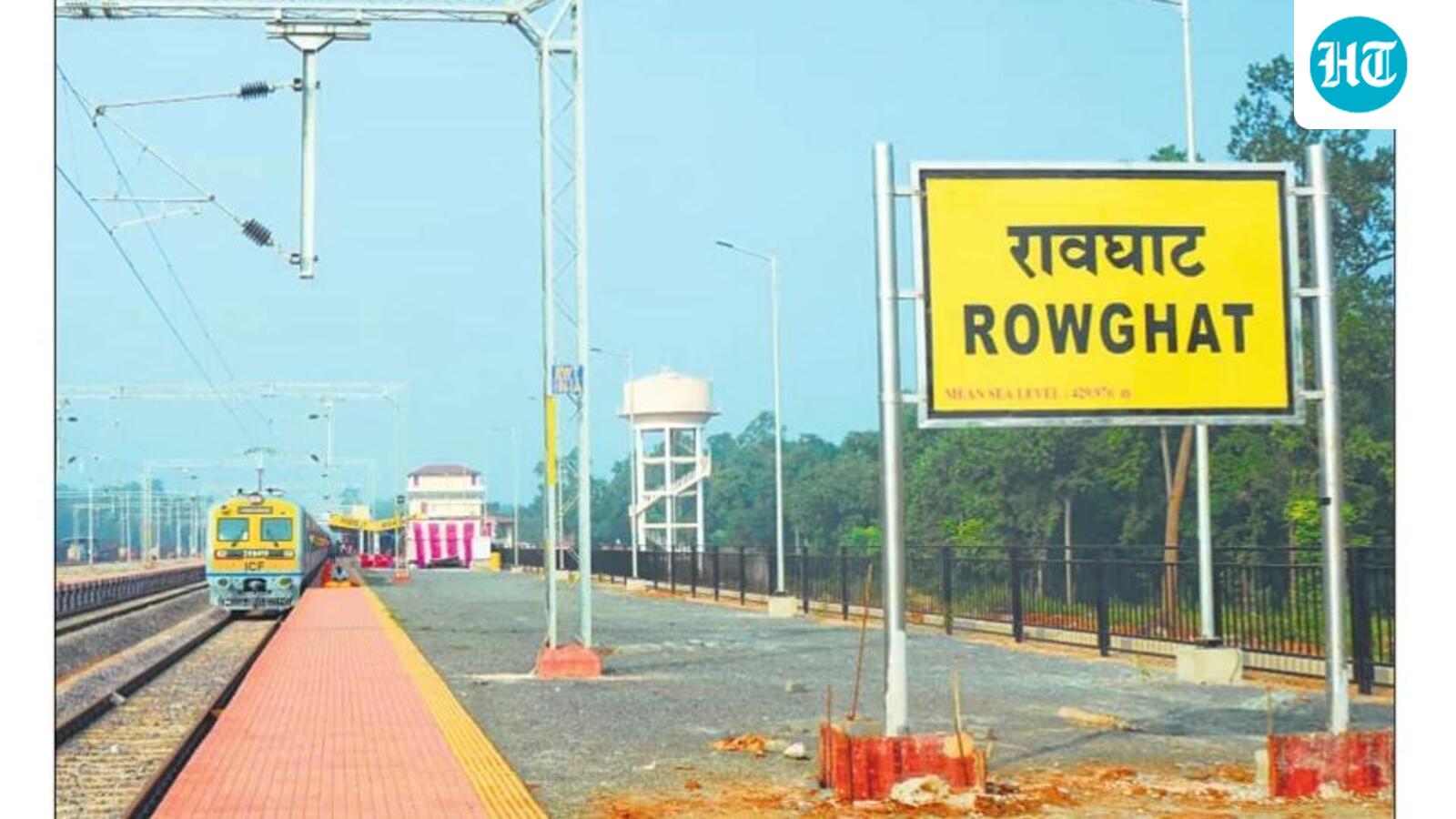
At around 6.30 in the morning of a late October day, a train with around 30 passengers leaves the station at Rowghat, in Chhattisgarh’s Kanker district. It will pick up more at Tadoki, Antagarh, Bhanupratappur, and Kewti, before reaching its destination, Dallirajhara, around 100km away.
The 12-carriage train soon enters a dense forest; the morning sunlight falls through the trees as the train rolls past hills, streams and small settlements. The beauty of the landscape is not lost on siblings Anil Potai and Anjani Potai, students of Swami Atmanand College in Raipur and residents of Narayanpur.
“There are streams almost every kilometre . It is so beautiful,” Anjani says, recording the landscape on her phone.
Her brother Anil reflects on what the rail link could mean. “Earlier, it used to take the whole day to reach Raipur. Now, I can reach there in a few hours. I am sure that many tribal youths will now study in Raipur,” he says.
At Tadoki, five security personnel board the train, a reminder of the violence that wreaked the region not so long ago; at 7.30am, the train reaches Antagarh, where another 50 people board, most headed for mining town of Dalli Rajhara in Balod district.
One of the security personnel, whose name is being withheld for security reasons, is travelling to his village in Bihar for Diwali. He says the situation has improved considerably and that there is little to worry about once the train crosses Antagarh. “But here, fear is still there,” he says.
Punem, a resident of Antagarh travelling to Dallirajhara for a family function, says the train is cheaper and faster than other options. He plans to return by the same train. From Kewti, about 15km from Antagarh, farmer Kaushal Baghel boards the train for Raipur, saying it has made medical care more accessible. “The train has made it easier to reach Raipur. Earlier, it was an 8-10 hour bus journey. Now, I can go for my knee consultation at a Raipur hospital,” he says.
As more passengers board, people chat in local languages, click pictures and play music on their phones. For some older passengers, it is their first train journey.
Construction for the 95km Dallirajhara–Rowghatt railway line, which has 26 operational stations between Raipur and Rowghat, began in 2015. The 75km stretch up to Tadoki was completed in 2023, with passenger train services commencing the same year. The remaining was constructed over the next three years.
On October 20, 2026, state chief minister Vishnu Deo Sai and Union railway minister Ashwini Vaishnaw inaugurated the railway line.
Train to Maoist heartland
It is 6am, inside a forest in Chhattisgarh’s Kanker district, where a 12-coach passenger train is parked at the platform of the newly built Rowghat railway station, once a Maoist bastion, surrounded by serene hills and dense forests.
Its two platforms are protected by security camps providing round-the-clock cover, although no Maoist violence has been reported in the region for the past seven months.
The central government has claimed it wiped out Maoism in Chhattisgarh by March 31, 2026. Since January 2024, security forces have killed 493 Maoists in a series of encounters, while 2,793 Communist Party of India (Maoist) leaders and cadres have surrendered.
Rowghat, 140km from Kanker district headquarters, is the first passenger railway station in Abujhmad, once considered an impregnable bastion of Left-wing extremism. The train passes through places such as Tadoki, once a hotbed of Maoist violence.
A few passengers from nearby villages wait for the train to depart as station master MK Sahu sips his morning tea. “On average, about 40 people board the train from Rowghat every day, although the number touched 70 one day after the service started on October 20,” he says.
Narayanpur and Kanker districts, part of the Bastar region, witnessed major Maoist attacks over the past decade, killing 55 security personnel and 87 civilians.
In 2018, four District Reserve Guard (DRG) personnel were killed and nine injured in an ambush in Irpanar, Narayanpur. In 2021, Maoists blew up a bus with an improvised explosive device near Kadenar, killing five DRG personnel and injuring 14.
Maoists also killed 29 people they branded police informers, including former Zara village deputy sarpanch Ramji Dodi in March 2023.
In May 2025, security forces killed 27 Maoists, including CPI (Maoist) general secretary Nambala Keshava Rao, alias Basavaraju, in an encounter in the region. A DRG jawan was also killed.
For years, Maoist violence, difficult terrain and poor road connectivity kept much of the region away from mainstream transport and development. The railway is beginning to change that.
The Dallirajhara-Rowghat line is part of the 140km Rowghat-Jagdalpur project. It passes through North Bastar Kanker and connects Bhanupratappur, Kewti, Antagarh, Tadoki and Rowghat. It serves more than 150 villages and over 100,000 people, most from tribal communities, while also strengthening iron ore supplies to the Bhilai Steel Plant.
Dyanand, divisional railway manager of South East Central Railway, said ₹1,628 crore had been spent on the project.
Between October 21 and 23, about 2,288 passengers travelled in both directions, with average daily occupancy exceeding 700. Any increase in the frequency of the daily service would depend on demand, Dyanand said.
Dallirajhara and Bhanupratappur stations are also part of the Amrit Bharat Station Scheme. Work at Bhanupratappur has been completed, while Dallirajhara is nearing completion. Prime Minister Narendra Modi virtually inaugurated the renovated Bhanupratappur station in May 2025. The next phase towards Jagdalpur is progressing in stages, Dyanand said.
The change
For residents of this part of Bastar, the railway is more than a new mode of transport. It offers affordable access to nearby towns and Raipur, 218km away. A ticket from Rowghat to Raipur costs ₹55 for the 219km journey, which passes through 26 stations.
Maan Singh Sai, a small eatery owner from Narayanpur who is also undergoing treatment in Raipur, calls the train a boon.
“Earlier, the journey to Raipur would take around nine hours by bus or taxi because of the condition of the roads. Now, I travel by bus for about an hour to reach the station and in another four hours, I am in Raipur,” Sai said.
Kanker collector Kundan Kumar said the railway offered hope that peace in areas once affected by Naxal violence would be followed by progress. “For these communities, a direct, affordable rail link to Raipur changes everyday life,” he said.
A farmer can now bring back seeds, fertiliser and market knowledge from the city, Kumar said. “Connectivity of this kind is not merely infrastructure; it brings the markets and services of the state to people who have long been at their margins.”
Back at Rowghat station, point man Rajendra Gotar watches people stand for hours along the hills to see the passenger train pass.
“One day, I hope, many of them will take the train for the first time to start a new life,” he says.
KioskNews shows a cleaned-up reading view extracted from the publisher’s page — the original always lives on their site, not ours.