Conrad Black: Carney’s invasion musings
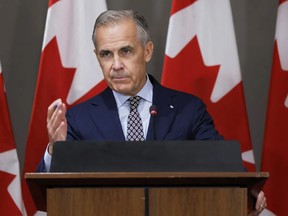
The green shoots of rational thought may finally be surging out of the ground in the current imbroglio between Canada and the United States. In his recent interview with the New York Times, Prime Minister Carney made a good many appropriate conciliatory noises, without backing down an inch on the legitimate points of Canadian sovereignty that he has been making. It was perhaps foreordained that before this exchange reverted to reasonable civility between apparently responsible people, it was necessary that reference be made to the possibility of armed conflict between Canada and the United States.
Sign In or Create an Account
I’ve described this elsewhere as equivalent in likelihood to an invasion of Martians or of angry elves commanded by Santa Claus. In the early 1920s Canadian Lt.-Col. James “Buster” Sutherland Brown, in charge of strategic planning, conceived of a conflict with United States in which Canada would take the initiative by storming across the border, seizing cities east and west. He was regarded at the time as possibly deranged and transferred to other tasks, but was revived decades later by militant anti-Americans in Canada as a clairvoyant folk hero.

Columnist Jesse Kline keeps you up to date with what’s happening in Israel and the effects of antisemitism on life here in Canada. Friday mornings.
By signing up you consent to receive the above newsletter from Postmedia Network Inc.
A welcome email is on its way. If you don't see it, please check your junk folder.
The next issue of Channel Israel will soon be in your inbox.
We encountered an issue signing you up. Please try again
Of course, there have been moments in the distant past when armed conflict on the Canada-U.S. border was a legitimate consideration. The admirers of the founders of the U.S. Democratic Party, Thomas Jefferson and James Madison, commended themselves for doubling its size of America by the Louisiana Purchase from Napoleon, while shrinking the defense budget. They failed to notice that in disbanding the army of 20,000 trained soldiers that the first president, General George Washington, and his chosen successor John Adams had maintained, they lost all deterrence against abusive conduct by the Royal Navy. The British imposed a naval blockade on the United States and overwhelmed the commerce of New England with smuggling from Canada, and Jefferson invoked the insurrection act in border areas.
President Madison, principal author of the Constitution of the United States and one of the greatest lawgivers in history, rising above Hammurabi, Justinian, and Napoleon, plunged into the war of 1812 unaware that he had no forces whatever to expel the British from Canada. He was also unable to overcome the loyalty of the French Canadians to the British crown, which they had promised in exchange for the freedom of religion, language, and the Civil Code that had been assured to them in the Quebec Act of 1774. Many years later, in the last months of his life in 1826, Jefferson described the conquest of Canada as “a mere matter of marching.” Only if you had the troops to march.
When Canada became an independent country, July 1, 1867, the minister of defense and the militia, Sir George-Etienne Cartier, in preparation for anticipated cross-border attacks by the American Fenians, recent immigrants from Ireland, fugitives of the famine full of hate for the oppressions of the English in their home country, managed the astounding feat, which would not be easily duplicated today, of raising an armed and trained militia of nearly 40,000 Canadians near border crossing points with the United States from New Brunswick to Southwestern Ontario. This deterred the Fenians, and at the Washington conference of 1871, our first and shamefully desecrated prime minister, John A. Macdonald, joined and was a key player with the British Empire delegation in working out a comprehensive settlement of all American grievances with Britain and gaining the clear recognition of both great powers of Canada’s independence.
The principal British motivation for acceding to the requests of Macdonald and Cartier and the Liberal leader, the publisher of the precursor to the Toronto Globe and Mail, George Brown, and others, for an independent Confederation consisting of all the settlements strung along the American border, was that after the terrible American Civil War, Canada was vulnerable to the victorious Union army. Slavery had been abolished in the U.S. at the cost of 750,000 American lives in a population of 31,000,000; five states had been smashed to rubble and scorched to ashes by the Grand Army of the Republic commanded by Generals Ulysses S. Grant and William T. Sherman. With all due respect to the Prussians, these were the greatest army and generals in the world. The deterrent power of the Royal Navy, the war-weariness of the enervated but triumphant American Union, and the statesmanship of the chief founder of our country prevented an American assault on Canada to avenge itself against Britain. Apart from the eccentric James H. Brown, no one of any official seniority at all has raised the prospect of war on our border since, until Mark Carney inexplicably volunteered it last week.
The positive aspect of this extraordinary musing from our prime minister is that it failed to roil the waters of Canadian-American relations. The prime minister was placatory and eloquent in his remarks about the United States to the New York Times and unexceptionable in his comments at the United Nations. And President Trump in one of the busiest weeks of his nearly six years in the White House, focused at the United Nations on the Iran and Ukraine conflicts, the imminent demise of the failed communist state of Cuba, and the arrival of the president of China for a ceremonious and apparently cordial state visit. This meeting appeared to produce some de-escalation of Chinese support for Iran and renewed assurance that the United States would not attempt to alter the arrangement on Taiwan made by President Nixon with Chairman Mao Zedong and Premier Chou En-lai in 1972.
Mark Carney has expressed his hopes for economic growth and encouraged the major projects office to address the most promising proposals raised at the Canada investment conference last month. The implication, though not confirmed as a certainty, is that he is winning the struggle with his environmental conscience and will promote Canada’s sensible capitalization of its immense potential as an exporter of oil and natural gas. The concept of privatizing airport management is being considered, as has been successfully done in the United Kingdom and elsewhere, to build a sovereign fund to assist in the advancement of the major projects. Not only has this the makings of a workable plan, but it possesses some of the grandeur that Canadian federalism has always required to prevail over provincial tendencies to decentralization.
Such a program could be an inspiring reenactment of the spirit of the Canadian Pacific Railway, one of the wonders of the world when it was built across the Canadian Shield, and the Saint Lawrence Seaway, which brought ocean shipping to the great cities of the eastern and central interior of this continent. If this is what the Prime Minister intends, he will have and deserve widespread support.
National Post
Join the Conversation
This website uses cookies to personalize your content (including ads), and allows us to analyze our traffic. Read more about cookies here. By continuing to use our site, you agree to our Terms of Use and Privacy Policy.
KioskNews shows a cleaned-up reading view extracted from the publisher’s page — the original always lives on their site, not ours.