Dancing to be prescribed for Parkinson’s disease patients at Alexandra Hospital
SINGAPORE – From February 2027, patients at Alexandra Hospital (AH) diagnosed with Parkinson’s disease will be prescribed dance as part of their treatment.
Dance, one of the oldest human expressions that use rhythmic body movement to communicate, is helping to rewire how Parkinson’s patients are receiving care at the hospital.
Lim Huay Tin, who was diagnosed two years ago with the progressive, long-term neurological movement disorder, told The Straits Times she did not know how to dance.
But when the music started during a demo session for the media, the 80-year-old had no problems following the facilitator’s actions to the beat of the song.
As there is no cure for Parkinson’s, treatment focuses on relieving symptoms – such as resting tremors, gait abnormalities and hallucinations – maintaining mobility, and supporting quality of life with medications and rehabilitation therapies.
Dance movement therapy will be offered as one of the intervention activities at the hospital. There is growing evidence that such structured, music-led intervention improves gait, balance, cognition and mood in Parkinson’s patients.
Sessions will be conducted by a trained dance movement therapy facilitator alongside the hospital’s geriatricians, nurses, pharmacists and therapists.
Several international studies found that dance could help manage Parkinson’s disease symptoms by improving motor control, balance, mobility, and mood because the rhythmic cues from dance music improve walking and movement.
It was also found that having patients move to a steady beat acts as an external stimulation that helps them initiate movement, walk more smoothly, and reduce “freezing” episodes.
“Dance movement therapy is about dancing to feel, not dancing to show. No one needs dance experience, and everyone takes part in their own way,” said Kayo Sakamoto, a research scientist at AH, who added that the therapy is catered to patients at different stages of Parkinson’s.
Even for those who just sit and watch, “bobbing to the music helps the brain bypass damaged movement pathways, easing the stiffness and improving one’s overall coordination”, she said.
According to the studies, music provides an external beat that the brain can lock on to, known as a rhythmic auditory-motor entrainment. It helps recruit alternative pathways through the premotor cortex and cerebellum to get movement started and keep it going.
Dance also demands continuous adaptation: learning steps, anticipating sequences and reading a partner. So while it is not a cure, dance serves as a helpful complementary activity alongside standard care for patient’s with Parkinson’s.
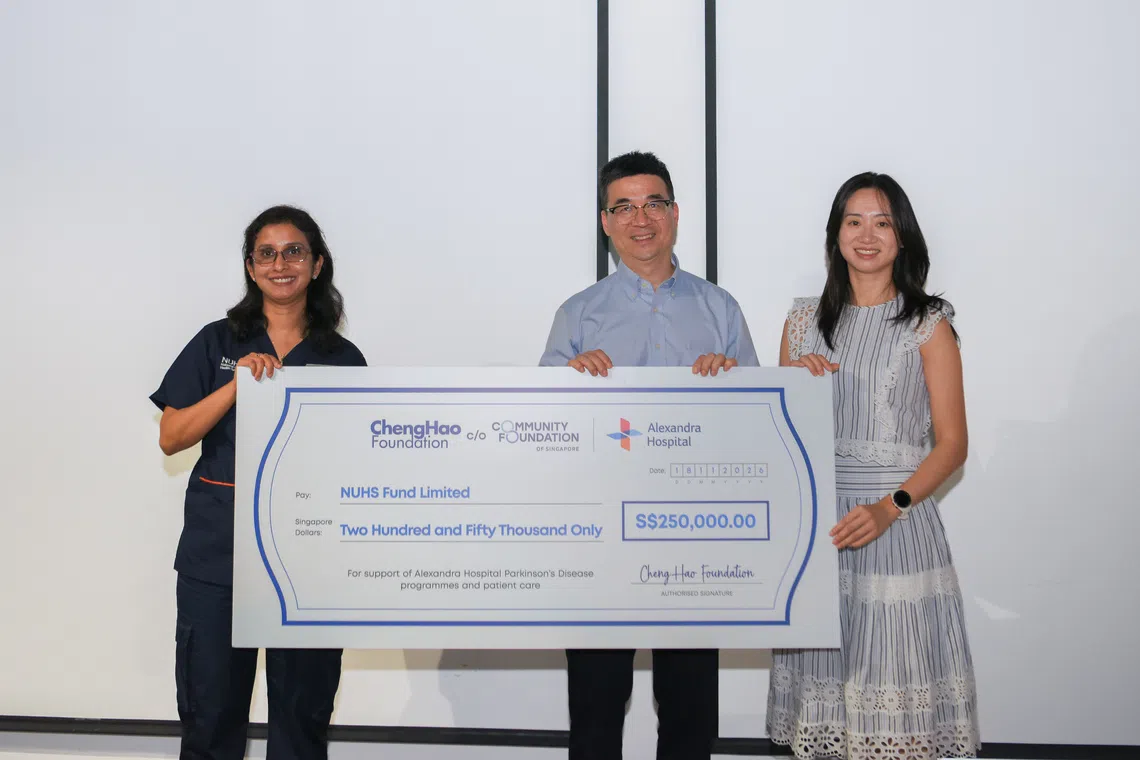
Over the next five years, AH will be taking treatment of the disease to Parkinson’s Café, a clinic-in-a-cafe concept funded with the $250,000 from ChengHao Foundation.
ST PHOTO: TRISHA SOON
“(At AH), dance is not an add-on to Parkinson’s care. It is a targeted intervention for the very things medication struggles with – freezing, balance, initiating movement, and the low mood and isolation that come with the diagnosis,” said geriatrician Preetha Venugopalan Menon, a consultant at the hospital.
“In 2027 we are adding what the evidence tells us works, dance, rhythm and reaction training, in a setting where patients feel seen, heard and supported,” she added.
Medication alone addresses only part of what these patients lose, Menon said.
The number of Parkinson’s patients under the hospital’s care has tripled from 84 in 2022 to 256 in 2025.
Parkinson’s affects about three in every 1,000 Singaporeans aged 50 and above, and ranks among the top four neurological conditions locally. With one in four Singaporeans projected to be aged 65 and above by 2030, the number of people living with the condition is expected to keep climbing.
Other institutions have used dance to stave conditions such as early onset dementia. For instance, Dementia Singapore worked with Japanese experimental dance choreographer Osamu Jareo, for a new dance therapy initiative called Totsu-totsu.
Menon said AH distinguishes itself through a more structured, integrated and research-informed approach.
“At AH, dance is not a standalone activity but part of a comprehensive suite of complementary therapies, including rhythmic movement, music, drumming and movement-based interventions. These therapies are incorporated into regular Parkinson’s care to support patients’ physical, cognitive, emotional and social well-being, extending care beyond conventional pharmacological treatment,” she said.
Over the next five years, AH will be taking treatment of the disease to Parkinson’s Café, a clinic-in-a-cafe concept funded with the $250,000 from ChengHao Foundation, a donor-advised fund administered by the Community Foundation of Singapore.
The concept blends clinical medical reviews with peer and caregiver support in a relaxed cafe setting, encouraging open conversation while healthcare workers observe functional abilities and daily challenges.
Over the next five years, the programme aims to become a mainstream standard of care for Parkinson’s disease at AH, with the potential to scale to other public healthcare institutions.
KioskNews shows a cleaned-up reading view extracted from the publisher’s page — the original always lives on their site, not ours.