NT dollar volatility a challenge: analysts
OPTIONS: The central bank needs to continue to encourage Taiwanese exporters to convert their US dollar holdings into NT dollars, Cathay United’s chief economist said
The central bank could face difficulties stabilizing the local currency if foreign investors, who hold substantial New Taiwan dollar-denominated assets, continue to move funds out of the country, financial-market analysts said.
Foreign institutional investors’ share of the local market’s capitalization increased as the market expanded, Cathay United Bank Co (國泰世華銀行) chief economist Lin Chi-chao (林啟超) said.
Taiwan Stock Exchange data showed that their share of the local market capitalization rose from 45.41 percent at the end of 2024 to 48.09 percent on Oct. 2. That increase coincided with a rise in the TAIEX from about 23,000 points in January last year to an all-time intraday high of 49,968.92 on Oct. 6.
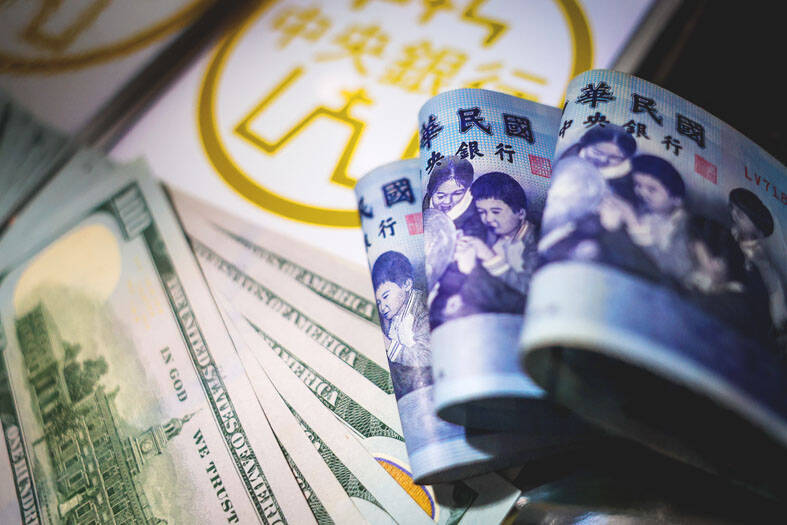
New Taiwan dollar and US dollar banknotes are displayed in front of the central bank’s logo in Taipei on May 6 last year.
Photo: CNA
However, the TAIEX has shed about 10,267 points, or 20.55 percent, since then, after plunging 1,873.08 points, or 4.51 percent, on Friday to close at 39,701.64 amid concerns over possible restrictions on artificial intelligence (AI) data center development in the US.
Foreign institutional investors tend to adjust their portfolios when faced with heightened volatility in the stock market, making the central bank’s job harder because of the large amount of funds involved, Lin said.
Foreign investors held US$1.743 trillion in Taiwan-listed stocks, bonds and NT dollar deposits at the end of last month, down from US$1.927 trillion at the end of September and equivalent to 292 percent of Taiwan’s total foreign exchange reserves, central bank data showed.
“With their holdings of local assets increasing, even if they were to trim their positions by just 1 percent and moved the proceeds overseas, it would be harder than ever for the central bank to maintain the NT dollar’s stability,” Lin said.
As of the end of last month, the NT dollar had depreciated 3.2 percent against the US dollar this year, and that weakness has continued into this month.
The central bank said foreign institutional investors recorded net capital outflows of about US$28 billion last month.
In the face of large capital outflows, the central bank cannot rely solely on its foreign exchange reserves as a tool to shore up the NT dollar, as sustained market intervention could prove costly, Lin said.
The central bank needs to continue to encourage Taiwanese exporters to convert their US dollar holdings into NT dollars when they have no immediate need for foreign currency, to help ease downward pressure on the local currency, he said.
Compared with the South Korean won, which appreciated 8.38 percent against the US dollar during the January-to-October period, the NT dollar has underperformed, despite both economies benefiting from AI-driven export growth, Lin said.
Many large Taiwanese technology companies have expanded their global production bases by moving funds overseas, while their South Korean counterparts have repatriated overseas earnings to meet domestic capital investment needs, providing support for the won, he said.
In addition, foreign investors’ preference for bonds issued in the South Korean market has generated capital inflows that have further supported the won, he added.
The NT dollar dramatically rebounded on Friday, closing up 0.33 percent at NT$32.768, but there are no clear signs that the local currency has returned to a sustained upward trend, as volatility in the stock market could persist, foreign-exchange analyst Lee Chi-chan (李其展) said.
Such signs would include foreign institutional investors reversing their substantial net selling in the local stock market or a decline in US dollar index, potentially prompted by slower US inflation and reduced expectations of US Federal Reserve interest-rate increases, Lee said.
However, neither condition would be easy to meet in the short term, he said, adding that “the NT dollar still has a long way to go to reverse its current weakness.”
KioskNews shows a cleaned-up reading view extracted from the publisher’s page — the original always lives on their site, not ours.