South China Sea code of conduct: can Beijing and Asean meet 2026 deadline?
China and Southeast Asian nations have made progress in negotiating a code of conduct for the South China Sea, with Manila announcing that roughly 80 per cent of the draft agreement is complete.
Philippine Foreign Secretary Theresa Lazaro said on Saturday after a series of Asean ministerial meetings that 77 per cent of the proposed code’s paragraphs were complete, although key sticking points remained.
“Since our [Asean] chairmanship, the progress of the code of conduct has really been hastened, and there might just be a definitive possibility, but definitely a statement will be released,” Lazaro said, while declining to elaborate on the differences.
Her comments came on the eve of the Association of Southeast Asian Nations summit in Manila, where leaders from the 11-member bloc will gather from Sunday to Tuesday alongside counterparts from China, Japan, the United States, Canada and Brazil.
Regional countries agreed in 2023 to conclude the code this year – a commitment the Philippines prioritised upon assuming the bloc’s chairmanship.
02:43
China and Asean renew agreement to develop code of conduct for South China Sea
The proposed code seeks to prevent long-standing maritime disputes from escalating into wider conflicts that could draw in external powers such as Washington, Manila’s treaty ally.
China claims sovereignty over nearly all islands and features in the South China Sea, along with rights to adjacent resource-rich waters, while the Philippines, Vietnam, Malaysia and Brunei maintain their own competing claims.
Maritime observers identify several contentious issues around the proposed code – whether it would be legally binding, its geographical scope and the role of third-party countries.
Bao Yinan, an associate research fellow at the Huayang Centre for Maritime Cooperation and Ocean Governance in China, singled out geographical scope as the biggest hurdle.
“This directly touches upon the existing territorial sovereignty and maritime delimitation disputes of all parties, and is where they will find it very difficult to make concessions,” he said.
A prime example is the Paracels in the South China Sea, a group of islands known as Xisha in China and Hoang Sa in Vietnam.
“Including the Xisha Islands and surrounding waters in the scope of the code would be inconsistent with China’s long-time position that there is no dispute over them,” Bao said.
“Any near-term compromise can only rest on the hope that Asean, especially Vietnam, will no longer insist on including the Xisha Islands.”
Whether the code would be legally binding remains another major sticking point.
Asean members have long pressed for legally enforceable provisions, a demand Beijing rejects. There is also a split over outside powers – Manila insists the code must not infringe on the rights of non-parties, whereas China wants to restrict joint military exercises and energy exploration involving external partners.
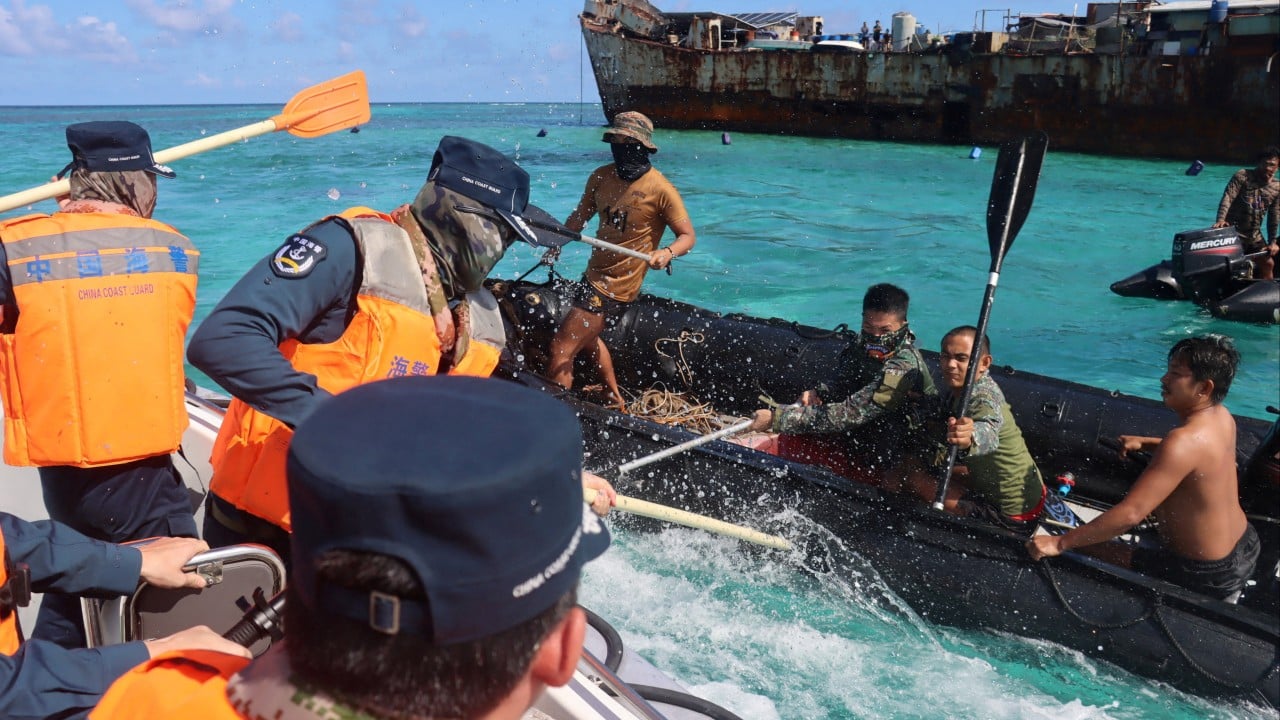
These diplomatic tussles unfold against escalating physical face-offs. Since 2022, Chinese vessels have repeatedly challenged Philippine ships near disputed features, including the Second Thomas, Scarborough and Sabina shoals.
02:04
Philippines accuses China of firing a water cannon at its vessels for a second day
Recent months have also seen an intensifying “war of words”, involving the Chinese embassy in Manila and Philippine officials including defence chief Gilbert Teodoro Jnr and coastguard spokesman Jay Tarriela.
“These kinds of sustained and intense clashes – both at sea and psychologically – have greatly depleted mutual trust between China and the Philippines,” Bao said. “The lack of sufficient mutual trust is fatal for diplomatic negotiations.”
Singapore taking over the Asean chair next year adds another variable. As a non-claimant state with established neutrality, it could serve as an honest broker.
Bao noted that while this impartiality might help with negotiations, exerting “decisive influence” on sensitive issues could prove difficult.
“Nonetheless, Singapore is capable of playing a ‘lubricant’ role to advance stalled negotiations,” he said.
The shifting dynamics of US politics could also shape the debate, according to Bao.
Whether the South China Sea remained a foreign policy priority in the final two years of US President Donald Trump’s term was “worth paying attention to”, he said, pointing to the constraints of a hostile Democratic-led Congress following recent midterm elections.
02:29
‘Stop grandstanding’: Beijing slams Philippine defence chief after minister exposes South China Sea note
“Two possibilities exist: Washington might actively support the Philippines and disrupt the [code of conduct], aiming to contain China, or it could act low-profile, potentially trading its support for Manila in exchange for Beijing’s cooperation on other global crises, such as Iran.”
US officials have told the South China Morning Post that Iran will be on the agenda when Trump meets Chinese President Xi Jinping and Russian President Vladimir Putin for an unprecedented trilateral summit on the sidelines of this week’s Asia-Pacific Economic Cooperation forum in China. The US president is due to arrive in the region on Tuesday for a special summit with Asean leaders in Manila.
KioskNews shows a cleaned-up reading view extracted from the publisher’s page — the original always lives on their site, not ours.