Cambodia’s full opening statement to first UNCLOS conciliation meeting with Thailand
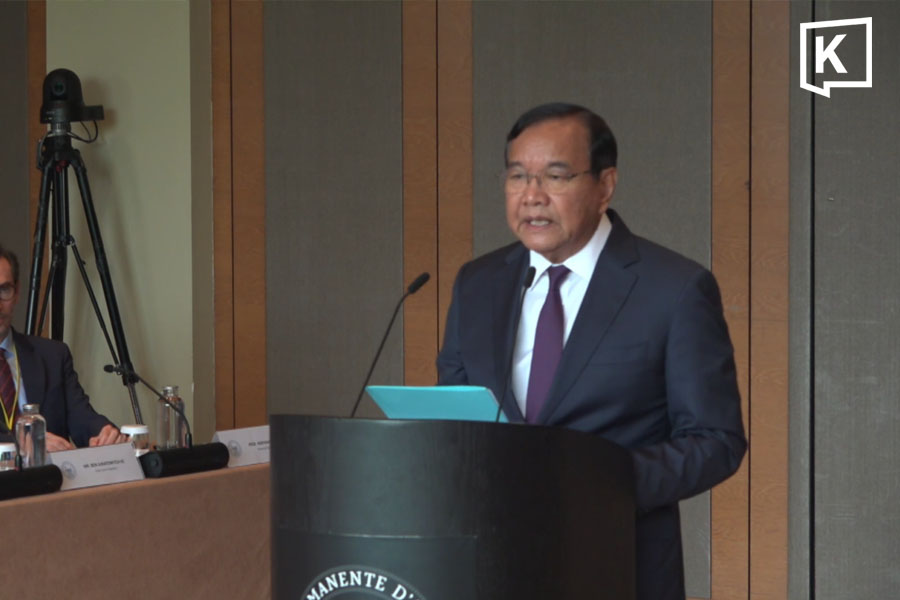
SINGAPORE — 15 September 2026, Opening statement by Prak Sokhonn, Deputy Prime Minister, Minister of Foreign Affairs and International Cooperation of the Kingdom of Cambodia, at the first meeting of the Thailand-Cambodia Conciliation Commission under UNCLOS.
The following statement was transcribed from video by Khaosod English. Thailand’s full opening statement from Foreign Minister Sihasak can be found here.
Thank you, Madam Chairperson.
Madam Chairperson, members of the Commission, Excellencies, ladies and gentlemen, it’s a great honor for me to address you as agent on behalf of the Royal Government of Cambodia at this first meeting between the parties and the Commission.
Cambodia is grateful to you, Madam Chairperson, and members of the Commission, for having agreed to serve on the Commission, and for the breadth of experience that you bring to this proceeding. I also wish to thank the Permanent Court of Arbitration, and in particular, Dr. Di Giacomo Toledo, Mrs. Souk, and their colleagues for their efficient conduct of the registry functions.
I extend our thanks to the representative of the Kingdom of Thailand, and to all other participants for their presence today.
Before turning to the substance of Cambodia’s presentation, I would like to speak briefly about the country I have the privilege of representing, and to explain why Cambodia
has initiated this conciliation. Members of the Commission, Cambodia has a proud history, but has also faced considerable adversity. The Khmer Empire, dated from the 9th century, was one of Southeast Asia’s great civilizations.
Its enduring legacy is reflected in monuments such as Angkor Wat and the Temple of Preah Vihear, both inscribed in the UNESCO World Heritage list, as well as Cambodia’s rich tradition of dance, theater, music, and martial arts, many of which are recognized as the world intangible cultural heritage.
Cambodia became a French protectorate in 1863. Its modem territorial boundaries was established through a series of treaties and maps, including the Franco-Siamese Convention of 1904 and Treaty of 1907, and the maps produced pursuant to them, which define its land border with Thailand. Following independence from France in 1953, Cambodia initially enjoyed relative peace and prosperity.
This was shattered by the spillover of regional conflict in the 1960s and the 1970s, during which Cambodia endured massive aerial bombardment. From 1975 to 1979, the Khmer Rouge regime perpetrated one of the gravest tragedies of the 20th century, claiming the lives of approximately one-quarter of the population and devastated the country’s institution, infrastructure, and social fabric.
Cambodia began rebuilding in earnest following the 1991 Paris Peace Agreement and the United Nations-supported peace process. Emerging from decades of conflict and isolation as one of the world’s least developed countries, Cambodia faced the enormous task of reconstructing its economy, institution, and society. Few nations, therefore, understood more deeply than Cambodia the value of peace and the devastating human and economic cost of conflict.
It is against this historical backdrop that Cambodia’s commitment to resolving its maritime boundary peacefully and in accordance with international law must be understood. From the mid-1990s, Cambodia has sought to resolve its maritime boundary with Thailand.
With a view to gaining access to the resources necessary to fuel its industrial growth and economic development, which its neighbors have enjoyed for decades. To that end, Cambodia and Thailand initiated discussion in April 1995 conceming their maritime boundary. By 2001, the two states had agreed a memorandum of understanding regarding the area of their overlapping maritime claims to the continental shelf.
That memorandum reflected a shared commitment to concludeagreement regarding their maritime boundary and the development of resources for their mutual benefit. Despite their efforts to negotiate solution, the parties have not reached agreement on either a maritime boundary, or a joint development treaty, and the resources beneath the undelimited waters remain unexplored. As the world confronts the greatest energy disruption in modern history, our region stands to gain, now more than ever, from the development of these resources.
On 5 May 2026, Thailand publicly announced its unilateral cancellation of the 2001 Memorandum of Understanding, despite Cambodia’s repeated call for it to be honoured. Faced with that situation, the royal government of Cambodia gave careful thought to the peaceful option available to it under international law.
In keeping with its commitment to the rule of law and to the peaceful settlement of dispute, Cambodia chose to initiatecompulsory reconciliation under the United Nation Convention on the Law of the Sea.
At the time Cambodia instituted these proceeding, my Prime Minister, Samdech Moha Borvor Thipadei Hun Manet, delivered a special address on 2 June 2026. In his words:
“Both Cambodia and Thailand stand to gain from a fair and lasting settlement, agreed with the guidance of the international expert conciliators and in accordance with international law.
A peaceful resolution is in the shared interest of both countries and will contribute to peace and stability in the region. It will protect sovereignty, strengthen confidence, unlock energy resources, support development, and create new job opportunities, not only for now, but also for the future generation of the Cambodian and the Thai peoples.”
Cambodia took these steps to find a peaceful pathway forward in accordance with international law. Cambodia sees this conciliation process as a means to rebuild trust, not as a form of escalation.
Cambodia sincerely hopes that Thailand will engage constructively in this process and, in parallel, will work toward improving bilateral relation through the full and effective implementation of all existing bilateral agreements, particularly the joint statement of 27 December 2025.
This would facilitate the retum of the more than 20,000 displaced villagers to their homes, the preservation of important cultural sites which has been damaged in the fighting, and pave the way to the normalization of our bilateral relationship.
Such efforts would also contribute significantly to de-escalation of tension and the rebuilding of mutual trust and confidence. Restoring peace and stability between Cambodia and Thailand would benefit not only the people of the two neighboring countries but also the broader ASEAN community.
Madame Chair, members of the commission, turning now to Cambodia’s objective of this conciliation. Our overriding objective is to achieve a resolution that serves the people of both nation and contribute to peace, cooperation, and shared prosperity in the region.
To that end, Cambodia wishes to conclude, with the assistance of the commission and in accordance with international law, a treaty with Thailand delimiting a single, all-purpose maritime boundary between the two states In the alternative, Cambodia would be prepared to conclude an agreement with Thailand for the joint development and equitable sharing of resources between the two states, pending final agreement on their maritime boundary.
If a final agreement on either maritime boundary, or a joint development arrangement cannot be concluded, Cambodia would request the commission to prepare a report containing recommendation to the parties, on the basis of which such an agreement could subsequently be concluded in compliance with the parties’ obligation under UNCLOS.
Respect for international law, the peaceful settlement of dispute, and the institution that upholds those principle is deeply rooted in Cambodia’s national experience.
Our recourse to the International Court of Justice reflect our confidence in the international institution as a mean of resolving complex disputes between states peacefully and in accordance withinternational law.
That experience shows that questions of highest national importance can be
addressed peacefully and through multilateral mechanism rather than by force, and that international frameworks can provide a stable and enduring foundation upon which neighboring states can manage their differences.
The same commitment shapes how Cambodia approaches its ongoing relation with the Kingdom of Thailand. Cambodia and Thailand relationship has been through a challenging period, and Cambodia hopes that the commission may be able to help the parties turn a new page for their mutual benefit.
We draw encouragement from the outcomes of the conciliation between the Democratic Republic of Timor-Leste and the Commonwealth of Australia conceming the Timor Sea.
That process demonstrated that compulsory conciliation under UNCLOS can break longstanding deadlock between neighboring states and lead to a lasting treaty settlement.
Cambodia is confident that the commission, with its distinguished composition, is well-placed to assist Cambodia and Thailand in achieving a similar result. One that brings peace, stability, and shared prosperity in the region.
Madam Chairperson, distinguished members of the commission, on behalf of the Kingdom of Cambodia, I thank you for your attention, and for the care and diligence with which you undertake this responsibility.
We look forward to working with you, and with the Kingdom of Thailand in a spirit of good faith and mutual respect. I thank you for your kind attention.
Katrina Cooper is an Australian diplomat serving as chair of the Thailand-Cambodia UNCLOS Conciliation Commission.
KioskNews shows a cleaned-up reading view extracted from the publisher’s page — the original always lives on their site, not ours.