Ontario teachers told they serve white supremacist system that must be destroyed
First Reading is a Canadian politics newsletter curated by the National Post’s own Tristin Hopper. To get an early version sent directly to your inbox, sign up here.
Sign In or Create an Account
Just as the school year kicked off, staff in an Ontario elementary school were apparently told that they worked within a bastion of white supremacy that needed to be destroyed from within.
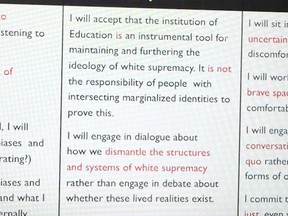
This is according to an image shared on Wednesday by commentator Jonathan Kay, and provided to him by an Ontario teacher.
It’s a projected slide from a Sept. 14 all-staff meeting held within an unidentified elementary school in the York Region, just north of Toronto.

Columnist Jesse Kline keeps you up to date with what’s happening in Israel and the effects of antisemitism on life here in Canada. Friday mornings.
By signing up you consent to receive the above newsletter from Postmedia Network Inc.
A welcome email is on its way. If you don't see it, please check your junk folder.
The next issue of Channel Israel will soon be in your inbox.
We encountered an issue signing you up. Please try again
The slide presents the assembled teachers with 10 “anti-oppression agreements.” Among them, “I will accept that the institution of Education is an instrumental tool for maintaining and furthering the ideology of white supremacy.”
The next “agreement” then includes a commitment to “dismantle the structures and systems of white supremacy.”
“It was just styled as an ‘agreement,’” wrote Kay on X, adding that the teachers weren’t required to recite the text.
As of press time, the York Region District School Board did not respond to queries about the slide’s authenticity.
But the language isn’t all that different from any number of official materials distributed to Ontario teachers declaring that they are servants of a white supremacist hierarchy.
In 2024, the York Region District School Board published a framework on “Dismantling Hate and Oppression,” which claimed schools are shot through with “colonial ideology” and that staff are all unwitting purveyors of white supremacy.
“The ideology of white supremacy impacts attitudes and behaviours in all peoples, regardless of race, culture, gender, or religion and this, over time, contributes to these behaviours and attitudes becoming normalized and taken-for-granted,” the board document says.
That same year, the Elementary Teachers Federation of Ontario published a 20-page “anti-oppressive framework primer,” which similarly tells teachers they operate within an inherently oppressive system that they must be “working intentionally to dismantle.”
As evidence, the report cites the existence of “Crazy Hair Day” in schools, as it perpetuates a “dominant Euro-centric culture” while also stigmatizing the mentally ill.
“’Crazy’ is a term that is ableist. It is demeaning to those living with a mental illness and unfairly stigmatizes those whose hair does not conform with the norm on a daily basis as ‘crazy,” it reads.
“For students and colleagues who for example, wear hijabs, turbans, or have complex medical needs, are their voices being included in days such as this?”
The Waterloo Region District School Board publishes a regularly updated guide to the “equity competencies” its teachers are supposed to exhibit, and this includes several statements not far removed from the “anti-oppression agreements” in the York Region meeting.
Among the “competencies” are acknowledgements that teachers and staff work within schools beset by “colonial structures” and “white supremacy.”
The equitably competent staff member, they are told, is one who “actively works to dismantle racist and oppressive school and system practices and structures” and “intentionally names, challenges and addresses white supremacy.”
The Peel District School Board, which operates just to the west of Toronto, practises “equity audits” to ensure schools are appropriately purging themselves of alleged white supremacy.
Online guidelines for the audits require Peel District educators to ask themselves if they are avoiding classroom practices that might come off as “Eurocentric” or “colonial.”
“In what ways will you challenge white supremacy culture in your classroom practice?” it asks.
In February 2024, all 20,000 teachers within the Toronto District School Board were supplied with a 40-page guidebook on “Facilitating Critical Conversations,” which declared that the very act of educating children in an institutional environment was part of “a colonial structure that centres whiteness.”
“Schooling in North America is inherently designed for the benefit of the dominant culture,” it wrote, defining the dominant culture as “white, middle-upper class, male, Christian, cisgender, heterosexual, able-bodied, neurotypical.”
The guide advised, “therefore it must be actively decolonized.”
The same guide also instructed teachers to prioritize race in all their interactions with students.
“Race matters — it is a visible and dominant identity factor in determining people’s social, political, economic, and cultural experiences,” it read.
But Facilitating Critical Conversations was ultimately removed by the Toronto District School Board following public backlash, with Ontario’s Ministry of Education saying it was needlessly divisive.

The word from Europe appears to be that “associate membership” status with the European Union isn’t actually a thing, despite the offer of such from European Commission President Ursula von der Leyen. Multiple EU diplomats interviewed by The Telegraph said they still had no idea what the term meant, and were skeptical of member states approving any kind of special relationship with Ottawa. Said one, “she knows full well there will be no associate membership. But she needed a strong headline that goes outside the bubble.” And all this EU talk might be a good time to mention that, to some British eyes, the whole “cozying Canada up to the EU” thing seems to represent a bit of unfinished business for Prime Minister Mark Carney. As governor of the Bank of England, Carney was vocally opposed to Brexit in the lead-up to the U.K.’s 2016 vote on exiting the European Union, a position that led to calls for his resignation. As Conservative MP Jacob Rees-Mogg said at the time, “he has shown himself to be partial in a political debate when the Bank of England needs to be independent.” So, precisely 10 years after his efforts to prevent a British exit from the EU failed, Carney just so happens to be attempting some kind of Canadian entrance to the bloc.
Last Wednesday, Ontario Premier Doug Ford praised Toronto Mayor Olivia Chow for doing an “incredible job,” and then telling the audience to “read between the lines” of his statement. The comment was widely interpreted as an endorsement of Chow, given that there’s a mayoral election this month – particularly given that a reporter had asked him if he was endorsing anyone in the race. Two days later, Ford said it actually wasn’t an endorsement, and blamed the media for any suggestion that it was.
First Reading is a Canadian politics newsletter curated by the National Post’s own Tristin Hopper. To get an early version sent directly to your inbox, sign up here.
Join the Conversation
This website uses cookies to personalize your content (including ads), and allows us to analyze our traffic. Read more about cookies here. By continuing to use our site, you agree to our Terms of Use and Privacy Policy.
KioskNews shows a cleaned-up reading view extracted from the publisher’s page — the original always lives on their site, not ours.