US still top debtor of Taiwan’s banks
NEW HIGH: Exposure to the US accounted for 30.28 percent of the local banking sector’s total at the end of June, up from 29.75 at the end of March, data showed
The US remained the largest debtor of Taiwanese banks for the 44th consecutive quarter at the end of June, with its share of Taiwanese banks’ total exposure surpassing 30 percent for the first time, the central bank said on Friday.
Taiwanese banks’ exposure to the US on an immediate counterparty basis reached a new high of US$222.53 billion at the end of the second quarter, up 6.47 percent from a quarter earlier, central bank data showed.
According to the Bank for International Settlements, the immediate counterparty basis is a methodology under which positions are allocated to the primary party to a contract.
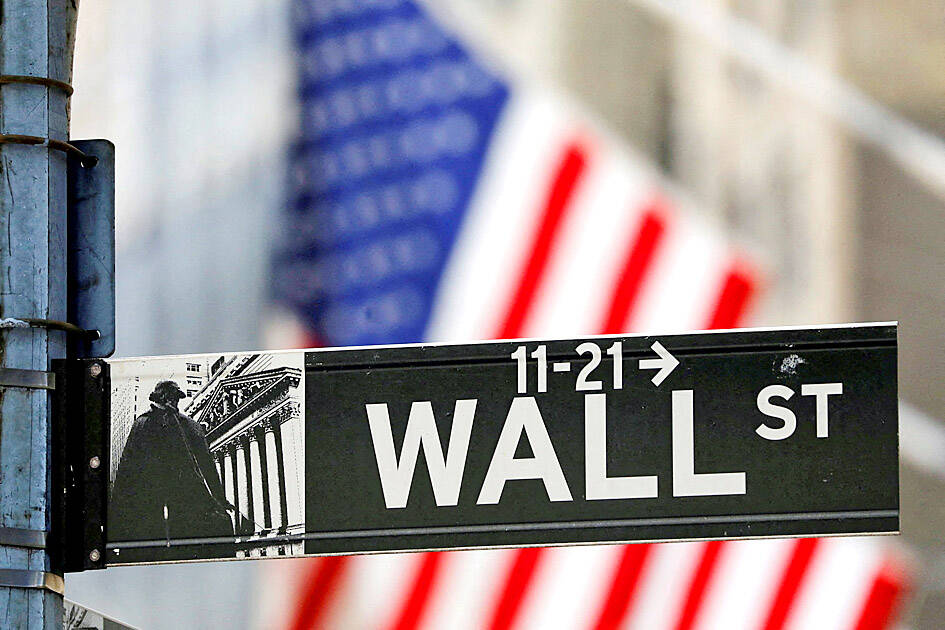
A street sign for Wall Street is seen outside the New York Stock Exchange in New York City on July 19, 2021.
Photo: Reuters
Department of Financial Inspection Deputy Director-General Hsieh Jen-chun (謝人俊) said the increase in exposure to the US resulted from growth in interbank loans and investments.
The increase in investments largely came from investments and fund deposits in US marketable securities amid a booming stock market, Hsieh said.
At the end of June, total international claims of Taiwan’s banks on an immediate counterparty basis, consisting of investments, deposits, loans and other holdings, rose 4.61 percent from a quarter earlier to US$735 billion, driven by increased lending to the global non-bank private sector.
Exposure to the US accounted for 30.28 percent of the local banking sector’s total at the end of June, a new high, up from 29.75 percent at the end of March, data showed.
The Taiwanese banking sector’s second-largest area of exposure was Luxembourg, at US$54.84 billion, up 6.07 percent from a quarter earlier, the central bank said.
Hsieh described Luxembourg as an important hub for mutual fund registration, meaning many local investors invest through banks in the country.
China came in third, with exposure totaling US$51.76 billion, up 4.94 percent from a quarter earlier, the central bank said.
Hsieh said the gap in exposure between the US and China widened gradually to a new high of US$170.7 billion at the end of June. Since the second quarter of 2023, the quarterly gap has exceeded US$100 billion for 13 consecutive quarters.
Australia was the fourth-largest debtor of Taiwan’s banks, with exposure totaling US$47.82 billion, up 2.06 percent from a quarter earlier, central bank data showed.
The next-largest areas of exposure for Taiwanese banks were Japan (US$41.46 billion, up 8.26 percent), Hong Kong (US$38.01 billion, up 11.67 percent), the UK (US$24.83 billion, down 1.35 percent), Singapore (US$23.87 billion, up 6.38 percent), France (US $20.83 billion, up 1.00 percent), and Vietnam (US$20.66 billion, up 7.74 percent), data showed.
The central bank said exposure to the top 10 debtor nations totaled US$546.62 billion at the end of June, rising 5.80 percent from a quarter earlier and representing 74.37 percent of total international claims by Taiwanese banks.
KioskNews shows a cleaned-up reading view extracted from the publisher’s page — the original always lives on their site, not ours.