Farmers’ Column: BBA grad turns 2 failed wheat sowings into Rs 1 crore from vegetables
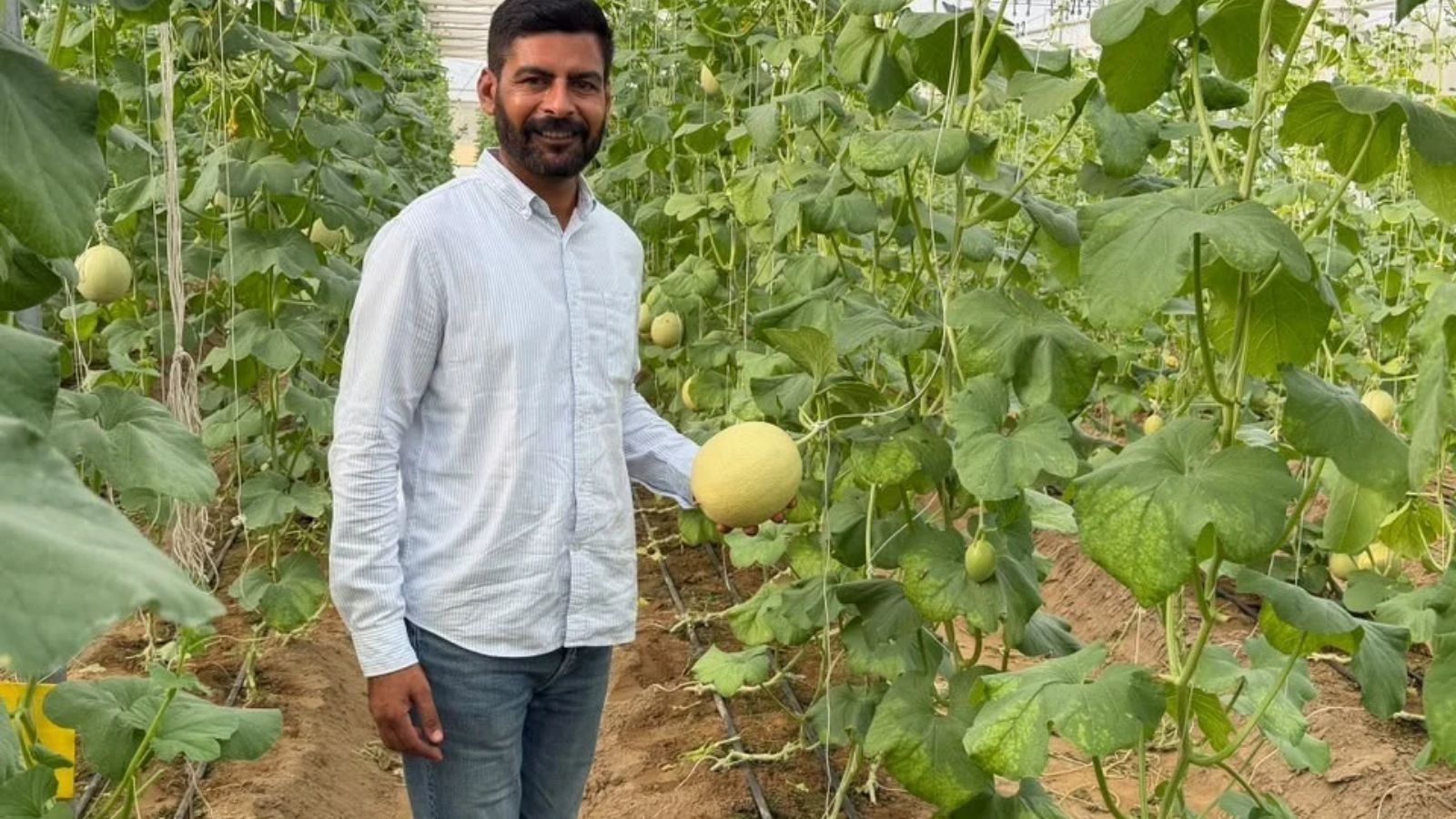
For Baldhir Singh Bhullar, a 35-year-old BBA graduate and a farmer by choice, two failed wheat sowings in a single season in 2021 became a turning point towards diversification — shifting him to vegetables in open fields and protected cultivation. Now, 13 acres under vegetables generate more than Rs 1 crore annually, compared to about Rs 75 lakh he used to get from 60 acres under wheat and paddy.
A resident of Basti Nanaksar in Ferozepur district, Bhullar had sown wheat on 25 acres in 2021 using a Crop Residue Management machine for the first time without burning stubble. The crop on 20 acres was attacked by a stem borer, forcing him to uproot it. He sowed wheat again, but within three days, heavy rain damaged the freshly sown crop.
“After we faced heavy losses, my father wanted to lease out the land, but I had a different plan,” Bhullar said.
He planted tomatoes on 13 of the 20 acres where the wheat crop was destroyed. That year, tomato prices were high enough for him not only to recover the losses, but also to earn nearly four times more than he could have earned from wheat production in that area.
“That was the year I decided to move towards vegetables,” he said.
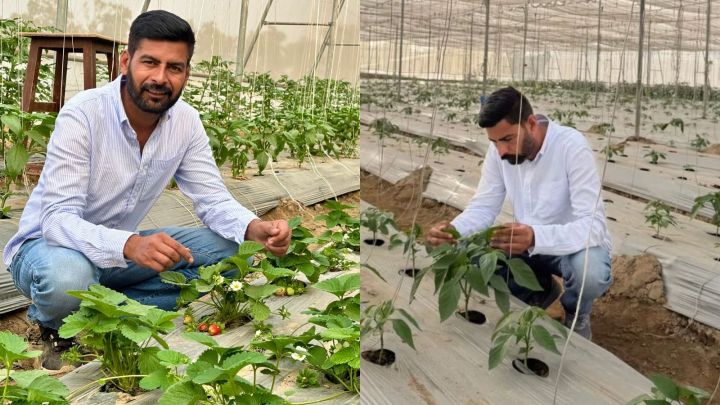
He initially grew seasonal vegetables on a couple of acres. Within five years, he expanded open-field vegetable cultivation to eight acres. In 2023, he added five acres under protected cultivation — one acre in a polyhouse and four acres in net houses — to grow vegetables under controlled conditions, taking the total area under vegetables to 13 acres.
Bhullar’s joint family, including his first cousins, own about 75 acres in Ferozepur. Of this, around 60 acres are used for Punjab Agricultural University-recommended short-duration paddy varieties during kharif and wheat during rabi.
Story continues below this ad
In the open fields, he grows cabbage, cauliflower, tomato, chilli and other seasonal vegetables. Under protected cultivation, he grows green, yellow and red capsicum, seedless cucumber and Japanese melon.
Capsicum, a year-round crop, occupies about one acre. Seedless cucumber is grown on 3.5 acres in two cycles — February to April, with harvesting beginning around 35 days after planting and continuing until July, and August to December. Japanese melon is grown on about three kanals in two cycles — from spring to summer and again from August to early December.
Bhullar said protected cultivation gives him greater control over temperature, humidity, irrigation and pests. He uses drip irrigation and fertigation, while biological pest-control methods have reduced his dependence on pesticides.
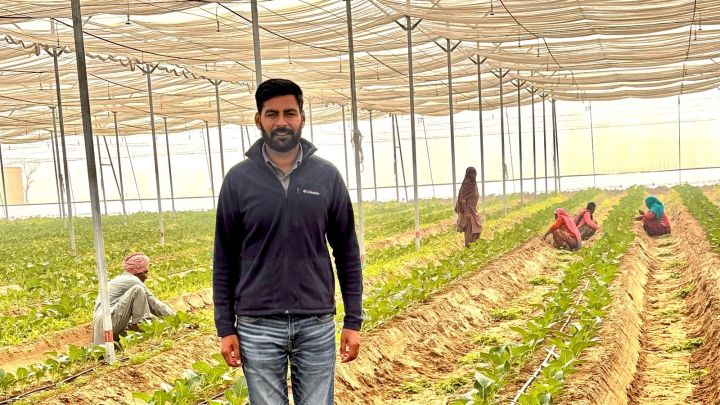
“I am dreaming of increasing polyhouse and net-house farming to 15 acres,” he said.
Story continues below this ad
The economics have encouraged Bhullar to expand. Vegetables under protected cultivation can generate Rs 15-20 lakh per acre annually, while open-field vegetables earn around Rs 5-6 lakh per acre from two crops a year, with a net margin of about 50 per cent after all expenses.
“From around 60 acres under wheat and paddy, we generate about Rs 75 lakh annually, with a profit of Rs 90,000 to Rs 1 lakh per acre. In comparison, five acres under protected cultivation generate Rs 74-75 lakh, while the remaining eight acres under open-field vegetables generate another Rs 40-45 lakh, depending on the crop and season,” Bhullar said.
The returns vary by crop. Capsicum yields 250-300 quintals an acre, worth Rs 15-16 lakh at an average Rs 50-55 per kg; cucumber yields 500-600 quintals in the summer cycle, worth about Rs 9 lakh per acre at Rs 15-18 per kg, and 180-250 quintals in winter, worth around Rs 7 lakh per acre at Rs 28-32 per kg. Japanese melon yields 40-60 quintals from three kanals, worth Rs 4-5 lakh annually. “After all expenses, vegetables provide an overall 50-55 per cent profit margin. Even when prices fall, returns remain higher than wheat and paddy,” he said.
The initial investment in protected cultivation, however, is substantial: a polyhouse costs around Rs 40 lakh per acre and a net house about Rs 28.4 lakh, with 50 per cent subsidy support available under government schemes. “But the investment is worth it. With proper management, one can recover the entire cost within the first two seasons,” Bhullar said.
Story continues below this ad
Bhullar employs around 25-30 people for about 10.5 months a year.
His efforts towards crop diversification, water conservation and not burning paddy stubble recently earned him the Pravasi Bharatiya Award from Punjab Agricultural University (PAU).
KioskNews shows a cleaned-up reading view extracted from the publisher’s page — the original always lives on their site, not ours.