How Navi Mumbai beat Surat and Indore to be named India’s cleanest city
When Navi Mumbai Mayor Sujata Patil heard her name called at Vigyan Bhavan in New Delhi on November 11 and walked up to receive an award from President Droupadi Murmu, she assumed the news was good but not the best. At the Swachh Survekshan ceremony, the third-prize winner is, as a norm, called to the stage first.
This year, the order had changed. So had the winner. The first prize was announced first, and Navi Mumbai had gone past Surat and Vijayawada to be named India’s cleanest city in the Super Swachh League, the contest among the country’s top-performing cities across population groups, a title Indore had held for eight years.
Two weeks on, the city isn’t letting anyone forget it. The win is on posters across Navi Mumbai and blares from the public announcement systems of the very garbage vans on whose backs the civic body outdid other 4,751 cities.
“Nishchay Kela, Number Pahila.. (We have decided on Number 1),” the vans announce amidst a medley of awareness jingles as they ply the roads to collect garbage.
The “Number Pahila” tagline was first devised in 2021, but for officials the win did not come as a surprise. NMMC had been vying for the top rank for a decade, and the measures put in place by a succession of officials over those years compounded this year, they say, and percolated down to the last gaothan, the old village pockets folded into the planned city.
And being clean is only a tenth of it. “Visible cleanliness” is one of ten categories on which cities are scored, alongside segregation of waste, used-water management, advocacy for swachhta, the welfare of sanitation workers and citizen feedback. In all, 50 indicators and 173 sub-indicators add up to a score out of 12,500.
Dr Ajay Gadade, deputy municipal commissioner in charge of NMMC’s Solid Waste Management department, believes visible cleanliness, access to sanitation and used-water management are where the city likely scored big. The Ministry of Housing and Urban Affairs (MoHUA) is yet to release the breakdown of marks scored against each category.
A city that wakes at 6 am
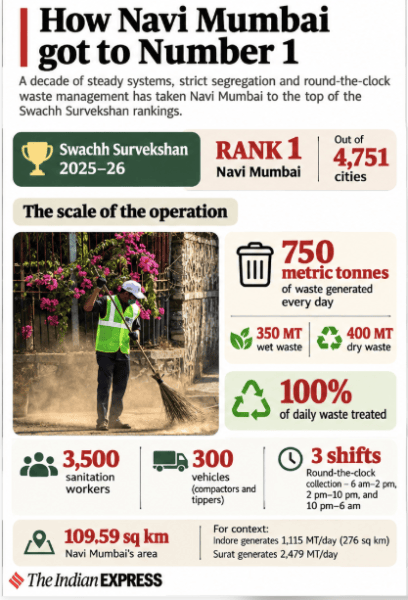
Navi Mumbai has an advantage its officials readily admit to. It is small, and it was planned. Spread over 109.59 square kilometres, the area under NMMC generates 750 metric tonnes of waste a day. Indore, which reigned as the cleanest Indian city for eight years, is estimated to generate 1,115 metric tonnes a day, collected from 276 square kilometres. This year, Indore was placed in a newly introduced category, ‘Swachh Shehar Jodi’, where it ranked second as a mentor city paired with its mentee, Depalpur. Surat, which has hovered around rank 2, generated an average of 2,479 metric tonnes a day in September 2026, according to records furnished by the Surat Municipal Corporation.
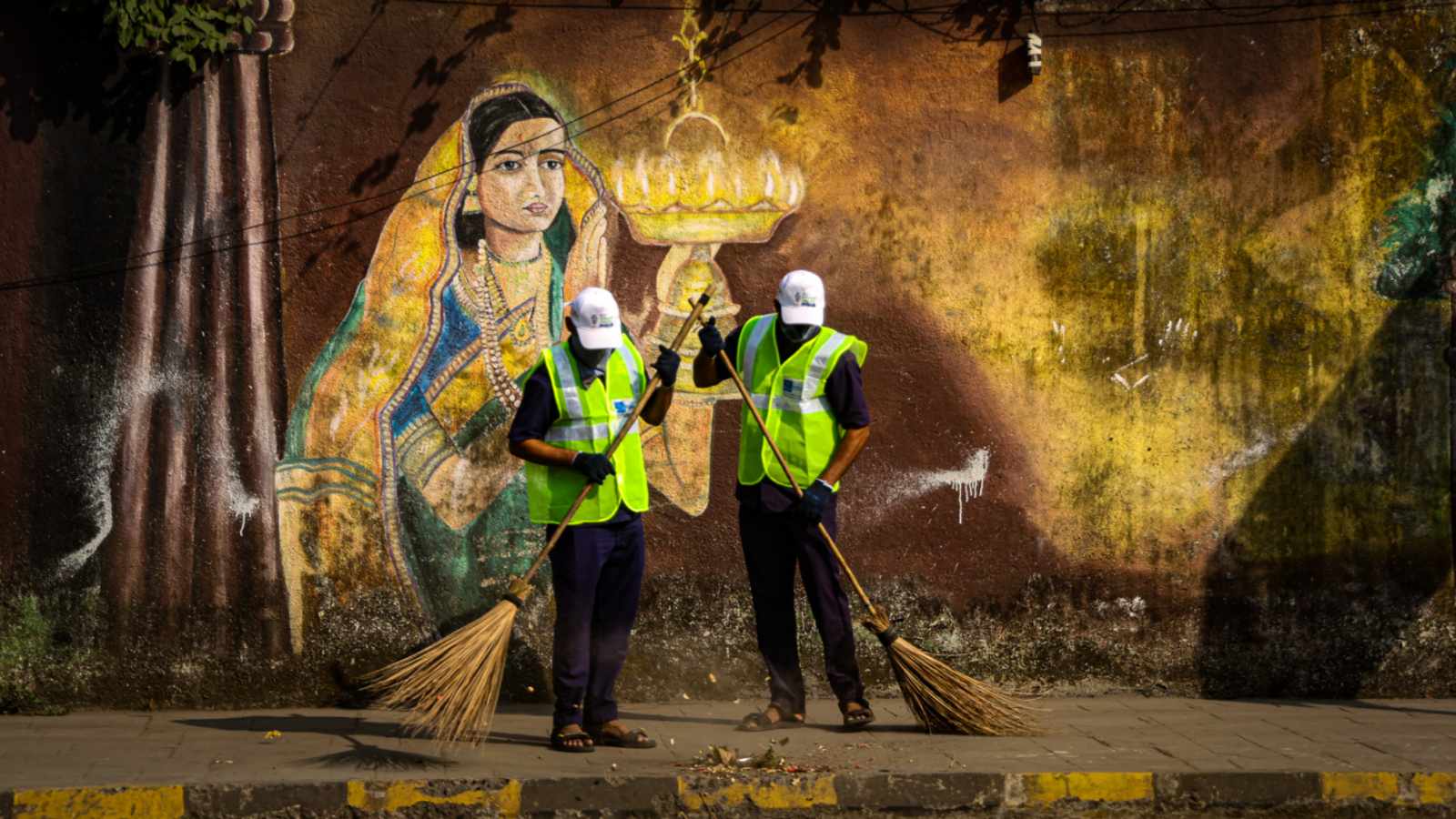
What NMMC claims credit for is the model built on top of that advantage, one that runs with clockwork precision. For the city’s safai karamcharis, the day begins at 6 am with the sweeping of streets, each worker assigned a 700-metre stretch for the shift. Another lot of workers do the rounds on vehicles, collecting waste from housing societies, slum pockets and gaothans.
Mohammad Salim Ansari has worked the Nerul route for over 11 years. “I leave my home by 5 am to arrive at my route. We work in teams to collect bins from the societies or dedicated spots. Here, we remove the garbage from the plastic liners and tip the bin into the compactor,” he told The Sunday Express.
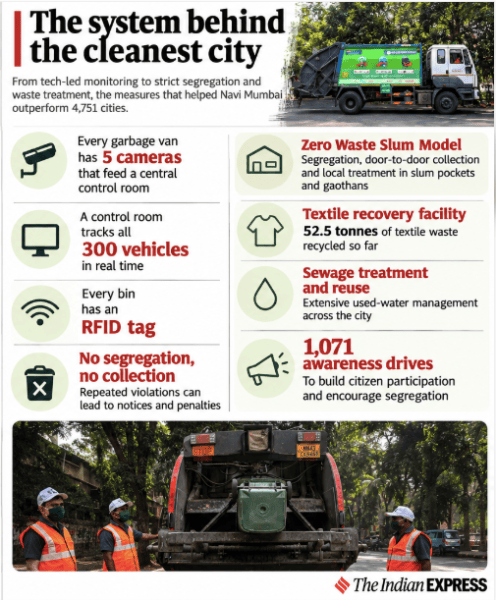
What Ansari tips in has to be segregated already. If it isn’t, the appeals begin, and they escalate. A society that keeps mixing its waste can find that the garbage van simply stops coming. “If a society fails to segregate the waste despite requests, the sanitation team on ground raises alarms with us and we stop collecting their waste. Even if that doesn’t work, we serve them with notices, and gradually such societies are slapped with penalties,” said Milind Ambekar, an NMMC sanitation inspector who oversees a staff of nearly 70 workers.
That hard line is what lets Navi Mumbai claim something few Indian cities can, which is 100 per cent treatment of its daily solid waste. Of the 750 metric tonnes generated each day, 350 is wet and 400 is dry. The wet waste is converted into premium compost. The dry waste is sorted into recyclables and high-grade refuse-derived fuel, which is supplied to fuel plants.
The fleet is built for the city’s two geographies. Large compactors, which operate by shift, take the main roads. Small tippers, with separate compartments for wet, dry, sanitary and hazardous waste, squeeze through the narrow lanes of the slum belts. Both ferry the waste to the civic dumping ground, where it is treated.
Nor does the city stop at nightfall. Collection runs in three eight-hour shifts — 6 am to 2 pm, 2 pm to 10 pm, and a night shift till 6 am. At least 3,500 sanitation workers and up to 300 vehicles keep it going.
“While maximum staff is deployed in the morning when they sweep and collect garbage, nearly 10 percent of staff work the afternoon shift while another 10 percent work during the night. During the morning, the focus is predominantly on garbage collection from residential clusters while later, waste is collected from the commercial areas,” said Vijay Naik, NMMC’s sanitation inspector for Belapur.
It is this round-the-clock rhythm, officials say, that lifted the city in “visible cleanliness”, one of the ten criteria on which Swachh Survekshan marks are allocated.
The room that watches the bins
Away from the public eye, on the first floor of the NMMC headquarters and beyond several rooms, is the place Gadade credits for much of the rest. The Integrated Command and Control Centre (ICCC).
Walk in and a large dashboard fills the view. Between grids, maps and a riot of colour, it holds the cleanliness activity of all eight wards as it happens. Where every garbage van is, the live feed from the five cameras mounted on each, and the actual garbage each vehicle has cleared. It tracks 300 sanitation vehicles across 291 routes in real time, monitors segregation compliance and supports grievance redressal.
Even the dustbins report in. “Each dust bin has an RFID scanner which notes which dustbin is being emptied and updates the figures,” an official says.
When The Indian Express visited the ICCC, the second shift was in progress and officials were tracking garbage compactors in Ghansoli, one of the city’s eight wards. The ground mirrors the screen. Sanitation workers on the Nerul route said that once collected, the waste is ferried to the corporation’s Turbhe dumping ground, where 100 per cent of it undergoes treatment.
The slums, where civic officials reported the least cooperation, needed a different approach. Until 2019, waste from Navi Mumbai’s 45 small and medium informal settlements and semi-urban pockets went into large community bins, which were emptied by refuse collection vehicles. The bins overflowed, the vehicles struggled to reach them, and the system created hygiene problems across those settlements.
In April 2019, NMMC replaced it with what it calls the ‘Zero Waste Slum Model’: instead of hauling garbage out of the slum, the slum deals with most of it itself. “Under the model, door-to-door collection covers roughly 2,000 households per project site (approximately 1,000–1,200 kg of waste daily). Waste is segregated at source into wet and dry streams; wet waste is processed scientifically into compost on-site, while recyclables are sorted by women workers and sold to recyclers,” said Kailash Shinde, NMMC commissioner.
Old shoes, old clothes, old water
Across several pockets of the city stand dedicated bins for the things that would otherwise go in with the daily waste and impede segregation such as sanitary waste, hazardous waste, and discarded shoes and clothes.
The shoes and clothes, in particular, have found a second life. In 2025, NMMC launched what it calls the country’s first Textile Recovery Facility, Punarsutra, at Belapur, the city’s administrative hub, developed in partnership with the Ministry of Textiles. Discarded clothes from the bins are recycled there into upcycled products of 300 categories, mats to bags. The facility has so far collected up to 52.5 tonnes of post-consumer textile waste. The shoes are upcycled into slippers, school bags and other items in partnership with the GreenSole foundation.
Even the plastic has found its way back into the city, into NMMC offices, gardens and public spaces as recycled benches.
Then there is the water. The city treats 100 per cent of its 260 MLD of sewage across seven sequential batch reactor plants and four tertiary treatment plants, and up to 30 per cent of the treated wastewater is reused for industrial supply, landscaping and construction.
Above all, officials say, the sustained effort has changed how residents behave. “Over the past one year, we really increased our awareness campaign programmes. We would regularly involve school students and NSS volunteers as we believe children are key to bringing about a change. When a child learns about cleanliness in school, he will go and tell his parents and they will listen to him,” Dr Gadade said. In the past six months alone, records show, volunteers conducted over 1,071 community awareness programmes across schools, streets and housing societies.
The other Navi Mumbai
Not all residents share that view. In the gaothans and slums, many say that what they see around them does not match the ‘cleanest city’ tag. “I am surprised that we have won cleanest city. However, a look around here and one will find it difficult to believe it. Maybe those judging were only taken to the clean areas only. Gaothans and slums are may have been kept out,” said Vinod Chavan, a Turbhe resident.
Residents describe two Navi Mumbais.Vashi, Nerul and Belapur, the planned residential hubs, look like the cleanest city. Turbhe, Ghansoli, Koparkhairane and Rabale, the industrial belt where much of the city’s migrant workforce lives, do not, and residents there say the gap is wide.
 How Navi Mumbai got to Number 1.
Some have gone looking for proof. Yash Rajwani walked from Belapur railway station to Airoli railway station and documented what he found on social media: trash lying around bins, and stretches near the stations at Belapur and Vashi that were far from clean. Over the 34-km walk, he filled 36 garbage bags.
An NMMC official said railway station premises come under the railways, and that the corporation has sought permission to bring those areas under its purview too. On the gap between the nodes, officers said they find it hard at times to get cooperation from residents in the gaothans and slums, some of whom continue to dump garbage outside, but that efforts and new initiatives are under way to keep those areas clean as well.
Staying at Number 1
Having got to the top after a decade, Navi Mumbai now has to stay there. Officials call the challenge big but attainable.
“The award didn’t come overnight. We had been working for over a decade. Not only cleaning the waste but also creating awareness was a change that we managed to achieve. Our campaign ambassador, Shankar Mahadevan, had created multiple jingles to create awareness and in the past one year, we really enhanced our outreach activity,” Mahendra Konde, NMMC’s public relations officer, told The Indian Express.
Next on NMMC’s cards is a tie-up with other cities of the Mumbai Metropolitan Region to work in coordination on wider cleanliness goals. According to sources, a recently convened meeting has already begun work towards the next Swachh Survekshan.
 What put Navi Mumbai on top
“Like before, we have to continue to do our best. We have to keep motivating teams on ground to continue the good work,” Dr Gadade said.
On the streets, that goal has a face. “We were all overjoyed when we heard this news. I was felicitated by the local community and even the NMMC commissioner, Kailash Shinde, as one of the best safai karamcharis.. This support is motivating but our work can’t stop here. We begin every new day with the same vigour, ” said Asaram Kharat, a sanitation worker in Nerul, as he perched a wet waste bin onto the compactor for unloading.
KioskNews shows a cleaned-up reading view extracted from the publisher’s page — the original always lives on their site, not ours.