Parkinson’s Handbrake: How AIIMS surgeons used AI to map the Brain’s faulty signals
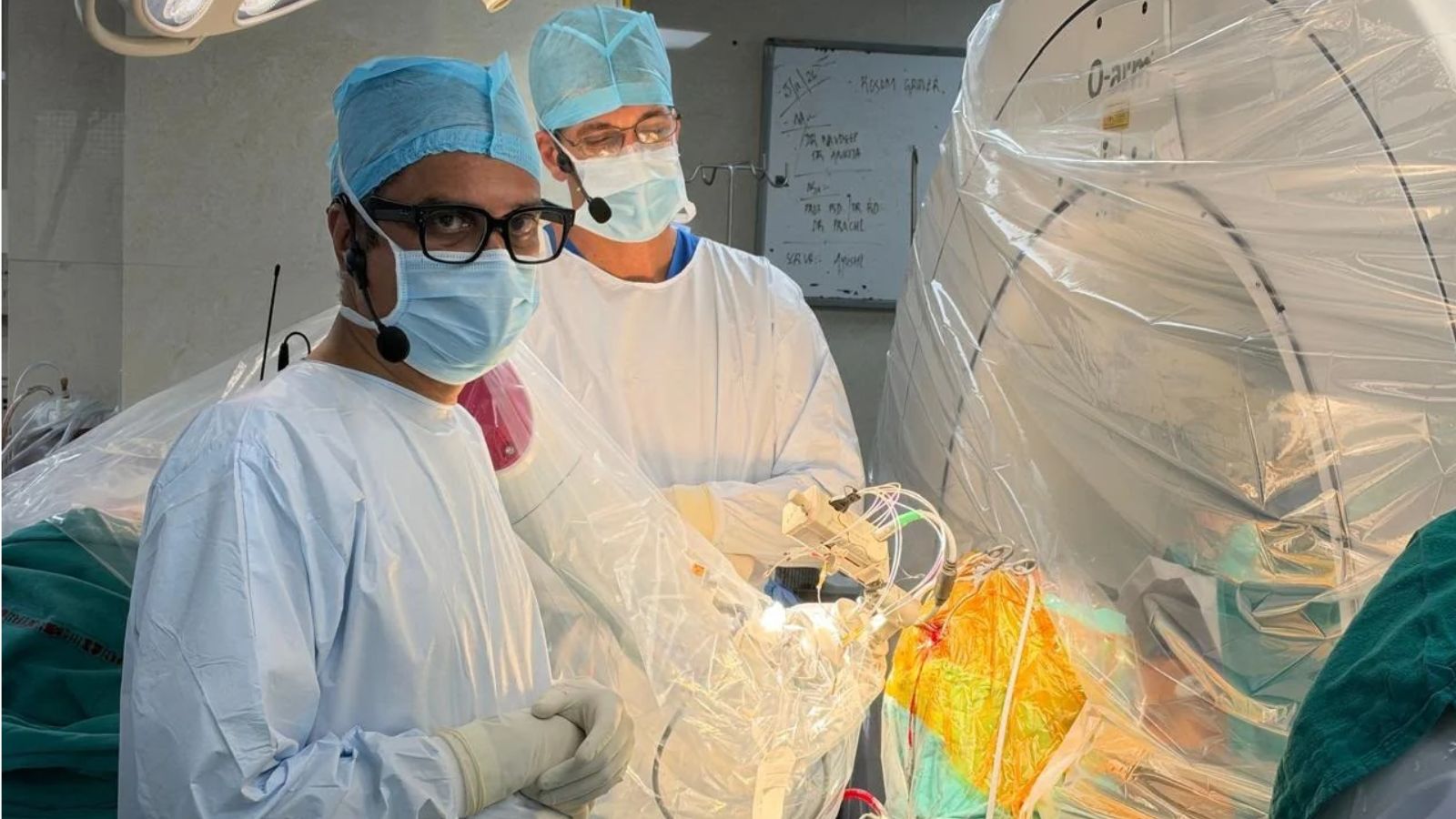
Neurosurgeons at the All India Institute of Medical Sciences performed India’s first robot-guided deep brain stimulation, a procedure for Parkinson’s patients whose symptoms are no longer controlled by medication.
The operation, on November 25, was led by Dr P Sarat Chandra, head of neurosurgery at the institute, together with Dr Ido Strauss of Tel Aviv University in Israel. At present, this technology is being used in selected centres across the world. Other faculty involved in the surgery included Prof Ramesh Dadamani, Prof Satish Verma and Prof Dattaraj.
In deep brain stimulation, surgeons implant thin electrodes deep in the brain. The electrodes deliver small, steady electrical pulses that calm the abnormal activity behind tremor, stiffness and slowness of movement. They are connected to a device under the skin, usually near the chest, that works like a pacemaker for the brain.
“It does not cure Parkinson’s and does not stop it from advancing,” said Dr Elavarasi, associate professor of neurology at the institute. “In the right patient, it eases symptoms and improves quality of life.”
Dr Chandra said the robotic approach was significant because it was not only cosmetically better but also more accurate.
“The accuracy is better as the placement of electrodes is guided by a certain kind of electrical activity called beta oscillations,” he said.
How robotic DBS works
Beta oscillations are a rhythm of electrical activity in the brain’s movement circuits. In a healthy brain, Dr Chandra said, they appear when the body is at rest and fade once movement begins. In Parkinson’s, they keep surging even during movement.
“It’s like a handbrake of the car, which is still on despite the car moving,” he said. “This is what leads to symptoms of bradycardia and rigidity in Parkinson’s.”
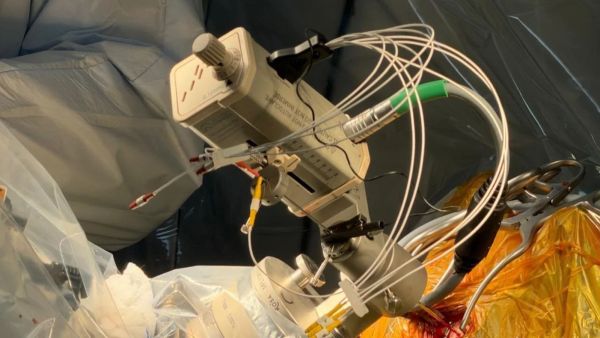 Dr Chandra said the robotic approach was significant because it was not only cosmetically better but also more accurate. (Photo: Special Arrangement)
In the robotic procedure, an artificial intelligence algorithm analyzes the brain’s signals and builds a heat map of where beta activity is strongest. “The surgeon then uses that map to decide the final electrode position,” Dr Chandra said.
Dr Elavarasi said the robotic method was also less invasive. Surgeons need to shave only a coin-sized patch of the scalp rather than the entire head, and the electrode passes through a 2.5-millimeter hole instead of a larger incision, she said.
“The fixation caps used in conventional surgery are not needed. The cosmetic result is better,” she said.
Dr Elavarasi, however, emphasised that there was no direct evidence that robotic surgery was superior to conventional methods. “The technology is being used in selected centers across the world,” she said. Whether patients fare better years later remains unanswered and will require comparative studies, she said.
The robot works alongside a technique called microelectrode recording, in which doctors listen to the electrical activity of individual neurons deep in the brain during surgery. Each region has its own signature, which tells surgeons when they have reached the target.
At the workshop held alongside the surgery, Dr Genela Morris of Tel Aviv University demonstrated an A.I.-based method of interpreting those signals as an operation proceeds.
“Advanced imaging and M.E.R. have made targeting more precise,” Dr Elavarasi said. “A.I. helps identify the entry and exit zones better. That reduces errors, shortens the time taken to find the target and brings uniformity. It does not replace human judgment.”
The cost
Not every Parkinson’s patient qualifies for DBS. At AIIMS, a multidisciplinary team assesses patients with significant motor fluctuations and a good response to levodopa, and with no clinical red flags, before surgery is considered, Dr Elavarasi said.
The bill can be high. “The cost of the DBS implant starts at around Rs 10 lakh at AIIMS, while the surgery itself is technically free. Private hospital costs can exceed Rs 35 lakh,” Dr Elavarasi said.
KioskNews shows a cleaned-up reading view extracted from the publisher’s page — the original always lives on their site, not ours.