Taiwan vital to US security: Johnson
DEFENSE: The US House speaker dismissed speculation that Trump is using arms sales as a negotiating tactic with Beijing amid concern over delayed deliveries
By Hollie Younger / Staff writer, with CNA


Taiwan is a partner whose “stability and independence” are important to US national security and the economy, US House of Representatives Speaker Mike Johnson said on Monday when asked about arms sales to Taipei in an interview with Fox Business.
Asked whether US President Donald Trump was using a long-delayed US$14 billion arms deal as a negotiating tactic for trade with Beijing, Johnson said that he “wouldn’t read too much into that.”
The delayed arms package is “related to the Iran conflict” and the need for missile stocks in the Middle East, he said.
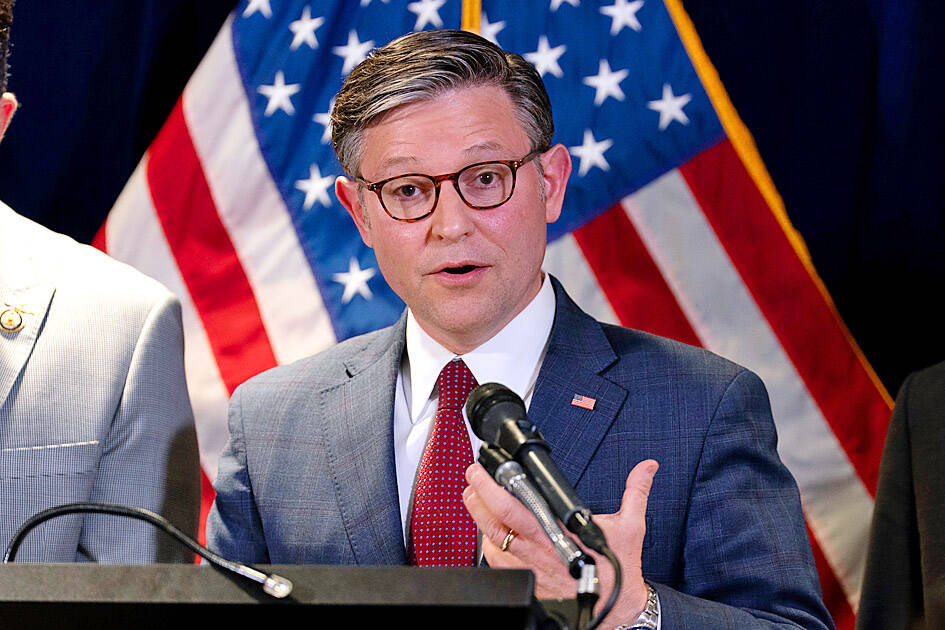
US House of Representatives Speaker Mike Johnson speaks in an undated photograph.
Photo: AP
“If you look over [Trump’s] two terms, he will have completed, I think, US$40 billion in arms sales to Taiwan, which is about twice what [former US] president [Barack] Obama did,” Johnson said, adding that he did not think anyone can question the US’ resolve.
“We understand that Taiwan is a very important partner, friend and ally of ours, and we need them to be stable and independent” for national security purposes and the economy, he said.
Xi on Thursday last week told Trump that he hoped the US would adhere to the “correct position” of opposing Taiwanese independence, a Chinese readout of the talks said.
Johnson in May affirmed there would be no reduction in US support for Taiwan or arms sales to the nation.
In December, Trump announced a US$11.1 billion arms package, the largest-ever US weapons package for Taiwan.
He completed almost US$18.3 billion in arms sales to Taiwan in his first term — from 2017 to 2021, data from the US-Taiwan Business Council showed.
Former US president Bill Clinton completed US$8.7 billion in arms sales over two terms from 1993 to 2001, while former US president George W. Bush approved US$15.6 billion over two terms from 2001 to 2009, the data showed.
The Obama administration approved arms sales of US$14 billion over two terms from 2009 to 2017, while former US president Joe Biden approved US$5.7 billion in a single term from 2021 to last year, the data showed.
Separately, Minister of National Defense Wellington Koo (顧立雄) yesterday confirmed that the US has “shown goodwill” over the late delivery of Taipei-ordered F-16V Block 70 jets, saying the two sides are still in talks over the matter.
The contract signed between Taipei and Washington for the fighters did not include financial penalties for late delivery of the 66 F-16Vs, meaning Taiwan will not receive financial compensation.
However, the US could provide more technical support, spare parts and an extended warranty for Taiwan’s F-16Vs, the Chinese-language China Times said in a report yesterday, quoting unnamed military sources.
Koo’s remarks on the sidelines of a Legislative Yuan session were in response to the China Times report, which said the US government would help Taipei seek compensation from the jets’ manufacturer, Lockheed Martin.
Under the “Peace Phoenix Soaring” project, Taiwan’s air force spent NT$247.2 billion from 2020 to this year to procure 66 new F-16V Block 70 jets from the US.
Deliveries of the jets were scheduled to be completed by the end of this year, but the program was delayed by factors such as the relocation and restart of the production line and supply chain disruptions.
Lockheed Martin has since operated two shifts, with production running for up to 20 hours a day to accelerate deliveries.
The first two of the 66 F-16Vs Taiwan purchased departed from the US mainland on Aug. 17 and are reportedly in Hawaii, where they have yet to depart for Taiwan.
Asked when the first two F-16Vs would be delivered, Koo told reporters in Taipei that the ministry would make the information public as soon as the delivery date is confirmed.
KioskNews shows a cleaned-up reading view extracted from the publisher’s page — the original always lives on their site, not ours.