‘It’s about being loudly visible’: Ahadadream, the British-Pakistani dance star defanging racist slurs

When Ahad Elley was 12, his family moved from Karachi to the UK. Quickly, he discovered his Pakistani identity was the basis of a slur. “Growing up in Pakistan, I never knew that was a bad word, because why would it be? The word ‘pak’ means clean, it has no negative connotations.” Elley’s childhood response was to disconnect from his heritage, and what followed was “potentially shrinking or hiding parts of myself to fit into society”. It’s likely a familiar story for many diasporic south Asians who, at some point, have felt the call to assimilate.
Twenty years later, Elley is better known as Ahadadream, an integral architect of the current British south Asian music scene, as well as a DJ, producer, label head, A&R and promoter shining a light on dance music from around the world. His tracks are favourites in sets by A-list dance artists such as Fred Again, Caribou, Peggy Gou and Four Tet, and with the release of his debut album, P★KI (pronounced “pee-star-kay-eye”) Elley’s star is set to rise further.
The album’s title has caused some upset, given the word is laced with hurt and histories of racist violence, but Elley wants to reframe a slur used against him. “The intention is pride, confidence, and self-love,” he explains over video call from his home in east London. “There’s no intention to cause anyone any hurt or pain. But I totally understand everyone’s perspectives, and it’s also about sharing perspectives with each other, which I think is your responsibility as an artist.”
Music wasn’t always an obvious journey for Elley. Like many desis, he thought of creativity as a hobby. “Music had always been drilled into me as something you did on the side,” he says. It was dance producer Skrillex who, in 2023, encouraged Elley to pursue his dreams. “He said to me: ‘No, you’ve got to quit your job. If you can’t make enough money, you can come and sleep on my sofa.’”
Elley had spent a decade working full-time corporate jobs while establishing himself at the forefront of British underground dance music in his spare time. While studying chemistry at university, Elley had discovered club culture: attending Elijah and Skilliam’s infamous grime raves, Butterz; listening to Mini Mixes on Annie Mac’s Radio 1 show; running his own nights. He felt the pull of percussion early on, he says: “Rhythmic music has probably always been in my blood, going to weddings and being exposed to the dhol [drums]. Maybe I was drawn to UK funky because it’s more rhythmic, and that was almost a gateway to discovering things like gqom from South Africa, [Brazilian] baile funk, [Angolan] kuduro … I don’t understand why those sounds aren’t given as much importance as house and techno.”
And so his own sets and productions began weaving together kinetic global polyrhythms. In 2017, he co-founded the label More Time, releasing tracks by artists from Trinidad to Taiwan. Simultaneously, he worked behind the scenes at DJ livestreaming company Boiler Room, all while making space for south Asian DJs who couldn’t easily be categorised: whether at his club night No ID, or Dialled In, the platform he co-founded. Though it started as a London-based festival, Dialled In has scaled up, with parties across the Indian subcontinent, international shows for south Asian artists, mentoring and, most recently, a record label – through which Elley is releasing P★KI.
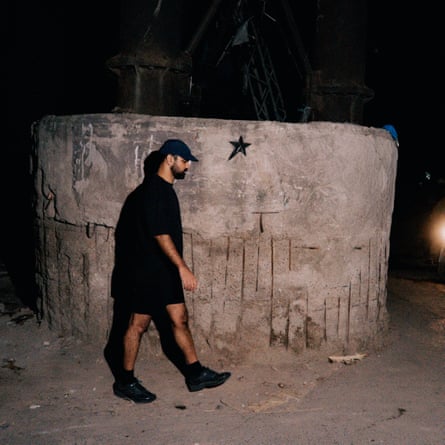
Capturing the bold energy of his DJ sets, with drums leading the melody throughout, P★KI is a thrilling love letter to Elley’s constituent parts, marrying a bright, borderless mesh of sounds that feel like being free. There’s a euphoric shout-out to inclusive clubbing on Make Space, alongside dark, boisterous nods to grime, slinky UK funky, skittering bass. The album’s visual identity, created with Elley’s wife, architect Esha Sikander, is a nod to the Radio Pakistan logo, with Elley dressed in brash colour combinations to embody his journey. He grins: “It’s about being loudly visible.”
It’s fitting, then, that P★KI opens with Elley’s edit of transcendent qawwali singer Nusrat Fateh Ali Khan, arguably the greatest icon of Pakistani music. Tere Bin is a gleaming rework that’s become a fan favourite – at least one couple have played it down the aisle at their wedding and, at Dialled In’s fifth birthday in London this summer, a rapturous, misty-eyed crowd sang along.
“It’s always so emotional,” says Elley. “Sometimes I question where those emotions come from: like, why are there tears on the dancefloor when we’re all singing Nusrat Fateh Ali Khan at the highest possible volume we can? There’s some sense of healing, and part of that is because in our day to day lives we are maybe a little bit disconnected from our heritage or identity.”
On P★KI, Ahadadream is proudly facilitating that healing for a new generation, rejecting the urge to shrink away.
KioskNews shows a cleaned-up reading view extracted from the publisher’s page — the original always lives on their site, not ours.