Tins, tablets and trust: The business of fund raising in Singapore
“Xin ku le,” the elderly woman says in Mandarin, thanking Lester Ng for his hard work. Then, she dropped a few dollars into his collection tin and offered him more blessings.
The brief encounter took place at Bedok Hawker Centre in May 2025, during the Kidney Dialysis Foundation’s (KDF) annual Flag Day.
“I did not expect many people to donate, especially in today’s largely cashless society,” says the 53-year-old healthcare professional. “But we received donations of $10 and even $50 notes.”
The event brought back memories of the Flag Days he took part in as a Scout. This is the reason he now volunteers with his two children. He wants to instil in them the habit of giving back.
His children often collect more than he does. To Ng, it is a sign that Singaporeans still respond to young volunteers seeking small donations for a familiar cause.
At the same time, another type of fund-raiser has become just as familiar in Singapore’s streets.
On a weekday in November 2025, outside an MRT station in south-western Singapore, three young adults in matching vests and lanyards approach commuters, tablets in hand.
Most passers-by quicken their pace. When someone stops, one of the trio produces a pamphlet, explains the cause and asks for a donation.
Unlike Ng and his children, these are paid fund-raisers engaged by a company to raise money for a charity.
“I see them more now,” Ng says. “Instead of asking for small change, which requires minimal decision-making, they often seek larger donations and longer-term commitments.”
The contrast between the collection tin and the tablet reflects a wider shift in fund raising.
Even though these practices are regulated, it is becoming harder for people to know whom to trust, with volunteer collectors, paid fund-raisers and unverified sellers all competing for attention in public spaces.
Flag Days: More visibility than revenue
Flag Days were once a fixture of the civic calendar, with students collecting donations outside MRT stations, markets and shopping centres, often as part of school community-service programmes.
Today, that model is becoming harder to sustain.
Triston Siew, KDF’s manager for resource development and partnerships, says the charity landscape has grown increasingly crowded over the past decade.
Donors now support a wider range of causes, particularly those to which they feel a personal connection.
Schools are also less inclined to deploy large groups of students for collection drives.
“We were told that schools want their students to take part in activities with more visible impact, such as befriending or programmes that involve direct interaction with beneficiaries,” Siew says.
Adult volunteers increasingly want sustained and meaningful roles, too, adds Stella Antakusuma, KDF’s head of communications and stakeholder engagement.
Organising a Flag Day is labour-intensive. For its April 2025 Flag Day, Guide Dogs Singapore recruited more than 300 volunteers.
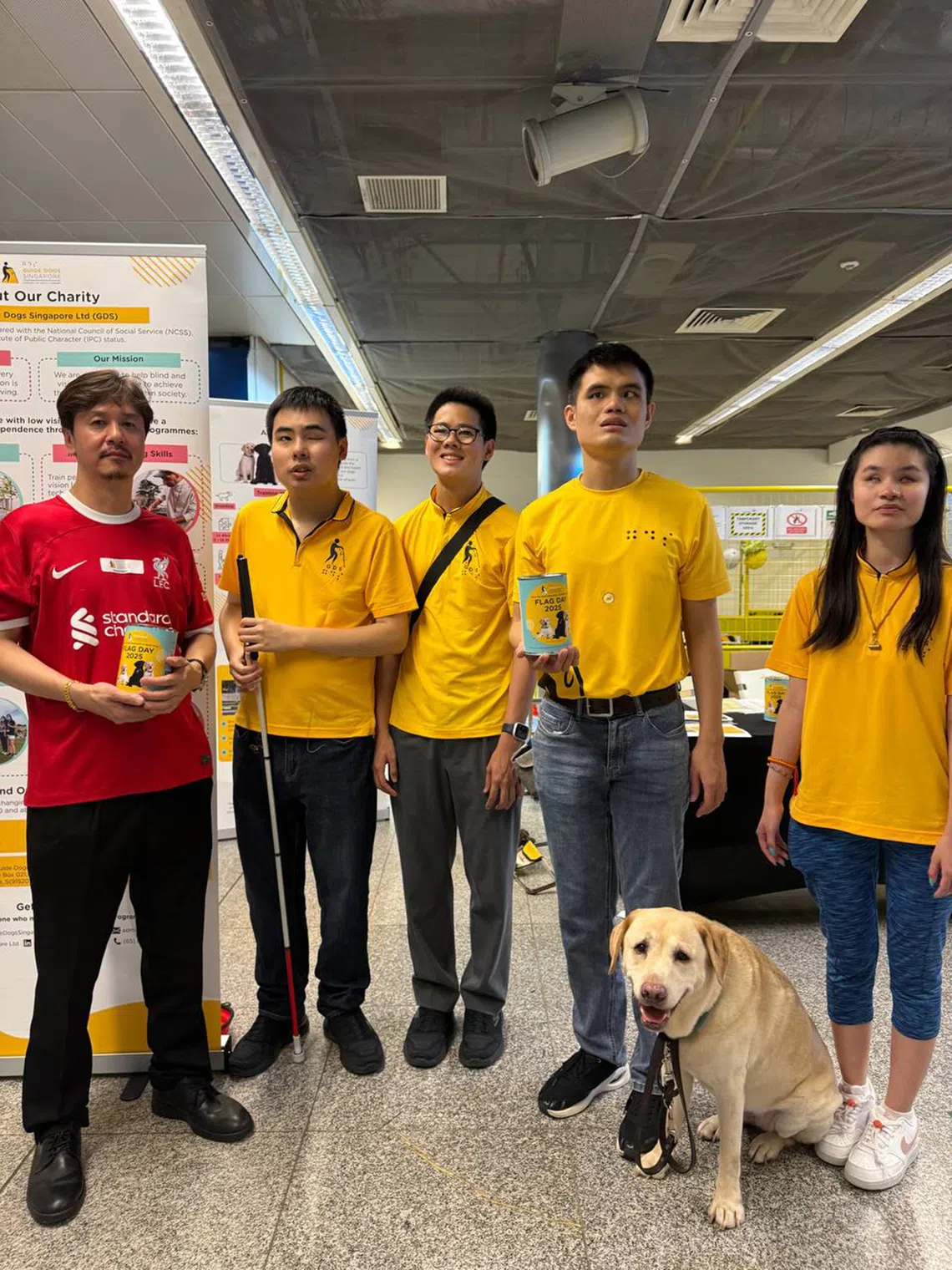
Volunteers at a Guide Dogs Singapore Flag Day.
PHOTO: GUIDE DOGS SINGAPORE
Flag Days also yield relatively limited returns. Typically, one Flag Day raises about $30,000, says the charity’s head of community partnership Eileen Koh.
The amount accounts for less than 10% of Guide Dogs Singapore’s annual fund raising.
Meanwhile, KDF’s Siew says the organisation raises about $50,000 from a Flag Day, against annual expenditure of between $5 million and $6 million.
However, these figures do not make Flag Days irrelevant. Rather, charities now measure their value differently.
“When we engage with people face to face, it is very different from being read about online,” Koh says. “So Flag Day goes beyond fund raising. It is also advocacy and awareness-building.”
Indeed, personal contact matters.
The earlier edition of the National Giving Study, published in May 2025, found that offline giving remained the most common donation channel among more than 1,900 respondents.
While it does not measure the popularity of Flag Days specifically, the study’s findings suggest that people remain willing to give in person even as digital options multiply.
Why charities outsource fund raising
There are about 2,400 charities registered with the Ministry of Culture, Community and Youth, says a spokesman for the Office of the Commissioner of Charities (COC).
COC does not track how many currently use, or have previously used, commercial fund-raisers. Nor does it separately track the number of companies providing such services or feedback specifically about them.
In 2019, The Straits Times reported that fewer than 20 companies in Singapore specialised mainly in commercial fund raising. One was SupportWorks Singapore, formerly known as Appco Group Asia.
At the time, SupportWorks said it had about 70 contracted charities as clients raising money for causes including animal welfare, the environment and health.
Public disclosures and charity websites show that commercial fund-raisers are used by organisations including 365 Cancer Prevention Society, Food from the Heart, Special Olympics Asia Pacific, Singapore Heart Foundation and the Bone Marrow Donor Programme.
They typically seek recurring monthly, half-yearly or annual donations. An annual donation can fall between $780 and $816.

A charity that hires fund-raisers directly must pay salaries and build systems to train staff, handle donor inquiries, process contributions and retain supporters, without knowing how much money the team will bring in.
ST PHOTO: KUA CHEE SIONG
For charities, the appeal is clear: Regular contributions make income more predictable.
Joanna Tan, director of Woodbridge Hospital Charity Fund, who also teaches fund raising at the Singapore University of Social Sciences (SUSS), says many organisations lack the expertise and resources to run full fund-raising teams.
Social service professionals, she says, are typically trained to provide care and support, not to market causes, recruit donors and manage payments.
A charity that hires fund-raisers directly must pay salaries and build systems to train staff, handle donor inquiries, process contributions and retain supporters, without knowing how much money the team will bring in.
“This is an additional headcount,” Tan says. “Their salary has to be paid without knowing how much they can actually raise.”
Outsourcing transfers some of that risk to a third-party company, which handles recruitment, training, deployment and sales. The recurring donations it secures can offer charities with limited reserves some stability.
However, the model also carries financial, managerial and reputational costs.
ST approached several charities that had publicly disclosed their use of commercial fund-raisers to understand how the arrangements worked and why the charities relied on them.
Most declined to be interviewed, although some acknowledged the importance of the issue and reiterated their commitment to transparency.
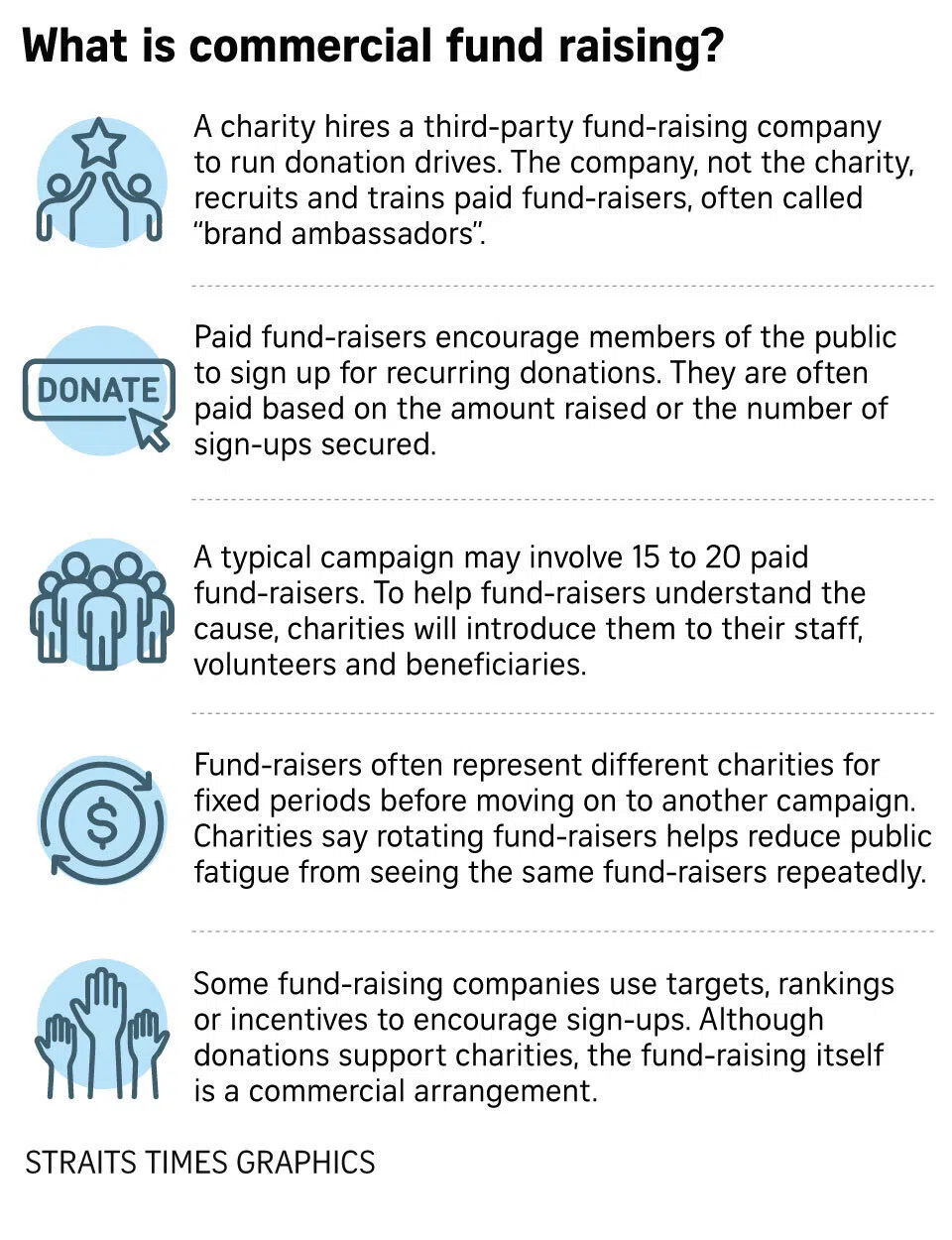
An executive at one such charity says that commercial fund-raising companies typically receive between 18% and 20% of the amount raised.
“In good times, donations can run into several million dollars,” says the executive, who asked not to be named. He acknowledges that commercial fund-raisers are often viewed with suspicion.
Some people see their tactics as guilt-tripping; others fear that donations are lining fund-raisers’ pockets rather than helping beneficiaries.
Nevertheless, the executive stresses that outsourcing fund raising is often the most cost-effective option.
“People do not realise something as simple as replying to an e-mail or confirming that a donation has been processed requires manpower, and not every charity can afford that.”
He elaborates that commercial fund-raisers hire individuals to approach passers-by in public areas and encourage them to make recurring donations.
These individuals are often paid based on the number of sign-ups secured or amount raised. A typical fund-raising campaign involves 15 to 20 of them.
Some commercial fund-raisers also use performance targets, rankings or incentives to motivate individual results.
The workers behind the tablets
For those doing the approaching, the work can be precarious.
A local freelance illustrator, who wishes to be known as Chan, spent four months as a paid fund-raiser in 2016, after graduating from polytechnic.
She found the role on an online job platform and was recruited by Appco, then part of Cobra Group. The business was acquired by SalesWorks Singapore in 2019.
Chan describes a tiered organisation headed by a chief manager, with several levels of managers below him. She reported to one whom she identifies only as L.
In her first two months, Chan and L’s other recruits sold home broadband services and mobile plans for two telecommunications companies. They were paid weekly on commission, based on the number of packages sold.
Most weeks, she says, she earned less than $100.
In her third month, she was reassigned to raise funds for a local charity. She recalls that 12.5% of every one-off or recurring donation formed a commission pool divided among the company, the chief manager, L and herself.
Performance is closely monitored through sales targets. High performers may recruit others, earn commissions and move into management roles.
“The company promised a lot: becoming your own boss, travelling overseas, retiring young,” Chan says. “It all boiled down to enduring hardship now and getting rich later... It keeps scaling up until you can run your own office.”
According to her, a typical day starts with briefings, coaching and team chants. Shifts can run from 9am to 9pm or match shopping centre opening hours.
Although breaks were allowed, paid fund-raisers were frequently encouraged to work weekends, sometimes seven days a week.
Despite being trained to approach strangers, sustain a conversation, secure a sale or donation, and handle rejection politely, she struggled to sign up donors.
“There were weeks when I earned nothing at all,” she says.
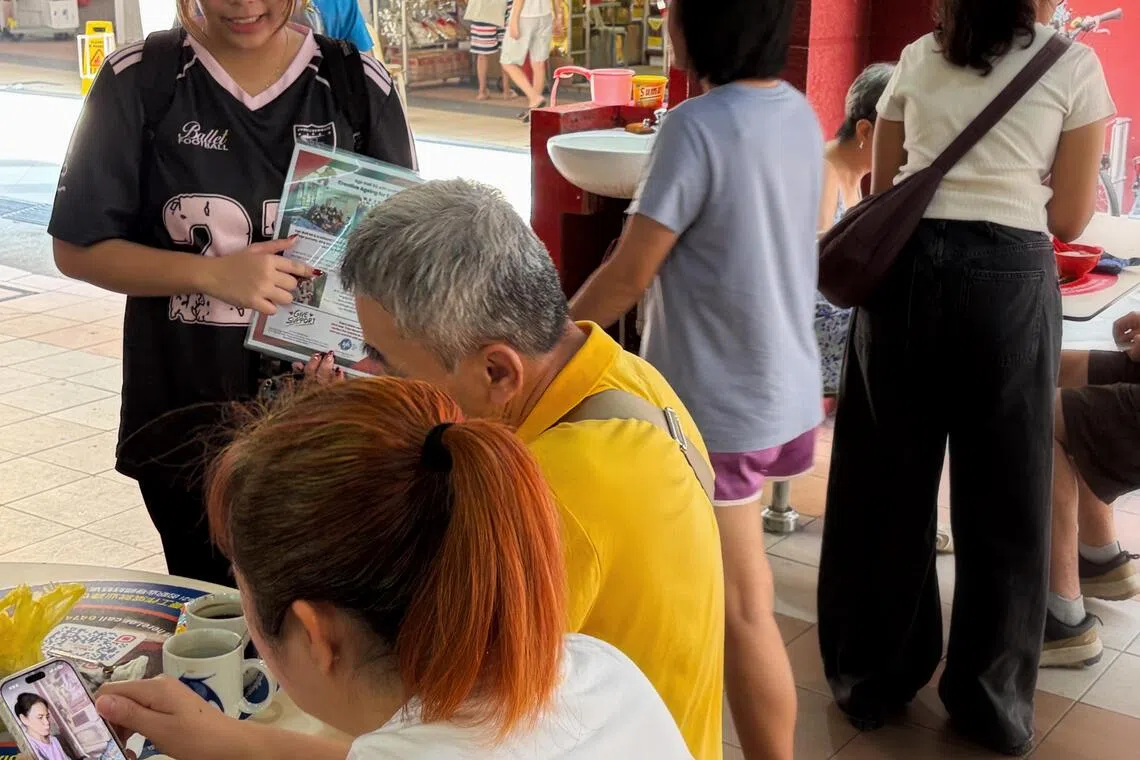
A woman seeking donations from members of the public at Kim Keat Palm Market & Food Centre in Toa Payoh.
ST PHOTO: KUA CHEE SIONG
Still, the job attracted young people with little experience of the working world, as well as older workers. Chan recalls a father who ranked among the top earners because he had a gift for talking to people.
Chan says she did not feel exploited. Fresh out of school, she had little basis for comparing the arrangement with other jobs.
On one exceptional day, a donor gave $10,000, generating an unusually large commission. Such windfalls were rare, however, underscoring the uncertainty of the work.
“I certainly do not want to work in sales again,” she says. “I will avoid it at all costs. How do you sell ‘charities’? It just felt transactional.”
A 2025 study led by SUSS associate professor Justina Tan examined how age and education shaped employment preferences.
It surveyed more than 1,000 Singapore citizens and permanent residents aged 18 to 35, with qualifications ranging from secondary school certificates to postgraduate degrees.
Among respondents aged 18 to 25 whose highest qualification was secondary education, flexible working arrangements ranked as the top consideration when choosing a job.
Commission-based roles can offer such flexibility, Justina Tan says, as well as the prospect of immediate payment.
Unlike workers in hourly paid jobs, who must keep fixed hours and wait until the end of the month for their wages, commission workers are usually paid within a much shorter period.
The promise of quick rewards can be appealing, she adds, particularly in a social-media culture that encourages instant gratification. Flexible work also allows people to juggle several jobs.
“If I do not earn money from this one, I can always do something else,” she says.
Some also find commission-based work genuinely rewarding. Paid fund raising requires them to engage with the public, persuade strangers and cope with rejection, experiences that routine hourly work may not offer.
But Justina Tan cautions that staying in such arrangements for too long could slow a worker’s development and leave the person at a disadvantage later.
“Human beings are creatures of habit,” she says. “If they can get by, they may simply stay where they are.”
When different appeals look alike
Regulated charity fund raising and private doorstep selling are not the same.
To members of the public, however, the encounters can look remarkably similar. A young stranger approaches, tells an emotive story and asks for money.
That overlap can make it harder for people to distinguish legitimate appeals from commercial sales approaches.
Professor Irene Ng of NUS’ Department of Social Work recalls opening her door to a woman and child who said they came from a low-income family and were selling ice cream for extra income.
The encounter stayed with her. Over the years, she has met others with similar stories.
“The most recent was a young girl,” Ng says. “The first thing she told me was: ‘I am 14 years old. I am selling ice cream because my parents said I need to earn my pocket money.’”
Others have sold small items or claimed to be paid fund-raisers for charities. At the doorstep, Ng says, it can be difficult to establish whether their claims are true.
If the stories are false, she worries that young people are being taught to lie for money. If they are true, she questions the ethics of using – or appearing to use – a young person’s hardship to elicit sympathy.
“Getting young people to tell sob stories and guilt-trip the public into buying something borders on a scam,” she says.
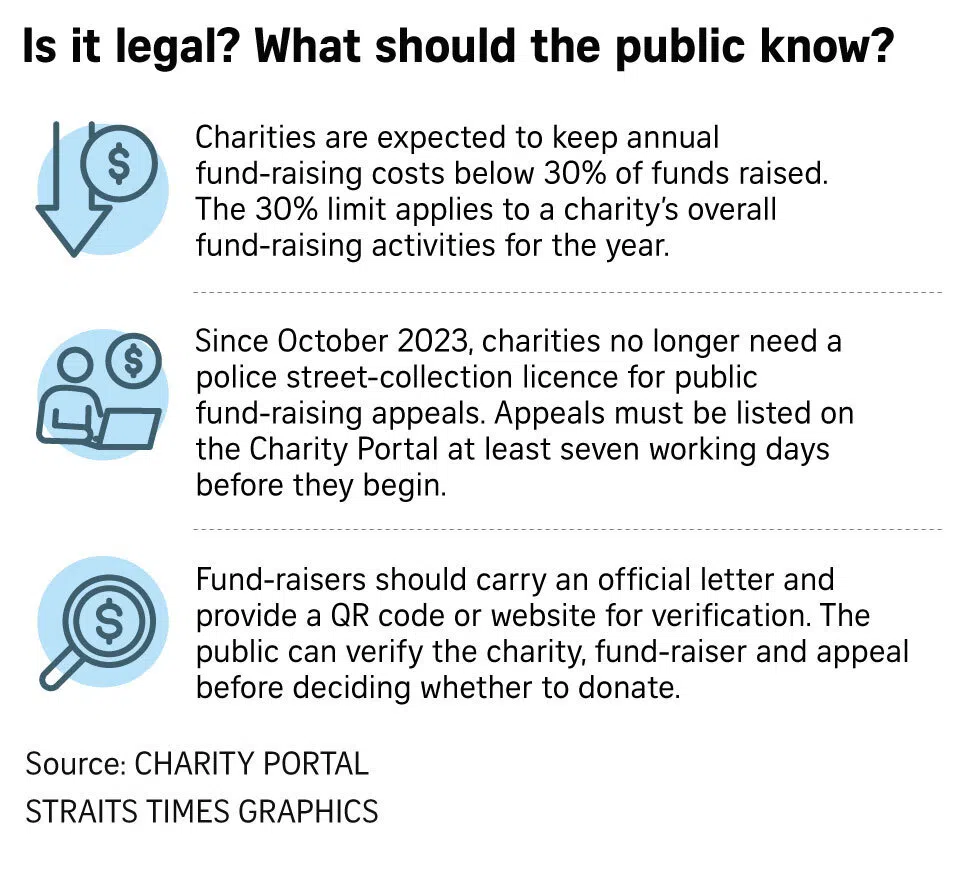
The legal distinction is important. A charity appeal involving the sale of goods is subject to fund-raising regulations, including the 30/70 rule. For such appeals, fund-raising receipts are generally calculated after deducting the cost of the goods.
But a person selling ice cream for a private company, or independently, is not conducting a charitable appeal merely because the sales pitch invokes hardship or sounds charitable.
Checks by ST found online advertisements for “brand ambassador” roles that revealed little beyond duties such as “increasing brand awareness”. One advertisement aimed at students directed applicants to contact a social media account listed on an accompanying poster.
ST reached out to local gig platform, Quest, after an online forum comment suggested door-to-door sale roles may be advertised there. The commenter said he was told the job was commission-based and preferred applicants aged 13 to 21.
Quest co-founder and CEO Evan Chow told ST via e-mail that the platform is meant for one-off tasks such as errands and creative work, and does not allow purely commission-based or potentially misleading listings.
Such posts are removed when identified and thus far, Quest has not received public complaints about similar cases. However, ST found at least six listings labelled “brand ambassador”, some repeatedly posted by the same user.
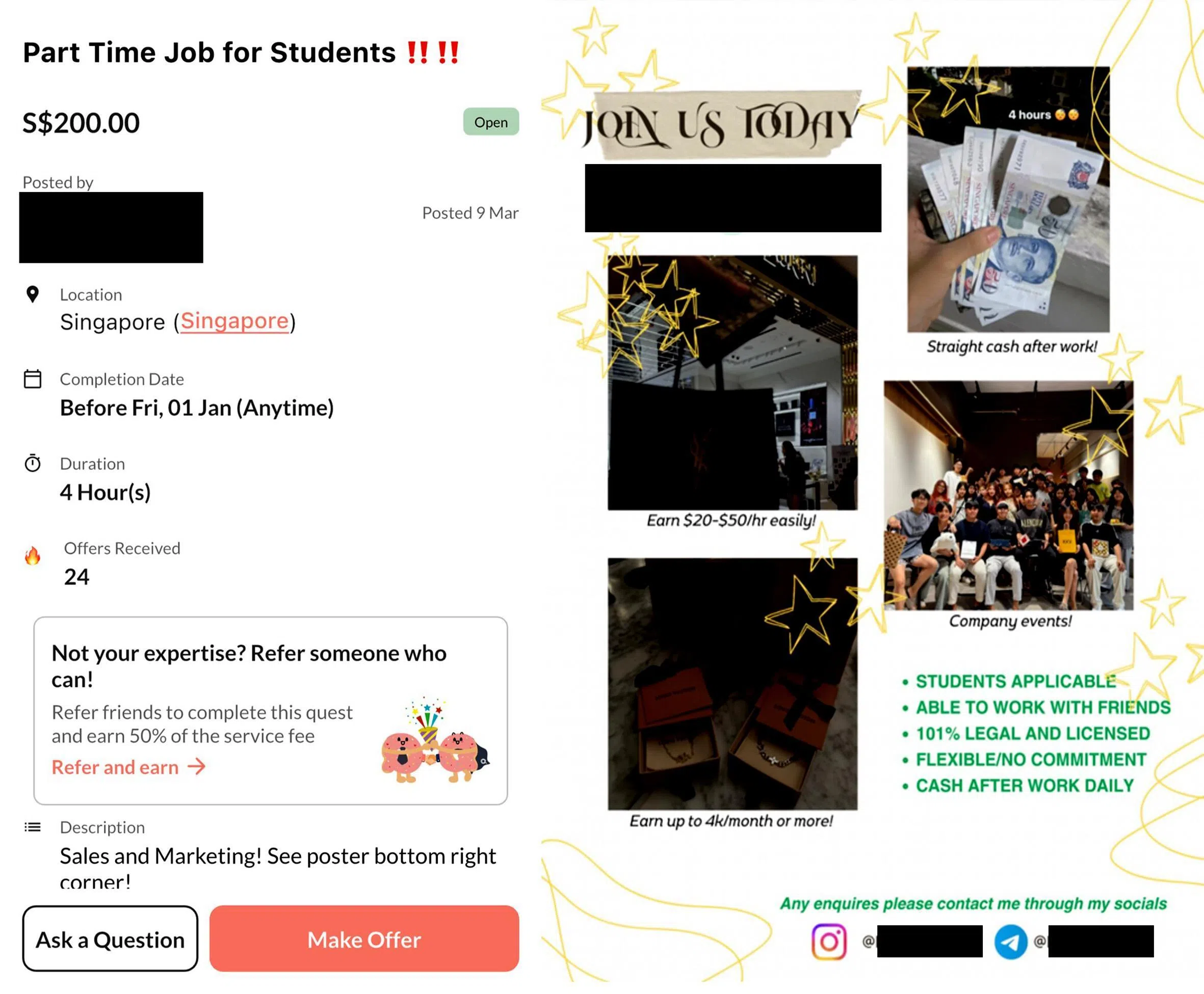
A job advertisement on a local gig-work platform targeted at students directed interested applicants to contact a social media account listed on an accompanying poster.
ST also contacted seven ice-cream wholesalers after online reviews alleged that young people were selling their products door to door at marked-up prices.
Three replied. One said it had not been affected. The other two were aware of such accounts but said they neither supplied ice cream to students or individuals nor endorsed street or doorstep sales.
One wholesaler, which declined to be named, says it has received complaints from members of the public and concerned parents for more than 12 years.
It supplies only licensed distributors and hawkers, and says internal checks found no evidence that it had sold ice cream to young people for large-scale resale.
A one-litre pack of traditional hawker-style ice cream typically costs between $5.50 and $7.90, depending on the brand and retailer, ST found.
The source of any particular doorstep operation may be difficult to establish. Suspicion, however, spreads easily, potentially affecting not only the seller involved, but also legitimate charities and fund-raisers who approach the public in similar ways.
“We believe greater public awareness and clearer guidelines would be helpful in addressing this issue,” one of the ice cream wholesalers says.
The COC receives about 80 feedback submissions a year on fund-raising conduct, charity governance and internal controls. These cover a range of concerns, not just complaints about commercial fund-raisers alone.
The agency advises people not to feel pressured to donate if they have doubts about an appeal. Suspicious activity can be reported to the COC, or to the police if fraud or a scam is suspected.
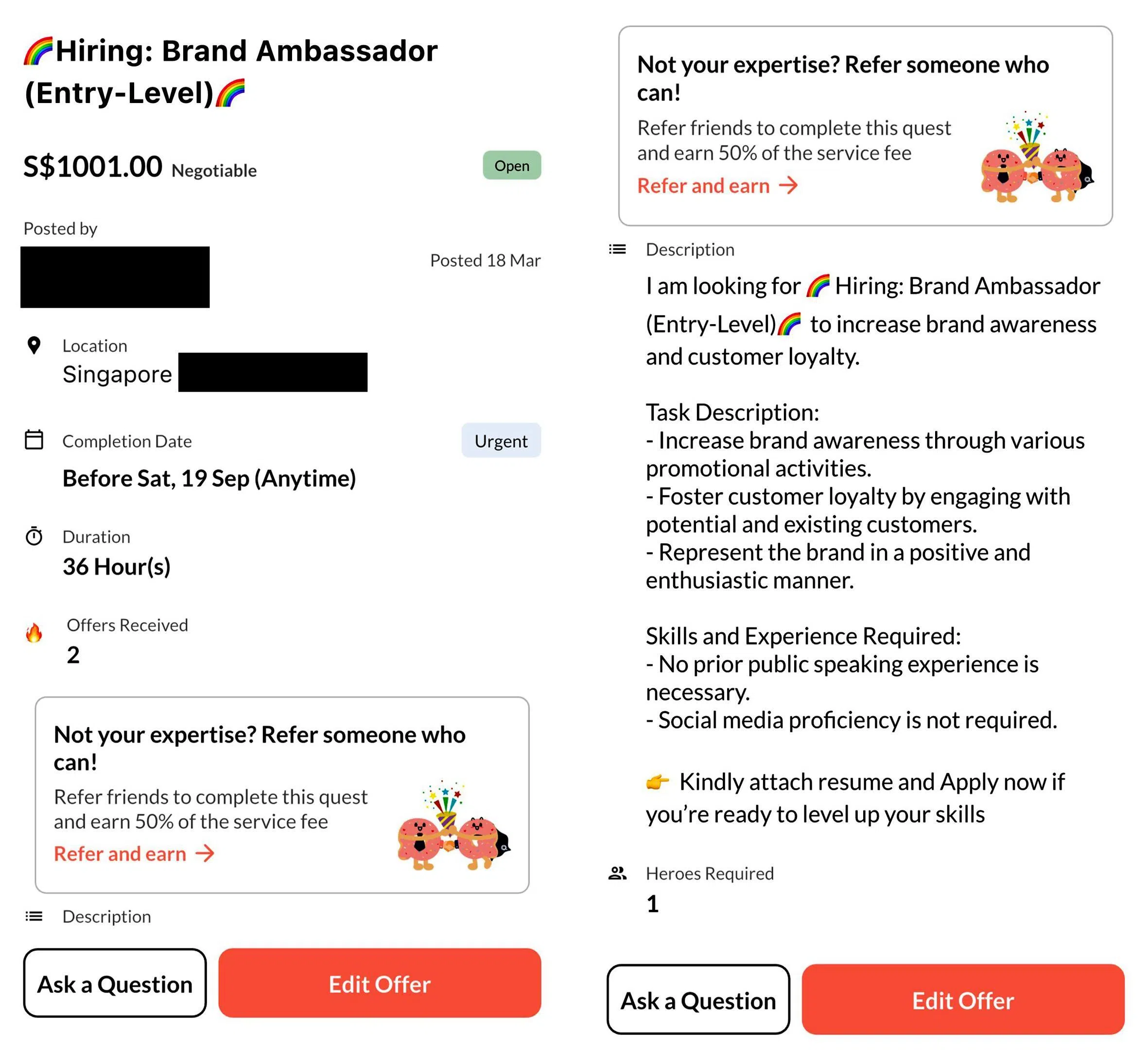
A job advertisement on a local gig-work platform for “brand ambassador” roles reveal little beyond duties such as “increasing brand awareness”.
Trust cannot be outsourced
That is the risk charities face. The harder it is for people to distinguish among volunteers, regulated commercial fund-raisers and unverified sellers, the more trust the sector stands to lose.
An unnamed former charity CEO says unverified sellers who present themselves as charities can taint the entire sector, especially when public anxiety over scams is high.
Outsourcing can be justified when it advances a charity’s mission, she says. But organisations remain responsible for ensuring that paid fund-raisers are properly trained, closely supervised and able to uphold their values.
“Only those who truly believe in the cause will stay,” she says of fund-raising work, including in-house roles. Charities must therefore keep investing in recruitment and retention, or face repeatedly training new staff.
Joanna Tan says the longer-term solution is for charities to strengthen their own fund-raising capabilities through clearer communication, stronger branding and greater transparency about how donations are used.
Online giving platforms have gained ground partly because they make the effect of a donation easy to understand, she says. Donors can see what $10 or $50 will pay for and who it will help.
“That is extremely powerful,” she says.
The aim is not to abolish face-to-face fund-raising, but to make it more accountable, transparent and closely connected to the cause it represents.

The Kidney Dialysis Foundation’s annual flag day.
PHOTO: KIDNEY DIALYSIS FOUNDATION
Joanna Tan suggests that charities tap senior corporate leaders as skilled volunteers to strengthen fund-raising, communications and donor management.
She adds: “More importantly, we need to understand how donors think and how that changes with society. We should not just ask for money, but involve people. Some may prefer to contribute their time and skills.”
For KDF volunteer Ng, Flag Day remains a meaningful cause. While some people avoided him when they saw the collection tin, he says the experience was rewarding overall.
He says: “Most of my friends and family were proud that my children and I volunteered together. Some even came down personally to donate. It felt like a well-spent afternoon, knowing we were helping needy dialysis patients.
“I hope people understand that giving back is not just for those with lots of free time or certain groups of people. If Singapore is to continue moving forward as a society, this should be part of everyone’s social responsibility.
“Small efforts, when combined, can make a huge difference. Volunteering and donating should be something we continue to make space for in our lives.”
KioskNews shows a cleaned-up reading view extracted from the publisher’s page — the original always lives on their site, not ours.