Notes from Central Taiwan: Beijing’s intimidation tactics in Taiwan and beyond
From surveillance of politicians’ families to threats against public figures, China’s pressure tactics seek to spread fear and silence dissent
By Michael Turton / Contributing reporter


Cognitive warfare, says the Ministry of National Defense (MND), is the People’s Republic of China’s (PRC) use of “political, economic, cultural, military and legal means, with the intent to divide internal unity and undermine social stability” in Taiwan. Last week offered several examples.
PRC media in October last year reported that the Chongqing Municipal Public Security Bureau had opened an investigation into Democratic Progressive Party (DPP) Legislator Puma Shen (沈伯洋), the DPP’s mayoral candidate for Taipei in next month’s election, for “Taiwan independence” activities. This was a cognitive warfare ploy, designed to unsettle the targeted person and to establish the idea that it has legal jurisdiction over Taiwan and its people.
Last week Taipei prosecutors argued for an 18-month prison term for a private investigator Cheng Yung-chin (鄭永津), who was charged with violations of the Personal Data Protection Act (個人資料保護法), along with fellow investigator Hsieh Yi-chen (謝乙辰) and two others over the surveillance of Shen. Cheng was said to have accepted NT$360,000 (US$11,299) from two Hong Kong residents to surveil Shen.

Puma Shen, a Democratic Progressive Party (DPP) lawmaker and candidate for Taipei mayor, on Wednesday campaigns in Taipei City.
Photo: Tien Yu-hwa, Taipei Times
The purpose of this steady drip-drip of PRC threats (recall that PRC officials have said that Taiwan independence activists will be imprisoned) against Shen is intended to instill fear into the candidate. It is also intended to put pressure on others who might be tempted to adopt his political stances.
Another kind of warning was also the subject of a trial last week. Japanese activist in Taiwan Yaita Akio, who was attacked in Taichung in July, said on Twitter that the Taichung District Prosecutors Office was seeking a five-year sentence for the perpetrator, Liao Gangfa (廖港發), after finishing their investigation. The Taichung District Prosecutors’ Office indicted Liao on Tuesday on charges of assault, public insult and participation in a criminal organization.
TRANSNATIONAL PRC REPRESSION
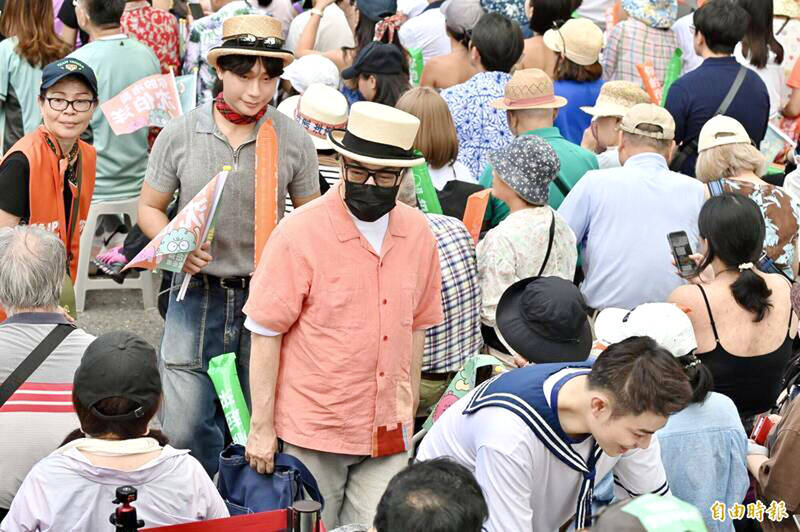
Taiwanese television host Kevin Tsai, center in orange shirt, attends a campaign event for Democratic Progressive Party Taipei mayoral candidate Puma Shen in Taipei on Sunday. A PRC-military-affiliated account, called Junzhengping, attacked Tsai on social media appeared to accused him of “reaping profits in mainland China while flirting with Taiwan independence,” saying people like him would “pay an unbearable price.”
Photo: George Tsorng, Taipei Times
Yaita said that violence on the PRC’s behalf is occurring regularly in democratic countries. He pointed to the surveilling of the son of President William Lai (賴清德) in the US, the attack on a Chinese restaurant named “Xi Jinping” in South Korea (vandalized by four Chinese nationals) and the vandalism against the Kami Comedy Club because a performer had publicly mocked PRC dictator Xi Jinping (習近平). He could have added a string of other incidents, including the planned ramming attack on the car of Taiwan Vice President Hsiao Bi-khim (蕭美琴) in Prague in March of 2024.
All of this is a form of cognitive warfare, designed to suppress speech and actions inimical to PRC imperialism against Taiwan, and fill the targets with anxiety and fear.
This month also saw the US arrest of a woman acting as an unregistered agent of China and surveilling President Lai’s son and his family near Seattle in September last year. It was amusing to watch pro-PRC types on Twitter claim that the purpose of the surveillance was to highlight the fact that Lai’s son lives in the US (a common issue with Taiwan’s elites is that their children are citizens of other countries). But the PRC’s allies in Taiwan, the Chinese Nationalist Party (KMT) and its sock puppet, the Taiwan People’s Party (TPP), have already done that. It is a staple of their election attacks on Lai.
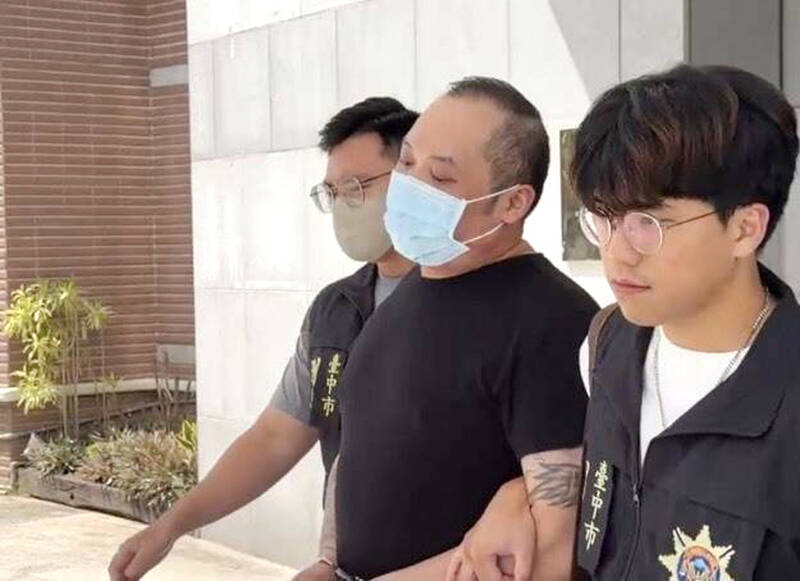
Police escort a Chinese suspect surnamed Liao, center, to the Taichung District Prosecutors’ Office on July 7 after he allegedly assaulted Japanese activist in Taiwan Yaita Akio. Liao was indicted on Tuesday.
Photo: Hsu Kuo-chen, Taipei Times
Hence, the claim that the surveillance existed to highlight where Lai’s son lives was itself a form of cognitive warfare. It was designed to conceal and downplay the actual reason for the surveillance by shifting the issue to what Lai was doing, not on what the PRC was doing.
The purpose of the surveillance was simple, though many commentators who do not have children did not get it: nothing messes with a target’s head more than threats to their children. I know this from personal experience, as my children were regular targets of threats in my blogging days. The surveillance existed to remind Lai that his children could easily be targeted, to stress him out with fear and anxiety. Action against leaders’ children, from medieval kidnapping of Kings’ sons through George Washington’s authorized but abandoned plot to have Prince William kidnapped in 1782, to the 1944 German kidnapping of the son of Hungarian Dictator Miklos Horthy to force Hungary to stay in the war on the German side, is a common policy in history.
Lai is well aware of the leverage his son represents. It should be noted that the team hired to surveil Puma Shen also tracked his daughter’s movements.
PRC COGNITIVE WARFARE IN TAIWAN
Television host Kevin Tsai (蔡康永) appeared to be the target of cognitive warfare last week. A PRC-military-affiliated account, called “Junzhengping” (鈞正平), attacked Tsai on social media after he attended the opening of Puma Shen’s campaign headquarters on Sunday. The post, though it did not attack Tsai by named, appeared to accused him of “reaping profits in mainland China while flirting with Taiwan independence,” saying people like him would “pay an unbearable price.” The attack, along with other social media comments, suggests that the PRC may leverage Taiwanese business activities in the PRC to silence them.
The staunchly pro-KMT United Daily News (UDN) put out a commentary warning that Tsai could face “dual political and social death” in the PRC, showing how the local pro-PRC papers are quick to reinforce the latest Beijing cognitive warfare claims. UDN later took down the commentary.
Another element of Beijing’s cognitive warfare was on display in a South China Morning Post article on how Beijing would govern a post-annexation Taiwan (Amber Wang, “Beijing’s policy advisers map out how post-reunification Taiwan could be governed,” Oct. 6, 2026). The piece mapped out various policy proposals by PRC “scholars.” The key point of the piece from the cognitive warfare perspective is the continuing insistence that Taiwan will be governed as Hong Kong is. Thus, anyone forwarding a comparison of annexed Taiwan to current Hong Kong is forwarding PRC propaganda.
The major goal of PRC cognitive warfare is to get Taiwan to surrender without a fight. It has two main axes of attack. On one hand the PRC insists that annexation is inevitable, that PRC power is overwhelming and will continue to grow, and that Taiwan has no chance of resistance. On the other hand, it dangles the possibility that annexation will not be so bad — if accepted without resistance, the PRC “scholars” say, it can be like Hong Kong. The SCMP article followed that latter approach, saying that Taiwan’s future status under PRC control will depend on how much resistance there is to annexation.
The reality, as many have noted, is that PRC promises cannot be trusted. Moreover, the proper model for Taiwan governance by the PRC isn’t Hong Kong but its treatment of the other would-be nations it has subjugated, Tibet and East Turkestan (Xinjiang).
The idea that these ideas come from “scholars” also provides them with a veneer of legitimacy that will enable actual scholars and journalists to comment on them as if they were sincere and not propaganda, helping to further spread them. Of course, they also plausibly buttress the nattering of PRC supporters and shills who claim that Taiwan will be in the same position as Hong Kong — assuming they “make a deal” — just surrender by another name.
Notes from Central Taiwan is a column written by long-term resident Michael Turton, who provides incisive commentary informed by three decades of living in and writing about his adoptive country. The views expressed here are his own.
KioskNews shows a cleaned-up reading view extracted from the publisher’s page — the original always lives on their site, not ours.