Milei’s reform to suspend primary elections overcomes key hurdle
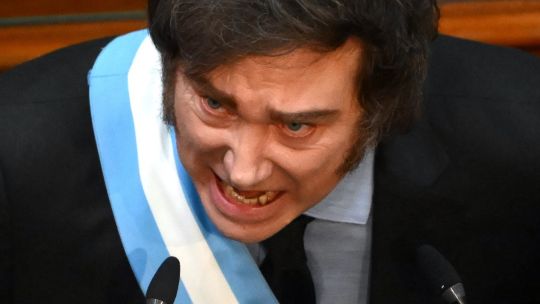
President Javier Milei’s bill to suspend primary elections next year cleared a Senate committee after months on ice, a move he hopes will boost his chances to win re-election against a fragmented opposition.
The Senate’s Constitutional Affairs Committee approved the measure with 11 signatures Wednesday afternoon, out of 19 members. The full Senate is scheduled to vote on the electoral reform next Thursday, and Milei’s party believes it has the votes to pass, according to two lawmakers from the libertarian’s party who asked not to be identified discussing expectations.
Foreign investors are closely watching the legislation as a barometer of Milei’s path to re-election as well as a sign of governability. Concerns over Milei’s stalled legislative agenda in recent months contributed to Argentina’s sovereign bonds posting one of the worst performances in emerging markets.
Argentina’s primaries, or PASO, have triggered market selloffs in both of the past presidential election cycles in 2019 and 2023 due to unexpected results, including Milei’s own shocking win three years ago. The fallout from both votes spurred a surge of inflation that cemented the incumbent’s loss.
Without an August primary, Milei would buy time and force his rivals, the divided Peronist party, to choose its candidate instead of an election deciding. Argentina’s primaries are non-binding, acting as a national survey for all parties at once since voting is obligatory.
The original bill, which sought to permanently eliminate the primaries altogether, was sent to Congress in April, but until now it had become emblematic of Milei’s stalled legislative agenda amid a corruption scandal, slower growth and sticky inflation.
Milei’s approval ratings have struggled against that backdrop, falling to 36 percent in October, as rising unemployment ranks as voters’ top concern.
To regain legislative momentum, Milei got crucial support earlier this week when former president Mauricio Macri’s PRO party announced it would support the electoral reform.
The PASO hurdle also lifts some pressure off Patricia Bullrich, Milei’s top senator and a former presidential contender, who sought to deflect blame in recent months for the lack of votes. In Argentina, governors often control how senators or representatives vote in the National Congress, which partly put the responsibility on Cabinet Chief Diego Santilli to secure the necessary support.
The main Peronist opposition party, meanwhile, is split between Governor Axel Kicillof and Sergio Massa, who lost to Milei in 2023 while he also served as economy minister. A primary allows voters to settle that internal dispute between Kicillof and Massa.
Without one, the deeply fractured movement would have to decide on a presidential candidate through negotiations among its competing factions.
Some investors see that division as potentially benefiting Milei. In the official elections scheduled for October 2027, Argentina’s Constitution allows a presidential candidate to win in the first round with at least 40 percent of the votes and a margin of more than 10 percentage points over the runner-up.
KioskNews shows a cleaned-up reading view extracted from the publisher’s page — the original always lives on their site, not ours.