Nearly 3-fold jump in serious adverse events caused by medical devices: New data
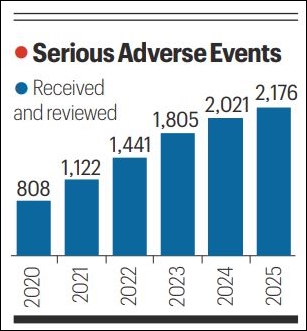
The Indian Pharmacopoeia Commission (IPC) has, for the first time, disclosed the number of Serious Adverse Events (SAEs) caused by the use of medical devices in the country since 2020: 9,373, with a nearly three-fold jump across six years, from 808 to 2,176 in 2025.
SAEs are medical events that may result in life-threatening conditions or prolonged hospitalisation for patients. The Indian Express accessed the data on October 27 following a part-compliance order issued under the RTI Act by a bench of the Central Information Commission (CIC) on September 10. The data (see chart) relates to the volume of SAEs “received and reviewed” by the IPC, which is an autonomous Central body that publishes official standards for drugs.
The IPC has been providing the number of Medical Device Adverse Events (MDAEs) logged in 775 monitoring centres located across the country in its annual reports, while keeping the figures for SAEs as restricted information.
The reports for the last three years, for instance, provide the broad figures for MDAEs but with “serious” events not categorised separately. The items flagged under “suspected devices” in these reports include relatively minor articles, too, such as surgical gloves, syringes, urine bags — and, in the 2022-2023 report, even a male condom that was listed as a “counterfeit device”.
In the 11-page order for data on SAEs, following an appeal by this newspaper, Information Commissioner Jaya Varma Sinha cited the plea by the IPC that public disclosure of the category of medical device involved and its manufacturer would be a violation of “commercial confidence”.
The order stated that brand details and a description of every medical device for which an MDAE has been logged could not be disclosed since “it is not conclusively established whether they arose due to a procedural lapse or due to the medical device itself”.
The IPC’s plea before the CIC stated that “the information sought regarding the name of the manufacturer of the medical device is exempted from disclosure under Section 8(1)(d) of the RTI Act, 2005, as it relates to commercial confidence and third-party information, the disclosure of which may harm the competitive position of the concerned entity”.
Story continues below this ad
In 2018, as part of Implant Files, the investigative series on the medical devices industry and its nexus with doctors and hospitals, The Indian Express first reported on the categorisation of MDAEs, which showed that coronary stents manufactured by the pharma major Abbott accounted for over 50 per cent of the entries. In all, 566 MDAEs had been logged that year, 290 of them for the coronary stents of the global major. Abbott had said at the time that its stents were recognised as “among the world’s most used and studied” with “an unparalleled safety record”.
The Indian Express subsequently filed several RTI requests for an update of the 2018 dataset, but the information was denied, citing provisions of the Act. The six-year dataset was released following a final appeal filed by this newspaper before the CIC in 2025.
The IPC contended before the CIC bench that details such as category and manufacturer of each and every MDAE were “too voluminous” and that their dissemination “requires collection and collation which would divert the time and resources of the public authority”.
According to the IPC’s annual reports, it logged 14,584 MDAEs for the financial year 2024-2025, with only 22 cases forwarded to the Central Drugs Standard Control Organisation (CDSCO) for “necessary action”. The list of 22 “suspected devices” mainly comprised items such as surgical gloves, syringes and urine bags along with one instance each of a mechanical ventilator and blood transfusion set.
Story continues below this ad
Similarly, for 2023-2024, the IPC listed 10,269 MDAEs, forwarding a list of only 16 cases to the CDSCO. This list contains “suspected” faulty medical devices, such as pregnancy test kits, catheters and BP monitors, and one instance of a drug-eluting stent.
A total of 3,868 MDAEs were listed for 2022-2023, when 12 cases were forwarded to CDSCO, along with one case of a “suspect” inhaler, an incubator and a coronary stent. The 12 “suspect” medical devices that required “further action”, the IPC committee said, included a male condom.
The compilation of MDAEs is done by the IPC under the Materiovigilance Programme of India (MvPI) launched in 2015. The IPC has developed the Adverse Drug Monitoring System (ADRMS), an online portal to streamline reporting of adverse events related to medical devices. All SAEs are required to be reported to the IPC within 15 days, with global norms requiring that it be classified as “serious” if the event leads to death, extended hospitalisation, life-threatening situation and disability, among others.
At the global level, for instance, the USA has the Manufacturer and User Facility Device Experience (MAUDE) database, a public repository that contains reports of adverse events and problems associated with all categories of medical devices. It contains granular information on medical device-related deaths and injuries, and allows users to access details such as brand, manufacturer, model and type of adverse event reported.
KioskNews shows a cleaned-up reading view extracted from the publisher’s page — the original always lives on their site, not ours.