Barkly jags rich rare earths across 23km in NT
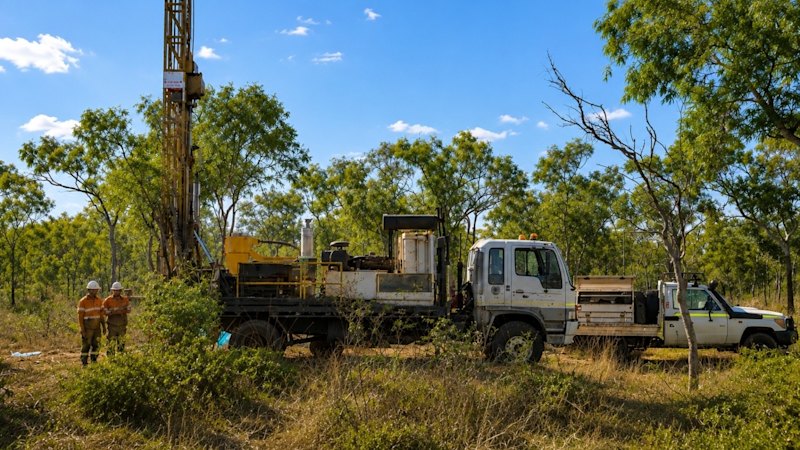
In what can only be described as a stellar assay-results debut, Barkly Rare Earths has hit significant rare earths mineralisation in every one of the first 28 holes assayed from a maiden drilling campaign at its flagship Barkly project in the Northern Territory.
Results from the company’s 10,000-metre phase one resource expansion program have confirmed a massive, shallow, flat-lying mineralised system, with significant intercepts returned from holes drilled up to 23 kilometres apart, flagging the system’s huge potential size.
The campaign is geared towards testing extensions to Barkly’s existing 40-million-tonne inferred mineral resource, which grades 2100 parts per million (ppm) total rare earth oxides (TREO). Based on these first numbers, it appears to be well on its way. Intriguingly, the current resource is largely split between northern and southern deposits, leaving almost 15km of virtually untouched ground in between for the drill bit to put to the truth detector. That sizeable gap helps explain Barkly’s lofty exploration target of 200 million to one billion tonnes grading between 1600ppm and 1900ppm TREO.
Highlights from the first batch of assays include a 2-metre hit grading 2716 ppm TREO from just 11m, featuring a higher-grade 0.5-metre core assaying an impressive 6064 ppm TREO. Another hole returned a 1.5-metre section grading 3228 ppm TREO from 15m, including a 0.5-metre interval at a solid 5170 ppm TREO.
‘Our ambition is to define a large-scale, high-grade resource.’
Barkly Rare Earths managing director Craig Wright
Notably, the mineralisation is not only high-grade but also rich in the valuable magnet rare earth oxides (MREO), which currently make up 34 per cent of the company’s inferred mineral resource of TREO. The MREO include yttrium, neodymium, praseodymium, terbium and dysprosium, some of the most sought-after of the 17 rare earth elements. They are essential for manufacturing high-strength permanent magnets used in electric vehicles and wind turbines.
In a stunning outcome, MREO made up a consistently high 31 to 40 per cent of the TREO in 27 of the 28 fresh intercepts.
The project itself is no run-of-the-mill sediment-hosted rare earths play, with mineralisation stretching through laterally extensive, near-horizontal Cretaceous sandstones and unusually tied to aluminium-phosphate-sulphate (APS) minerals.
Adding to the project’s appeal, the mineralisation starts at shallow depths, from as little as 3m below surface in some areas, pointing towards the potential for a simple, low-cost open pit mining operation. Furthermore, the company says concentrations of the deleterious radioactive elements uranium and thorium are consistently low, a significant advantage for processing and a key feature that distinguishes it from many hard rock rare earth deposits.
Barkly Rare Earths managing director Craig Wright said: “Twenty-eight holes assayed and twenty-eight intercepts — that is a very satisfying result, and the holes 23 km apart look like the same flat-lying horizon we mapped. Our ambition is to define a large-scale, high-grade resource, and results like these are why we are drilling another 300-plus holes.”
The company recently announced a stunning 99 per cent extraction of high-value MREO from a single-stage metallurgical test on material from its namesake project. The result was achieved using a simple initial caustic conversion followed by a hydrochloric acid leach.
Importantly, the test separated 92 per cent of the phosphorus impurities into the caustic solution, with no measurable rare earths detected, marking a significant technical win that could simplify and reduce the cost of downstream purification.
Barkly only listed on the ASX in January this year following an oversubscribed $8 million IPO. The company is now furiously drilling to deliver an updated mineral resource estimate by the end of the year.
The results come at a time when Western nations are scrambling to secure their own supplies of critical minerals and reduce their reliance on China. Beijing recently tightened its grip on the market by placing export controls on several key heavy rare earths, creating a perfect storm for explorers such as Barkly, as it chases what could emerge as a potentially globally significant deposit outside of China.
Barkly has drilled 68 holes to date, with assays from the first 28 now in. Samples from another 30 holes are currently at the laboratory, with a continuous flow of results expected through the final quarter of the year. The company plans to drill a further 300-plus holes to continue probing the extent of what appears to be a massive mineralised system.
With a 100 per cent strike rate from the get-go, a mineralised footprint that already stretches for tens of kilometres and the all-important magnet metals showing up in spades, Barkly has certainly hit the ground running. With hundreds more drill holes planned and assays from dozens more already in the lab, the company should be providing plenty of news flow to keep the market interested. If these early numbers are a sign of things to come, Barkly’s Northern Territory story could get interesting very quickly.
Is your ASX-listed company doing something interesting? Contact: mattbirney@bullsnbears.com.au
KioskNews shows a cleaned-up reading view extracted from the publisher’s page — the original always lives on their site, not ours.