Russia’s budget for defense to increase, social welfare to fall
Russia plans to sharply increase defense spending, cut funding for education and raise taxes next year as costs mount in its war with Ukraine, draft budget documents showed.
The plans have been submitted to Russia’s lower house of parliament for approval.
The government plans to spend a record 17.1 trillion rubles (US$204 billion) on defense next year, about 26 percent higher than last year’s forecast, the draft budget showed.
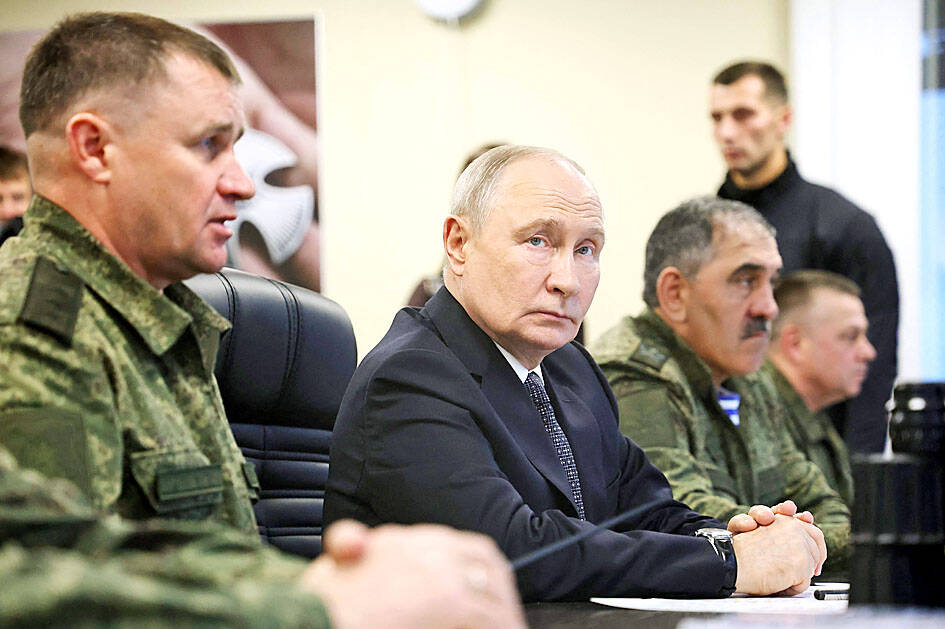
Russian President Vladimir Putin, center, looks on as he visits an observation post at the Chebarkulsky training ground in Russia on Friday.
Photo: AFP
Defense spending would account for more than one-third of all outlays and would be higher than spending earmarked for healthcare, education and social welfare combined, the documents showed.
While the documents forecast defense spending to decrease in 2028 and 2029, Russia has repeatedly overshot long-term defense spending forecasts since launching its Ukraine offensive.
Actual spending on defence is classified and could rise even further, Center for European Policy Analysis senior fellow Alexander Kolyandr said.
“The published totals are merely an opening bid in the negotiation between the finance ministry and the security establishment,” he said.
Unveiling the draft budget last week, Russian Minister of Finance Anton Siluanov described funding for social welfare and defense spending as a “priority,” but the documents show big cuts in non-military sectors, including social policy.
Planned outgoings on healthcare and education are set to drop by more than 5 percent each compared with the original plans, while funding on social programs are set to plunge by more than 6 percent.
Among the planned cuts are the federal government’s anti-cancer program, which is set to lose about 97 percent of its budgeted funding, the documents showed.
“The government is cutting back on civil servant pay and reducing their numbers, while slashing infrastructure projects, including construction and roadwork,” columnist Boris Grozovsky said.
To cover the shortfall, the government has proposed tax hikes, among them higher rates on bank deposits and property sales.
Russia has clocked a deficit each year since launching its Ukraine offensive.
Total shortfalls are estimated to be about 5.4 trillion rubles next year, more than 70 percent higher than the 3.2 trillion ruble deficit forecast last year.
State debt is set to rise above 20 percent of GDP next year, which is low for international standards, but above the level the finance ministry had previously described as “safe.”
Total government borrowing next year is estimated to be about 43 percent more than had been planned last year.
“There’s not enough money,” Grozovsky said. “The government is sending a signal to everyone: Don’t count on budget funds: they’ll go to those who absolutely must be given them.”
KioskNews shows a cleaned-up reading view extracted from the publisher’s page — the original always lives on their site, not ours.