The four schools that Melbourne parents, teachers and students rate highest
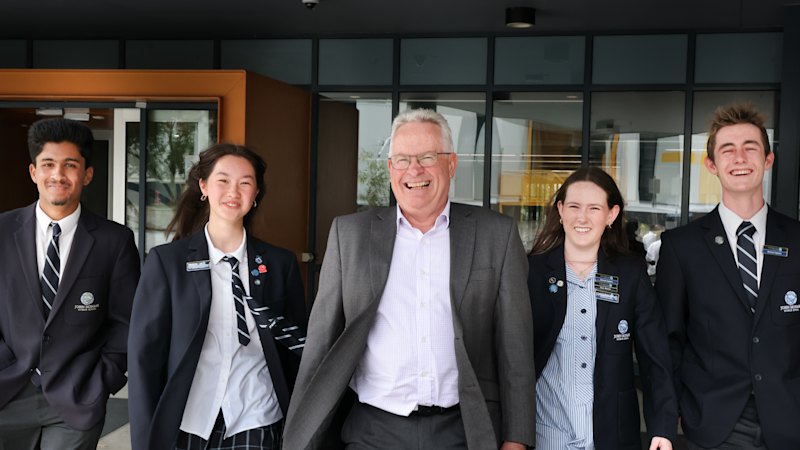
Two schools in Melbourne’s growth corridors and two selective schools have scored the highest on average across surveys of parents, students and staff.
Analysing the results of staff, parent and student surveys across more than 300 government secondary schools, this masthead found only four schools achieved results of higher than 75 out of 100 across all the three measures.
The schools were Alamanda K-9 College in Point Cook, Cranbourne West Secondary College, select-entry Nossal High School in Berwick, and specialist school John Monash Science School in Clayton.
Across all government secondary schools, about 50 per cent of student responses on average say their school is “good” or “very good”, while about 60 per cent of staff and 74 per cent of parents say the same.
There were two schools where parent and student survey results were above 75 per cent, but staff results did not reach the same level: select-entry boys school Melbourne High and Yuille Park Community College in Wendouree, near Ballarat.
The data also shows specialist campus Victorian College of the Arts Secondary School in Southbank is a unique case among government schools – its student connectedness result was above 75 per cent, but neither its staff or parent survey results reached the same threshold.
There were 16 schools where both parent satisfaction and staff endorsement survey results were above 75 per cent but student survey results did not reach this level, including Bayswater Secondary College, McKinnon Secondary College, Northern College of the Arts and Technology and Preston High School.
The Age’s analysis excludes secondary or combined government schools with student and staff numbers below a certain threshold. School-level data is unavailable for non-government schools. You can view the data for your school using our searchable tables included further down in this article.
John Monash Science School scored 92.8 for parental satisfaction, 79 per cent on the staff survey and a 77.1 per cent endorsement from students saying they feel connected.
The school’s results come back to its “team player” approach to learning, principal Andrew Chisholm said. Ninety-eight per cent of students enter STEM pathways – the main metric the school measures its success on.
“We wanted to try to remove the competitive elements that sometimes influence how students perceive VCE in particular because we’re only a year 10 to 12 school. So collaboration we view as particularly important,” Chisholm said.
“Our classes are team-taught, even specialist maths at year 12. It’s generally two teachers with 50 kids, and that also allows us to individualise some things for kids – there’s always another teacher there who can assist.”
He said this also helped teachers: “They can share the knowledge and the preparation, and they’re not just one person in one classroom by themselves.”
At Alamanda K-9 College in Point Cook, parents gave an 87.5 per cent satisfaction rating, teachers an 82.1 per cent rating, and students 82.5 per cent for connection.
The school’s principal Lyn Jobson said the school of 3335 students – which has seen the biggest raw growth in enrolments statewide in the past decade – went to great effort to make students, teachers and parents feel they were part of a whole-school family.
“It’s creating a sense of belonging in that people believe that we care about them. The parent results are always influenced by what the student results are,” said Jobson, who has temporarily stepped away from her role on personal leave.
“And the priority we have and have always had at the school, and it’s an old-fashioned term, is the kids are front and centre.”
The school is putting effort into maintaining contact with alumni, which Jobson acknowledged is not always the case for government schools. “They’re proud of their time at the school and they enjoyed it and it was beneficial to them in their life. So why would you give that up?”
Jobson reinforces to teachers that they influence student lives, and the school’s success is due to their efforts.
“They’re not just the staff, they are significant people in these students’ lives,” Jobson said. “We aim high all the time for our students. And we aim high because each one of the staff we have employed has the capacity to be highly successful educators.”
The Melbourne Archdiocese Catholic Schools use a different survey to question staff, families and students, and therefore results are not comparable with government schools.
On average, teachers give a 74.3 per cent rating of their relationships with school leadership. Overall students rate their sense of physical and psychological safety at school at 55.1 per cent, up 2.3 per cent in the past three years.
Independent Schools Victoria’s survey, which private schools voluntarily participate in, shows staff satisfaction rose 2.77 per cent, student connection 2.12 per cent and parent satisfaction 2.08 per cent between 2024 and 2025.
Start the day with a summary of the day’s most important and interesting stories, analysis and insights. Sign up for our Morning Edition newsletter.
KioskNews shows a cleaned-up reading view extracted from the publisher’s page — the original always lives on their site, not ours.