Why a ‘confrontational posture’ won’t help China in the Arctic
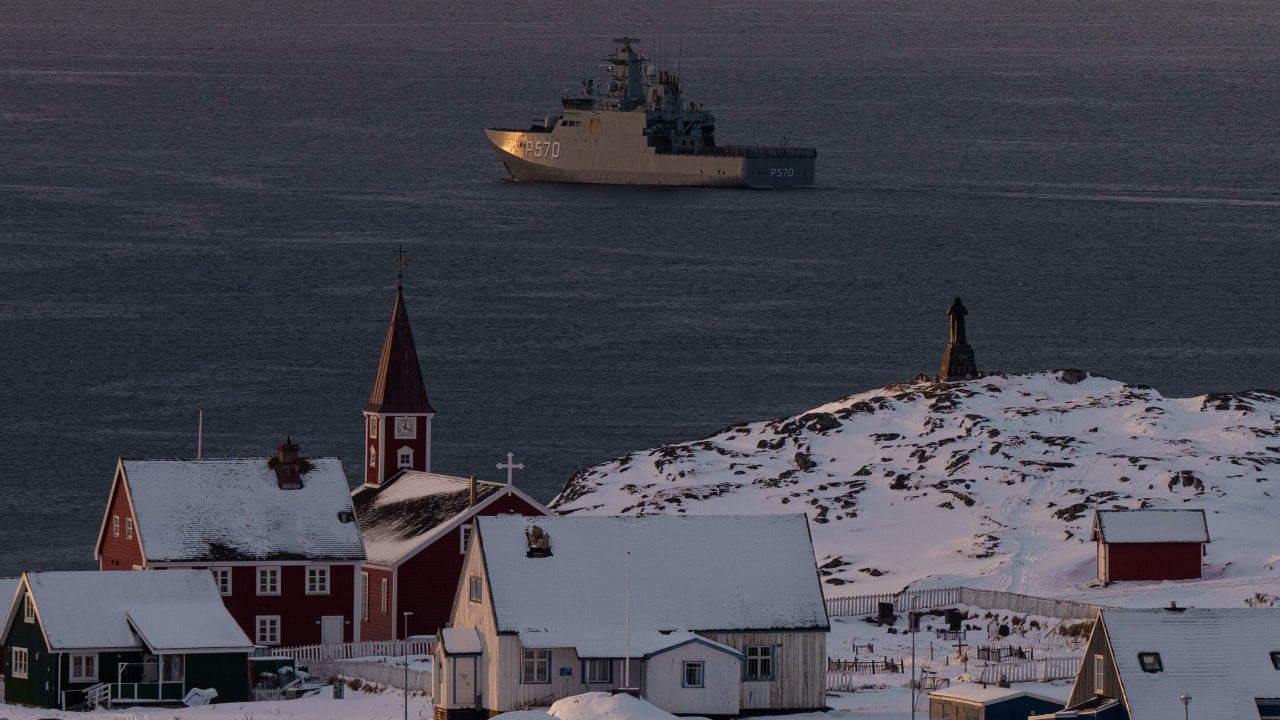
China should avoid taking a “confrontational posture” over a new security pact between the United States, Denmark and Greenland as it might end up being excluded from engagement on the emerging Arctic order.
That was the warning from Shanghai Jiao Tong University’s National Institute of Strategic Studies (NISS), a Chinese think tank, in a report released on Wednesday.
It also said the US was unlikely to turn the northern polar region into its “exclusive strategic backyard”. The report noted that Russia as well as America’s Nato allies including Canada and European nations could constrain how far a “northward Monroe Doctrine” would go.
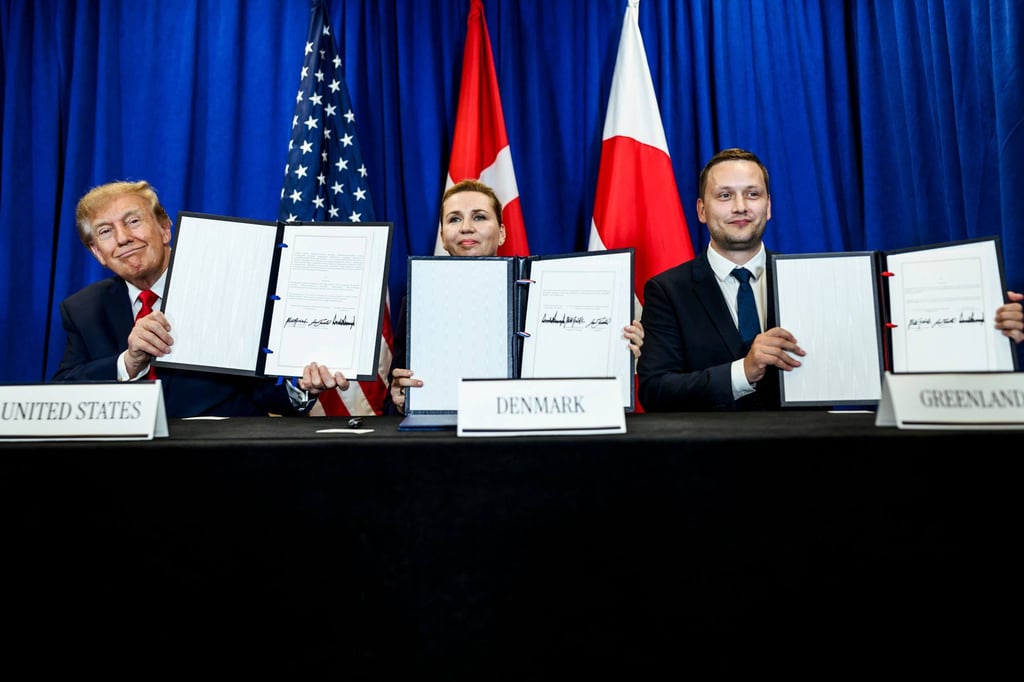
The new pact signed by the US, Denmark and Greenland on September 22 allows America to establish two new military bases in Greenland and gives it a formal say in vetting foreign investment in “sensitive” sectors on the world’s largest island, an autonomous Danish territory. Those sectors include but are not limited to critical infrastructure and resource extraction.
The deal also bans states outside the Nato transatlantic security alliance from establishing military installations or deploying troops in Greenland without the consent of all three parties.
Observers have said the agreement could have an impact on Beijing’s engagement in the Arctic because its activities in the region could face more scrutiny, while its efforts to develop polar shipping routes could be challenged.
The NISS report echoed those views, saying that the deal would raise the political bar for Chinese capital, research and infrastructure projects to enter parts of the Arctic.
“But China still has considerable policy space,” the institute said in the report, which was posted on social media.
It noted that the Greenland agreement would not alter the rights of countries outside the region to take part in scientific research, navigation and global governance in the Arctic under international law. It said the pact also did not empower the US to close off the Arctic Ocean’s high seas or legitimate international shipping lanes.
But the institute did caution against two “misjudgments” when assessing the impact of American policy on Chinese interests in the Arctic.
“First, overestimating the speed of ice melt and the commercial value of shipping routes, leading to duplicated investment,” the report said.
“Second, treating all Western restrictions as a denial of China’s legitimate rights and interests, thereby reinforcing the other side’s security concerns through a confrontational posture.”
Still, the report said China remained the extra-regional force that the US was “most explicitly” seeking to guard against in the Arctic.
The Donald Trump administration has designated the western hemisphere as Washington’s top foreign policy priority.
That approach was framed in the 2025 National Security Strategy as the “Trump Corollary to the Monroe Doctrine”, invoking a policy from more than 200 years ago that warned European powers against interfering in the affairs of the Americas.
Before the agreement was reached with Greenland and Denmark last month, Trump had repeatedly threatened to annex Greenland, citing national security concerns and the need to counter potential influence from Beijing and Moscow in the melting Arctic.
04:56
What are Trump’s motivations for wanting the US to take over Greenland?
Unlike the US and Russia, China is not an Arctic littoral state. Beijing described itself in a 2018 white paper as an “important stakeholder” in the region and a “near-Arctic state”.
The NISS report said the Greenland security deal was a sign that the Monroe Doctrine’s scope – which traditionally focused on Latin America – was extending further north.
“[Washington] is taking the Arctic as an extension of North America’s homeland security perimeter, using military denial, investment screening and alliance rules to restrict foreign activities at the northern end of the Americas,” the institute said.
“Greenland’s particular value lies precisely in the convergence there of minerals, infrastructure and Arctic-North Atlantic routes, making it the most direct intersection of resource security and military security in the US ‘northward Monroe Doctrine’.”
But the report also noted that the Arctic was not a no man’s land that the US could unilaterally carve up, and most of the land and offshore resources in the region were already subject to clearly defined sovereignty and jurisdiction.
“The ‘northward Monroe Doctrine’ also has clear limits,” it said.
The report was released a day before the Arctic Circle Assembly – the biggest annual international gathering on Arctic affairs – began in Reykjavik, Iceland on Thursday.
American activities in the Arctic and China’s role in the region’s affairs are both on the agenda at the conference, which runs until Saturday.
The Arctic has become a new flashpoint for great-power rivalry in recent years, as climate warming and record-low sea ice open the region to shipping and resource extraction.
In its report, the NISS said the Greenland deal was unlikely to change Russia’s established presence in the region, but it could help the US to restrict rival powers’ access to strategic space in the northern reaches of North America.
Russia has the world’s densest network of Arctic ports and the largest icebreaker fleet, while the Arctic shipping corridor known as the Northern Sea Route runs along its coast.
The report also pointed to Canada’s long-standing claim that another sea lane – the Northwest Passage – lies within its territorial waters, noting that Ottawa could be wary of Washington trying to dominate the Arctic.
In addition, the NISS noted that Finland, Sweden and Norway all had their own resource, shipping, local governance and security interests in the Arctic, and that they could seek to retain a degree of policy autonomy while maintaining security cooperation with the US under the Nato framework.
It also argued that, given the European Union’s increased investment in recent years in Greenland’s communications, energy, mining and infrastructure, it might be hard for the US to “unilaterally securitise” those areas in future.
“Russia’s coastal advantages, Canada’s sovereignty claims, the autonomous interests of the Nordics and the EU and China’s continued participation all limit the expansion space of the ‘northward Monroe Doctrine’,” the NISS said.
“The US can strengthen its influence on specific areas, but it will find it difficult to turn the entire Arctic into an exclusive strategic backyard.”
02:02
Chinese scientists conduct ‘crucial’ expedition in the Arctic Ocean
It said the key to China’s future policy on the Arctic would be improving scientific research and shipping, expanding industrial cooperation, taking part in multilateral rule-making and continuing Arctic engagement.
“[China should] avoid being excluded from the process of shaping the future Arctic order while respecting Arctic states’ sovereignty and local community interests,” the report concluded.
It said China should continue investing in areas including polar science, sea-ice forecasting and ecological monitoring, improve the foundations for its involvement in Arctic shipping, and increase the transparency of commercial projects.
The institute also called on Beijing to remain involved in setting international rules on Arctic shipping, fisheries, environmental protection and ocean governance.
KioskNews shows a cleaned-up reading view extracted from the publisher’s page — the original always lives on their site, not ours.