Carney says closer EU ties ‘about sovereignty,’ but here’s what being part of the EU could mean giving up
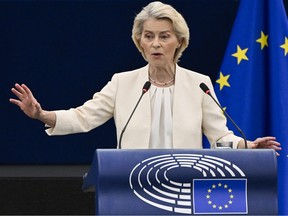
European Commission President Ursula von der Leyen promised to bring the EU’s relationship with Canada “to the highest level possible” in a speech on Wednesday, and said she wants to work with Prime Minister Mark Carney to make Canada an “associate member” of the 27-member bloc.
Sign In or Create an Account
The first-of-its-kind designation is the culmination of Carney’s year-plus effort to deepen engagement with Europe amid escalating U.S. tariff action against Canada.
Closer cooperation with the European Union could help Canada shift away from the U.S. but also give the European alliance more say in Canada’s decision-making process and policies.

Get a dash of perspective along with the trending news of the day in a very readable format.
By signing up you consent to receive the above newsletter from Postmedia Network Inc.
A welcome email is on its way. If you don't see it, please check your junk folder.
The next issue of NP Posted will soon be in your inbox.
We encountered an issue signing you up. Please try again
In his speech at the European Parliament on Thursday, Carney pitched the arrangement as being “about sovereignty; our ability to live as we wish.”
While we don’t know how the new Canada-EU partnership could work — and how Canadian laws would have to adapt — here’s what we know about what full members have had to give up in the past.
The EU requires free-flow of labour and open access to markets among its 27 member nations. It also includes border-free travel between 29 European countries, known as the Schengen Area. The alliance entered a monetary union with the introduction of the euro in 1999, which 21 of the 27 EU nations use.
Full members have access to a single, 18 trillion euro EU market, and have voting rights within the EU’s integrated decision-making body. This grants the EU significant negotiating leverage with trading partners and multinationals. However, this also significantly dilutes national interests of the member blocs.
The European Commission is the EU’s executive body, while the European Parliament functions as the lower house. Each member country elects a commissioner and minister to the governing bodies. The EU’s judicial courts, which also have a justice from each member, can overrule national courts where national interests come into conflict.
The EU also requires a joint action on a host of matters, including climate change, energy, AI and migration. The bloc also shares an agricultural agreement and subsidizes low-income farmers by roughly 55 billion euros per year.
The EU’s patchwork of regulations have long been called burdensome, with its rulebook, known as the acquis communautaire, totalling tens of thousands of pages. These regulations affect everything from security policy to taxation and social policy. A 2026 audit found that simplifying EU rules by 25 per cent for all businesses would save 37.5 billion euros per year.
The member states accede power to the EU on all matters related to customs, currency (in the case of the euro), fisheries and internal and international trade. This has kept countries like Switzerland and Norway from joining the EU, with Norway holding out due to the requirement that it grant EU members regulated fishing access to its waters.
EU countries pay approximately one per cent their gross national income to the European Union budget, which means larger nations pay out more than they receive in return. Net contributors Germany, Denmark, the Netherlands, Austria, Finland and Sweden have called for the EU to cut spending after it outlined a budget of €2 trillion for 2028 to 2034. The EU’s annual GDP has grown at a relatively staid 1.65 per cent from 1996 until 2026, according to Trading Economics.
The entry criteria for becoming an EU member country includes a requirement that candidates must be a “European State,” according to Article 49 of Treaty of the European Union. Additionally, the 1993 Copenhagen criteria states that the nation must respect democracy, free media, human rights, minority rights, rule of law and judicial independence. A country’s candidacy must be unanimously approved by the member countries. Morocco’s proposal to enter the EU failed because the country is located outside Europe, while Ukraine’s and Moldova’s entry into the alliance has been blocked by Hungary.
In extending her offer of associate membership to Canada in the European Parliament in Strasbourg, France, on Wednesday, von der Leyen said the EU and Canada “see the world with the same eyes, from AI to climate change, from the Arctic to geopolitics, and we have stood together on Ukraine, on defence, on raw materials and supply chains.” Carney also highlighted critical minerals, energy and security as other major aspects of the alliance.
Our website is the place for the latest breaking news, exclusive scoops, longreads and provocative commentary. Please bookmark nationalpost.com and sign up for our daily newsletter, Posted, here.
Join the Conversation
This website uses cookies to personalize your content (including ads), and allows us to analyze our traffic. Read more about cookies here. By continuing to use our site, you agree to our Terms of Use and Privacy Policy.
KioskNews shows a cleaned-up reading view extracted from the publisher’s page — the original always lives on their site, not ours.