To baldly go: Patrick Stewart was an icon for bald men everywhere

Patrick Stewart managed to be lots of different things at once. He was a towering figure on stage. He was a literal superhero onscreen. And, at times, he wasn’t above sending himself up. It also needs to be said that he was a bald man.
And a pioneering one at that. Nowhere was this more clear than during his stint on Star Trek: The Next Generation. Previously, Star Trek had been a kind of space-set action show, where the relentlessly virile Captain Kirk would beam down to new planets to either punch or get off with all the aliens there. But then came its successor, and Kirk was replaced by a nonviolent intellectual called Jean-Luc. Worse still, he didn’t have any hair. What a sign of weakness.
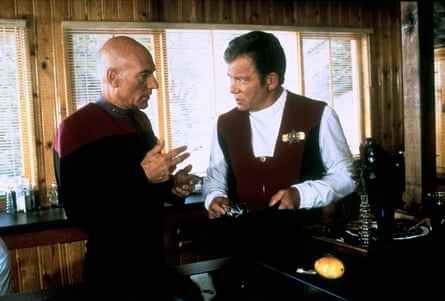
But Patrick Stewart made it work. Not only was his cool temperament a nice change of pace from the 1960s take, but his sex appeal was undeniable. Indeed, in 1992 TV Guide readers voted him television’s “most bodacious” man. Stewart received 54% of the vote, putting him ahead of much hairier contenders including Luke Perry and Burt Reynolds.
Not that he didn’t have his critics. When Picard’s casting was announced to the world, it is said that a reporter complained to Star Trek creator Gene Roddenberry that it didn’t make any sense. After all, the show was set in a future where space travel and teleportation were accepted as the norm, so wouldn’t it stand to reason that humanity would have created a cure for male pattern baldness? According to Stewart, Roddenberry’s response was that, by the 24th century, humanity will have evolved to the point where it no longer cares about baldness.
Stewart lost his hair in his teens, and was open about the effect this had on his psyche, telling Rolling Stone that he was so worried about how baldness might affect his love life that he spent more than he could afford on a wig. However, by ditching the hairpiece, Stewart became an icon for the bald.
When you lose your hair, you begin casting around for other bald men, because in a small way this helps normalise it. Stewart found himself a magnet for this, telling The New Yorker in 2023, “How many times have I been spoken to in the street by somebody who would pull off his cap, revealing a bald head, and say, ‘You saved my life!’”
Again, this is because Stewart was an exemplary bald. So often when men go bald they end up overcompensating by inflating themselves to preemptively ward off negative comments. Look at The Rock, and how much more aggressively he bulked out after he lost his hair. Look at Jeff Bezos, who reacted to baldness by pumping iron and building willy-shaped space rockets. Now compare this to Stewart, who pointed towards a different path of culture and elegance and refinement, embracing his baldness without ever apologising for it.
More than anything, though, you just have to look at the reactions to his death to see the real legacy of Patrick Stewart’s baldness. People were generally staggered to learn that he was 86 years old. This is because, as all bald people know, losing your hair ages you, but only temporarily. He was 47 years old when Star Trek: The Next Generation premiered in 1987, but he arguably looked a decade older than that. But then he carried on looking that age for decades afterwards. He didn’t go grey, or recede, or adopt an unflattering dye job, or any of the other things that makes men look old, because he didn’t have any hair. And unlike Captain Kirk, he never wore a high-end hairpiece. Patrick Stewart played the long game, and he won. O captain, my captain.
KioskNews shows a cleaned-up reading view extracted from the publisher’s page — the original always lives on their site, not ours.