2026 Elections: Shen and Chiang spar in public policy presentation
By Lee I-chia / Staff reporter, with CNA


In the first official policy presentation yesterday, front-runners in the Taipei mayoral race incumbent Chiang Wan-an (蔣萬安) of the Chinese Nationalist Party (KMT) focused on recounting his administration’s achievements over the past four years, while Democratic Progressive Party (DPP) mayoral candidate Puma Shen (沈伯洋) stressed city improvement and substantial support for residents.
Each of the six candidates were allowed 30 minutes to present their policy ideas, without cross-examination. Other candidates included Tang hsin-min (唐新民) of the Three Forces Solidarity Promotion Alliance, Hsiao Wen-chien (蕭文乾) of the MiLinguall Party, Kuo Hsi (郭璽) of the Taiwan Mahjong Greatest Party and independent candidate Lin Chih-cheng (林志成).
Shen talked about conceptual policies to help city residents save time, develop more space for activities, and support for the careers, health, childraising and urban renewal for residents.
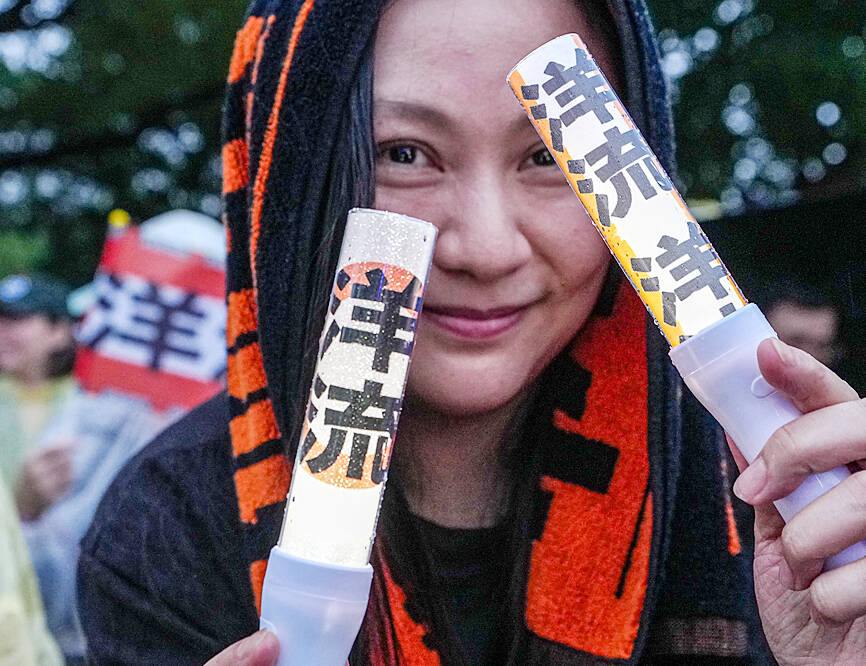
A supporter of Democratic Progressive Party’sTaipei mayoral candidate Puma Shen show off her campaign scarves and glow sticks bearing the slogan “Ocean Wave” at his “Taipei Current Festival” in Taipei yesterday.
Photo: CNA
He said that during a visit with former Taipei City Council speaker Chen Chien-chih (陳健治), Chen gave him three pieces of advice, which he has kept in mind — “taking responsibility” when engaging in politics, “[being] willing to communicate and listen” to integrate ideas and find solutions, and “being accommodating,” by not dismissing others with different opinions, because “a mayor must not only get work done, but actually achieve meaningful results.”
Shen recounted the achievements of former Taipei mayors, including widening of major roads, completion of the Feitsui Reservoir (翡翠水庫) and creation of Daan Forest Park, and said that if elected, he would build upon the infrastructure of his predecessors, but also repair and improve them.
He proposed setting up “sports stations” and building sustainable transportation networks to help people save time so they can exercise and spend more time with family; improve the city’s hiking trails and expanding greenery into the city with an urban micro-forest project; and connecting different cultural, shopping or historical areas with walkways and revitalizing public spaces.
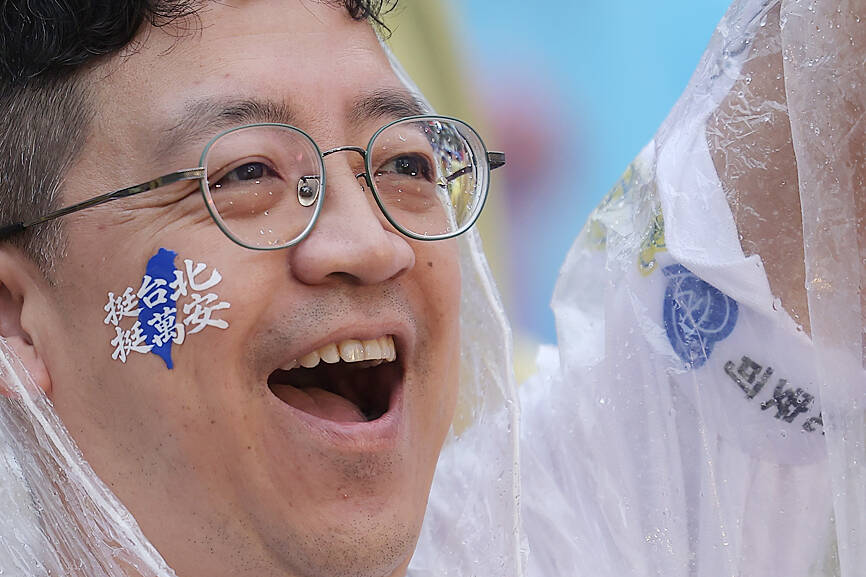
A person displays his support for Taipei mayor Chiang Wan-an with a “Support Taipei, Support Wan-an” sticker on his face during the “Safe Taipei, Together We Make It Happen” rally in Taipei yesterday.
Photo: CNA
Shen proposed a “parent-child pass” and extended eligibility for “culture coins” to encourage activity participation, accessible weight training courses for elderly people, support measures for youth entrepreneurship and midlife career changes, expanded subsidized mental health counseling sessions, a dedicated hotline for parents and a service team to help facilitate urban renewal projects.
Taipei is great, but it deserves to be even better, which requires change, and even a little step toward improvement can be a big step in changing Taipei, he said.
Quoting a line from Japanese manga Naruto “the fellow countrymen of the Konoha make up each part of my body… those of the village believe in me, and I believe in them,” Shen ended his presentation by saying that he hopes city residents allow him to carry their trust and together love and protect this homeland.
In the fourth slot, Chiang talked about his administration’s achievements in detail, focusing on easing citizens’ burdens and describing promises he made four years ago have turned into action.
Chiang listed achievements including removing scooters from sidewalks, adding pedestrian refuge islands, demolishing the Gongguan Traffic Circle to improve road safety, and also talked about plans to redesign roads to slow traffic within 50m of MRT exits to accommodate an aging society.
He credited former mayor Ko Wen-je’s (柯文哲) social housing groundwork for the success of his “Joyful Housing” program, which prioritizes newlyweds and families with children under the age of six, and said it would be expanded to single young people, students and people from other regions.
To accelerate urban renewal, Chiang proposed to lower the initial resident consent threshold from 75 percent to 50 percent, raise the base floor area ratio from 225 percent to 300 percent for large plots more than 3,000m2 near MRT stations and waterfronts, and hire more staff to expedite project reviews.
Chiang recounted his reduced working-hours and full-pay childcare initiative, which includes more than 480 companies, benefiting almost 900 employees, expanded temporary childcare services at 45 locations, and the establishment of a dedicated women’s and children’s hospital.
He also announced that he has a NT$9.2billion (US$280.16 million) artificial intelligence education plan to upgrade classrooms and establish Asia’s first AI education center, as well as plans to expand Senior Card benefits, health and travel subsidies for indigenous residents, and pet insurance subsidies.
Chiang said Taipei is a city of opportunity rather than a “political laboratory” for empty slogans or hatred, and that he urged voters to continue trusting him and firmly support his re-election.
KioskNews shows a cleaned-up reading view extracted from the publisher’s page — the original always lives on their site, not ours.