Israel's haredi and Arab voters reject political moderation in 2026 election - opinion
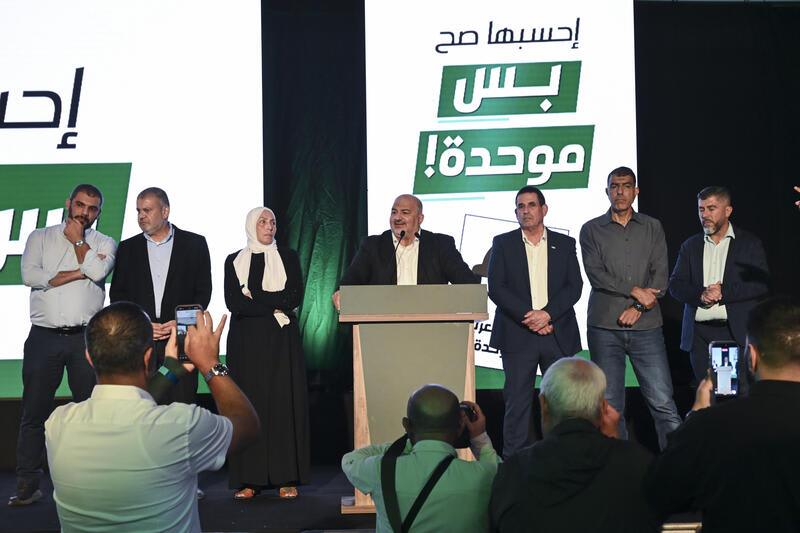
In an election defined by polarization, a handful of new parties tried to build bridges. Voters declined to cross them. From Moti Leitner’s moderate haredi (ultra-Orthodox) slate to Mansour Abbas’s pragmatic Arab one, the pitch was the same: a quiet majority in our community wants an in to Israeli society, on its own terms.
Leitner’s Haredi Public party promised to break the “fear barrier” on the ultra-Orthodox street. It backed core studies, workforce participation, and enlistment for those not learning full-time, and placed a woman, Nechumi Yaffe, third on its slate, a first for a haredi party.
Leitner claimed to speak for “tens of thousands” of haredim, and at one rally, put his support at 11% of the sector. He finished with roughly 9,700 votes.
Hopes of a shy-voter phenomenon proved unfounded. In Bnei Brak, the party took 758 votes; in Kiryat Vizhnitz, 11. In Alon Shvut it took 2.73%, in Matityahu 4.48%, and Efrat chipped in dozens across its neighborhoods. Leitner gathered his ballots on the fringes of religious Zionism, not on the haredi street. Haredi moderation, it turns out, is a religious Zionist aspiration more than a haredi reality.

Ra’am ran on a single, unglamorous message: ambivalent about Zionism, but unequivocal on bread and butter.
Many Israelis remain skeptical of Abbas’s moderation, but between the anti-Zionists of the Joint List and the agnostics of Ra’am, it is clear which was the moderate. To prove his determination, Abbas put former Yesh Atid lawmaker Yoav Segalovitz at number two on the list.
Ra’am gained two seats. But this gain was not a vindication.
The Arab parties swelled to a record 19 seats on turnout approaching 80%. Ra’am’s slice of that vote barely moved. Part of the problem is the packaging. Ra’am grew out of the southern branch of the Islamic Movement, and a pragmatic Islamist is still an Islamist.
That sells in the Negev, where Ra’am carried the Bedouin vote comfortably. It sells far less to Nazareth’s Christians, to secular professionals in the Galilee, or to a younger, more modern Arab middle class with no interest in a religious party.
Still, even if they disliked Islamism, when Arab voters turned out en masse, they did not even turn to the moderation of the Zionist Left. They turned to the hardline Joint List.
The hope both parties represented, a rising current of reasonable voters inside their sectors, has been dashed.
Perhaps the moderation current is real but simply broke against something older: the instinct of a community to close ranks under pressure. The haredim spent the past two years watching draft orders arrive and evaders dramatically arrested.
Arab citizens spent them burying record numbers of crime victims under a coalition that campaigned explicitly against the threat of their participation. Neither is a climate in which people vote for the candidate promising to meet the other side halfway.
As with much of the country, the forces of moderation were insufficient to overpower those of division.
The choice Israel must make
If Israel ends up with a unity government, the country will get moderation whether it voted for it or not. The majority Zionist public will land in the middle for lack of anywhere else to go.
But that dry land will soon be flooded if moderation doesn’t make it into the other blocs. The demographic warning is far from new: Zionist Israelis will share the country with a growing Arab and haredi population.
Arab citizens showed this week that they have votes and are not afraid to use them. Israel has spent decades living with the consequences of the haredim knowing the same thing. But the real lesson of the 2026 election is that change in these communities will not come from within.
Arabs and haredim are oddly similar: autonomous, opposed to the state, yet still economically dependent on it. Both present unique challenges to integration, but they both share the need to be integrated. Education, national service, and economic incentives are likely part of the solution for both.
Israel cannot survive when what will soon be 40% of the population are political non-starters.
Tuesday made plain that this will not resolve itself. That leaves a choice: Israel can keep holding its nose and governing with those who contradict its founding values, or it can try to change those values. I know which I prefer.
The writer is an English editor for Amit Segal, focusing primarily on issues relating to Israel and the Jewish people.
KioskNews shows a cleaned-up reading view extracted from the publisher’s page — the original always lives on their site, not ours.