Shipping giant to install 35-metre sail on cargo vessel to cut fuel bill
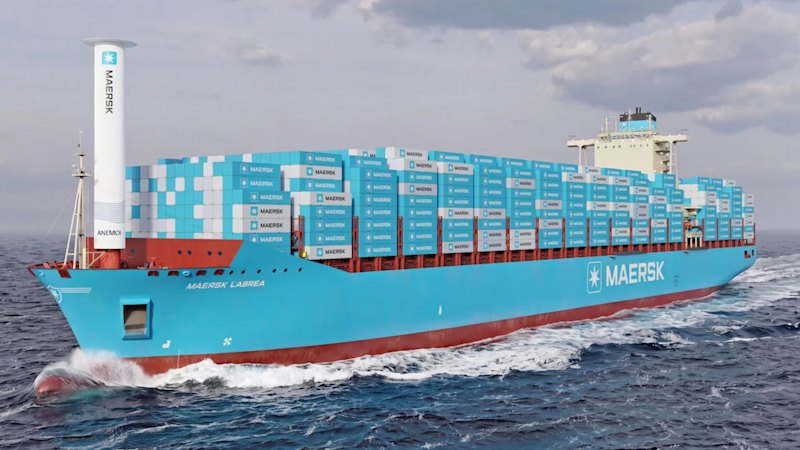
Maersk is to harness the power of the wind by installing a high-tech sail on one of its cargo ships in an attempt to reduce fuel costs.
The Danish shipping giant has commissioned London-based wind-propulsion specialist Anemoi to fit a 35-metre sail on one of its container ships.
The sail will allow the vessel to maintain its usual speed while throttling back its engines to save fuel and cut emissions, or go faster than otherwise possible, reducing journey times.
It will mark the first time that a modern sail has been installed on a container ship, where decks piled high with thousands of boxes leave little room for additional structures.
Anemoi, founded 10 years ago by Costas Apodiakos, a shipping magnate, will fit a rotor sail that generates power by spinning in the wind and has a spread of just five metres. That’s far less than rival sails such as the 20-metre-wide WindWings model from fellow British startup Bar Technologies.
The single sail will also be fitted close to the front of the 100,000-tonne Maersk Labrea, keeping well clear of its cargo of 8700, 6.1-metre containers.
Clare Urmston, Anemoi’s chief executive, said that the experiment could open the door to a flood of orders from the container sector if the sail delivers the targeted fuel savings.
She said the company’s Chinese construction site on the Yangtze River, about 160 kilometres from Shanghai, could be expanded to produce up to 250 sails a year.
“Wind is one of the most effective ways to improve the energy efficiency of vessels, and it’s also free,” Urmston said.
“The scalability in the container ship market could be huge. If the performance is as we expect it to be, we would move to a full-scale rollout.”
During trials that will start next year, the Labrea will operate on its usual trans-Atlantic routes, but hunt out the windiest stretches to maximise the boost to its speed, she said.
“The rotor sail works well in bad weather. It likes a good storm and doesn’t need to be folded in high winds like the wing-type sail,” she added.
Anemoi has installed its technology on 28 vessels to date, mostly bulk carriers and oil tankers with unencumbered decks, including the 400,000-tonne ore carrier Sohar Max, which consumed 6 per cent less fuel after being fitted with five rotor sails.
Ole Graa Jakobsen, head of fleet technology at Maersk, said that “wind-assisted propulsion is one of several promising maritime solutions with the potential to improve vessel efficiency”.
“It has already been tested in other parts of the shipping sector, and we see this pilot as a valuable opportunity to build practical experience and assess its relevance for our fleet.”
Anemoi’s rotor sails work like an aircraft wing by creating an air pressure differential, which leads them to spin up to 170 times a minute and create thrust.
Since ships rely on their engines to power numerous essential systems, the sails would not normally allow them to be switched off, though in tests one vessel reached 12 knots from wind power alone.
Container ships typically limit their speeds to as little as 16 knots to conserve fuel. Donald Trump has said he wants to end the practice by fostering the creation of a fleet of nuclear-powered cargo vessels capable of 30 knots in a challenge to China.
The Telegraph, London
The Business Briefing newsletter delivers major stories, exclusive coverage and expert opinion. Sign up to get it every weekday morning.
KioskNews shows a cleaned-up reading view extracted from the publisher’s page — the original always lives on their site, not ours.