IMF chief warns of AI tsunami as entry-level jobs face disruption

BANGKOK – International Monetary Fund Managing Director Kristalina Georgieva has warned that artificial intelligence is a “slow-moving tsunami” that will gradually reshape labour markets worldwide, urging governments to prepare workers for changing job demands.
Speaking at the IMF-World Bank Group Annual Meetings 2026 in Bangkok on Tuesday, Georgieva said AI’s impact would spread as the technology becomes more widely adopted across industries, with young people and those entering the workforce particularly vulnerable to changes in entry-level employment.
Studies show that 60% of jobs in high-income countries could be affected by AI, compared with 23% in low-income countries. The difference does not mean poorer countries face less risk, but rather reflects their lower levels of access to and adoption of the technology, she said.
Georgieva described AI development as unfolding in two waves. The first involves heavy investment in data centres and AI models, with the United States, China and India among the major technology developers. Asian countries, including Thailand, are also helping build the infrastructure needed to support AI expansion.
The second wave will involve the widespread application of AI across economic sectors and everyday life, similar to how mobile phones brought technology to a much broader population.
The investments are helping sustain global economic growth at around 3% despite the energy crisis, she said.
However, developing countries’ ability to benefit from AI will depend on four key foundations: reliable electricity, effective digital infrastructure, workers’ skills and regulations that appropriately manage technological risks.
The IMF estimates that AI could boost economic growth by around 0.5 to 1 percentage point in advanced Asian economies, potentially offsetting some of the economic effects of ageing populations. Emerging Asian economies could see an additional 0.2 to 0.8 percentage points of growth.
Georgieva also cited US research showing that about 10% of jobs are already beginning to require AI-related skills, mostly in highly skilled and well-paid occupations. Meanwhile, routine, repetitive jobs are likely to decline, while lower-paid employment is expanding in two areas: construction and activities related to data centres, as well as services.
Young people face particular challenges because entry-level positions have traditionally allowed workers to gain experience and develop skills before moving into more senior, better-paid roles. If technological change reduces these opportunities, new entrants could find it harder to enter the labour market and progress in their careers.
Georgieva outlined three priorities for governments: updating labour policies to help workers move into occupations where demand is growing; reforming education and promoting lifelong learning so people can continually develop new skills; and reviewing fiscal systems and tax structures to ensure governments can maintain revenues as AI changes employment patterns.
Earlier, World Bank Group President Ajay Banga said job creation must be treated as an urgent priority, noting that 1.2 billion young people will turn 18 over the next 15 years.
Employment provides more than income, giving people the opportunity to participate productively in society, maintain hope and preserve their dignity, he said.
Banga said job creation requires strong physical infrastructure, investment in human capital and sound government policies, alongside measures to reduce risks and attract private investment. The private sector accounts for 75% to 85% of employment in countries, he said.
For emerging markets, he argued, the opportunity lies not only in developing large language models but also in adopting affordable, practical forms of “small AI” to improve productivity in agriculture, education and healthcare.
He identified five sectors with strong job-creation potential: infrastructure and construction, smallholder agriculture, primary healthcare, tourism, and manufacturing and value-added processing.
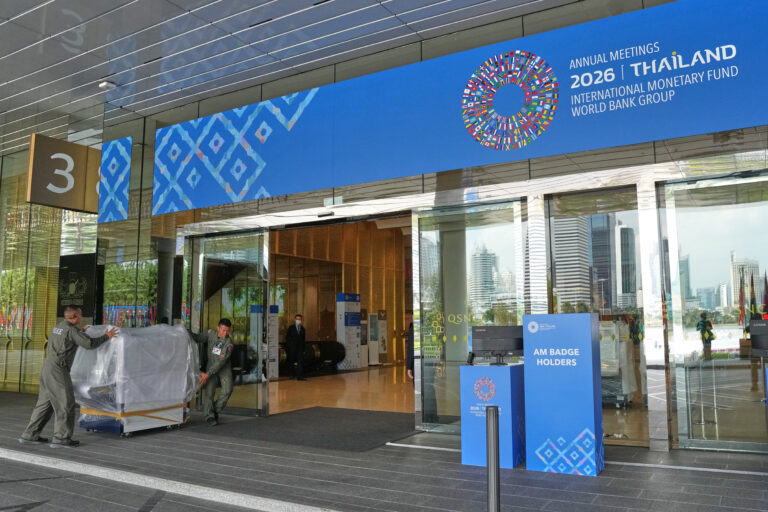
The IMF-World Bank Group Annual Meetings are being held at the Queen Sirikit National Convention Centre from 12 to 18 October, with Thailand hosting the event.
KioskNews shows a cleaned-up reading view extracted from the publisher’s page — the original always lives on their site, not ours.