New details reveal clashes that stopped beeper op. against Hezbollah days after Oct. 7 - exclusive
Readers of The Jerusalem Post are very familiar with the byline of Yonah Jeremy Bob.
As the senior military analyst and correspondent for the paper over the last half-decade (and before that, its legal correspondent), his stories have encapsulated and explained the dizzying pace of events the country has endured in recent years and have helped readers understand the implications and intricacies of the wars, campaigns, negotiations, and dilemmas that are a constant part of Israel’s landscape.
If we abide by the 1943 adage by American journalist Alan Barth that “news is only the first rough draft of history,” then the new book by Bob, together with Wall Street Journal editorial writer Elliot Kaufman, In The War Room: The Inside Story of Israel’s Fight Against Hamas and the Iranian Axis, is a final sculpted treatise that is a must-read for anyone who cares about the pivotal developments that led up to the cataclysmic events of October 7, 2023, and resulted in the ongoing battle against Iran and its proxies in Gaza and Lebanon.
It reads like a gripping, yet almost improbable espionage novel at times, and the proof in the pudding of Bob and Kaufman’s ability to weave an intriguing tale is that although we know what transpired in each successive development in the unbelievable timeline of events – whether the beeper and pager campaign against Hezbollah or the cataclysmic attack by Israel and the US on Iran’s nuclear facilities – readers feel compelled to turn the page such that it is as if they’re discovering the details all anew.
In the War Room provides an inside account of how Israel came back from its darkest hour after Oct. 7 to decimate Hamas and Hezbollah and command the skies over Tehran.

Inside the war room
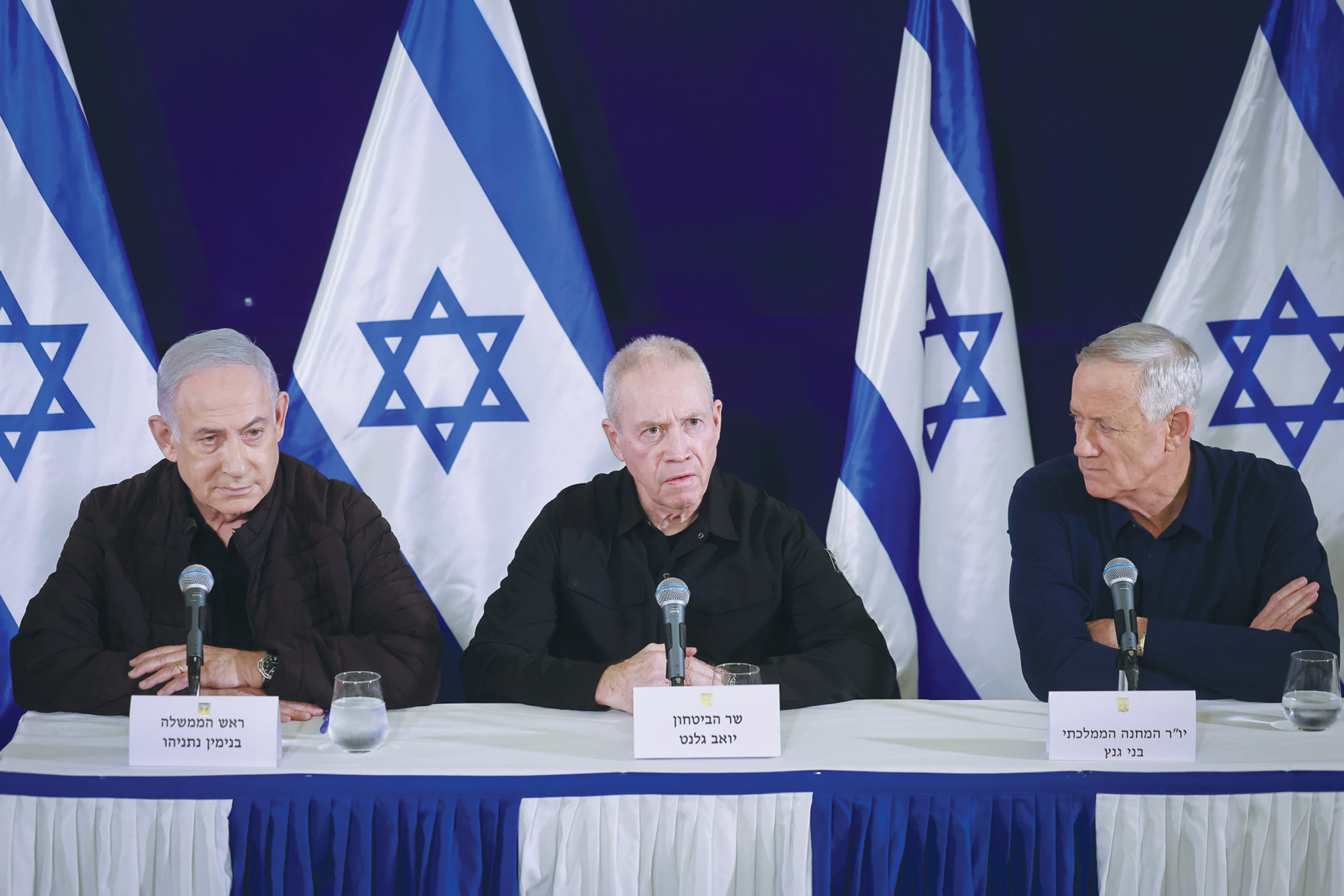
The recurring focus of the book that provides the insider coverage most spectacularly is the ongoing meetings taking place between the masterminds of the Israeli campaign to change the post-Oct. 7 regional landscape and fight a multi-pronged war – Prime Minister Benjamin Netanyahu, then-defense minister Yoav Gallant, and then-war minister Benny Gantz.
Bob and Kaufman place the reader as a fly on the wall as the contentious trio makes fateful decisions, constantly switching allegiances, opinions, and strategies – with one eye on the war and the other eye on each other.
The prose shows the war leaders expressing both doubt and conviction about how Israel should proceed and maneuver amid Hamas intransigence, growing US opposition to Israel’s policies, internal pressure due to the ongoing hostage situation, and damning world opinion.
Doves became hawks and hawks became doves depending on the situation and the decisions to be made. One can almost feel the perspiration under their military-chic black buttoned-down shirts as they deliberated in tense sessions in the “Kirya,” where day and night don’t exist.
“Gantz, the supposed dove, along with Gallant and [then-IDF chief of staff Herzi] Halevi, once again pressed Netanyahu to green-light an invasion. They told the prime minister that there was no way to get additional Israeli hostages back from [Yahya] Sinwar without cornering the Hamas leader to a point where he would fear being caught. They also noted that so long as Khan Yunis was in the hands of Hamas, the terrorist group would retain the strength to operate as a national military organization.”
THE AUTHORS state that later in the war, after Netanyahu fired Gallant and Gantz quit, the war room transformed into the prime minister’s personal domain.
“For all the war room’s dysfunction and small-minded rivalries, for large portions of the war, Netanyahu, Gallant, and Gantz balanced each other’s views. This may have helped Israel avoid major errors and kept its relations with US Democrats and Western Europe from collapsing.”
Once Gantz quit and Netanyahu fired Gallant, the prime minister had no war room of substance to push back on his ideas – or those of his coalition partners. He did not think he would miss Gantz or Gallant, but on this, he did.”
Bob and Kaufman had unprecedented access to the actors, and the writing is based on two years of private interviews and briefings with the Israeli triumvirate, meetings with the top Israeli military and intelligence officials, and trips to combat zones on four fronts: Gaza, Lebanon, Syria, and the West Bank.
In addition, they interviewed top Biden and Trump administration figures, including former US National Security advisor Jake Sullivan and Trump administration envoy to the Middle East Steve Witkoff.
But instead of just a “then they said” account, the writers utilize their vast backgrounds and expertise to put you inside the heads of the main players and help the reader understand their motives amid the global chess game taking place, like this passage on Gallant:
“In the days after October 7, however, Gallant mainly was trying to decide – and then convince a notoriously hard-to-pin-down prime minister and cabinet – what Israel’s policy should be against Hezbollah.
“Armed by Iran with an extraordinary missile arsenal, the US-designated terrorist group had long cowed the Lebanese Armed Forces and shared Hamas’s goal of destroying the Jewish state. In support of Hamas’s invasion, Hezbollah started shooting rockets at northern Israel the very next day, on October 8.
“Gallant still believed, as he did before the war, that Hezbollah, not Hamas, posed the larger, perhaps existential threat to Israel.
“During his sleepless night, he came to two conclusions. First, Israel needed to execute a devastating strike against Hezbollah right away.
“A combination of intelligence, sabotage, artillery, and air power could cripple the terrorist group before it could use its well-trained troops and tens of thousands of sophisticated missiles to follow up Hamas’s attack with a far more powerful assault of its own. This would allow Israel to regain the initiative, shock the Iranian terror axis, and isolate Hamas in Gaza.
“Second, Gallant concluded that Netanyahu, his Likud party leader and boss in Israel’s coalition government, though renowned for his hawkishness, would be dead set against his proposal.”
The authors deliberately shy away from the non-military aspects of the war and how they dominated the Israeli discourse for over two years while the agonizing hostage saga played out.
There’s none of the anguish of the families, the protests against the government (except in how public pressure affected or didn’t affect decision-making), the tragic personal stories of the war or the drama and trauma the country went through watching on TV as hostages were released in gruesome Hamas-led ceremonies and then were reunited with their families. That’s the topic of another book.
The hostages are mentioned perfunctorily, as in this passage:
“From November 23 to November 30, 2023, the fighting paused. Hamas would return around 100 hostages in exchange for the release of more than three times as many Palestinian security prisoners from Israel. This deal – or ransom – was hammered out by Mossad Director David Barnea and Qatari Prime Minister Mohammed bin Abdulrahman bin Jassim al-Thani, two men who influenced the course of the war from the shadows.”
Writing from an Israeli perspective
What’s also lacking in the book, to its great benefit, is a sense of even-handedness. Bob and Kaufman start from a belief that Oct. 7 was an atrocity that had to be answered. It’s written from a Zionist perspective and surely won’t be used as required reading in a US liberal arts Middle Eastern studies course.
Writing about October 17, 2023, the authors state:
“That day, Hamas said an Israeli air strike on Gaza City’s al-Ahli Arab Hospital had killed at least 500 Palestinians. That would be the headline in The New York Times and across the world. By the next day, however, it would turn out that the attack wasn’t Israeli, it wasn’t an air strike, it didn’t hit the hospital, nowhere close to 500 people were killed, and Hamas knew it.
“Israeli intelligence indicated that the culprit was a rocket launched by Islamic Jihad from a cemetery. It had fallen short, as the terrorists’ rockets often did, and landed in the hospital’s parking lot. President [Joe] Biden affirmed that finding less than 24 hours after the incident, a key early moment of support for Israel.”
But in the half-day period of uncertainty, the media leaped to echo the Hamas report. The BBC explained that the Israelis “said they are investigating, but it is hard to see what else this could be, really, given the size of the explosion, other than an Israeli air strike, or several air strikes.”
The world received the story essentially as Rep. Rashida Tlaib, the Michigan Democrat, put it on social media: “Israel just bombed the Baptist Hospital killing 500 Palestinians (doctors, children, patients).” The damage was done. The Oct. 7 attack was only 10 days old, but a new narrative was already forming.
WITHIN THE context of presenting the events from an Israeli perspective, and with Hamas, Hezbollah, and Iran portrayed for what they are – bloodthirsty elements aimed at Israel’s destruction – they manage to provide a subjective account of what transpired, without bringing in their own political biases or opinions.
Discussing the prickly subject of whether Israel could have ended the war and brought the hostages home earlier, the authors just present the facts, ma’am.
“Israel had opportunities to conclude the fighting at earlier junctures. In the summer of 2024, after the invasion of Rafah. In March 2025, extending the second hostage deal. In each case, the prime minister refused, deciding to fight on for better terms.
“Gallant, Gantz, and Halevi had reservations, but were willing to accept the terms of the deals on the table. Halevi believed that Netanyahu had not sufficiently invested in negotiations about the second phase of the January 2025 hostage deal, involving the shaping of postwar Gaza.”
And:
“Critics will say the prime minister fought on only to keep power. Netanyahu would say that after October 7, Israel needed total victory to restore security and deterrence. The debate would then go on in endless circles about whether total victory was even possible, and whether the interest being pursued was national or personal.
“For a time, pushing forward worked to Israel’s advantage. Even against great pressure, Netanyahu prevailed to maintain the war to keep open the possibility of invading Rafah, defeating Hezbollah, and destroying the Iranian nuclear program and proxy axis should the right opportunities arise for him.
“But continuing beyond that? The quest to end the fight in Gaza on a similarly convincing victory would drain Israel – and cost it severely on the world stage.”
Israel-haters who will bristle at the stingy use of the word “genocide” in the prose may eschew the book as just some more Israeli propaganda. But for historians, diplomats, and anyone who’s passionate about Israel and the continuation of the Zionist endeavor, In the War Room will indeed be required reading.
Bob and Kaufman have written one of the definitive, in-depth, and easily readable accounts of one of the most amazing periods of Israeli history that will continue to reverberate around the region for decades to come.
Their ability to synthesize and analyze the big events and put them into perspective will be a valuable resource for scholars and researchers in years to come. And they never lose sight of the main reason that the book exists.
“Despite all the successes and theatrics Israel would pull off in Iran and Lebanon, October 7 remains the day of this war which has seared deepest into the Israeli mind. Hamas invaded from Gaza and packed an entire intifada’s worth of slaughter into a single day, setting everything else into motion.” ■
The reviewer is the former managing editor of The Jerusalem Post.
IN THE WAR ROOM: THE INSIDE STORY OF ISRAEL’S FIGHT AGAINST HAMAS AND THE IRANIAN AXIS
By Yonah Jeremy Bob and Elliot Kaufman
A Wicked Son Book/
Post Hill Press
352 pages; $32.50
KioskNews shows a cleaned-up reading view extracted from the publisher’s page — the original always lives on their site, not ours.