China county makes diamonds 'as cheap as cabbage' through industrial-scale production
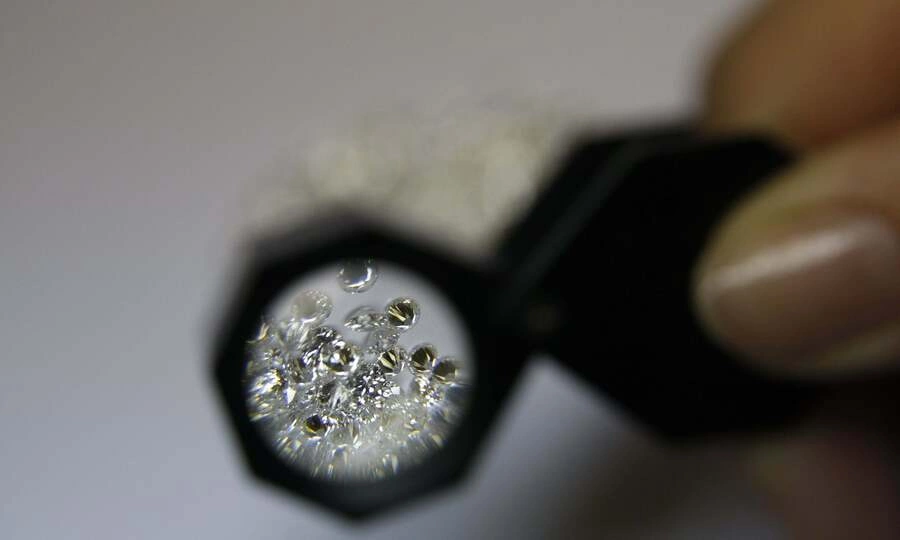
Zhecheng County in China's Henan Province has become a major hub for lab-grown diamonds, accounting for about 60% of the country's production.
The county, once known mainly for agriculture, chili peppers and beef cattle, has emerged as a major production center for lab-grown diamonds and other superhard materials.
China produced more than 70% of the world's synthetic diamonds in 2023, with Zhecheng accounting for nearly half of China's output. The county's share rose to about 60% last year, according to China Daily.
The rapid expansion has helped drive down lab-grown diamond prices, with Chinese media describing stones from Zhecheng as being "as cheap as cabbage."
A lab-grown diamond can cost only a fraction of a natural diamond, and in some cases tens of times less, according to Our China Story. One-carat lab-grown diamonds are commonly listed online for about 1,000 to 2,000 yuan (US$140-280), although prices vary depending on quality and other factors.
Lab-grown diamonds have the same chemical composition and physical properties as natural diamonds but are produced under controlled conditions rather than formed naturally underground. China primarily uses high-pressure, high-temperature technology to manufacture them.
The rise of lab-grown diamonds has sharply narrowed the price gap with natural stones. Global Times reported in 2022 that artificial diamonds produced in Henan were priced at about one-third the cost of natural diamonds.
In Zhecheng, graphite is subjected to extremely high pressure and temperatures to produce diamond crystals. The process can take about seven to 15 days, far shorter than the billions of years required for diamonds to form naturally, according to Xinhua.
The county's industry has roots in Henan's early development of synthetic diamonds and superhard materials.
China produced its first synthetic diamond in 1963, while Henan later developed a six-sided press that greatly accelerated production and helped lay the foundation for the region's superhard-materials industry, according to China Daily.
In the early 1980s, engineer Feng Jinchang returned to his hometown of Zhecheng and established the Shaoyuan Diamond Factory, helping to seed the county's emerging diamond industry. His efforts also helped train technicians who later went on to establish businesses of their own.
Over the following decades, Zhecheng developed an industrial cluster linking upstream suppliers with downstream manufacturers. The local industry now covers single-crystal diamond synthesis, micropowder processing, diamond products and jewelry, creating an increasingly integrated supply chain.
Zhecheng is now expanding beyond jewelry into industrial applications. Diamond single crystals and micropowders are used for cutting and polishing, while companies are exploring applications in areas including semiconductors, where diamond's high thermal conductivity can aid heat management.
In 2025, Henan Liliang Diamond Co., Ltd, a company in Zhecheng, unveiled a 156.47-carat lab-grown rough diamond at the 15th China Henan International Investment and Trade Fair, according to Xinhua.
It says the stone was certified by the International Gemological Institute (IGI) and became the world's largest known lab-grown rough single crystal.
KioskNews shows a cleaned-up reading view extracted from the publisher’s page — the original always lives on their site, not ours.