Suicide rates for men in their early 50s reach record high in England and Wales
Suicide rates among men in their early 50s across England and Wales have hit a record high, extending a persistent trend of elevated numbers within Generation X, official figures reveal.
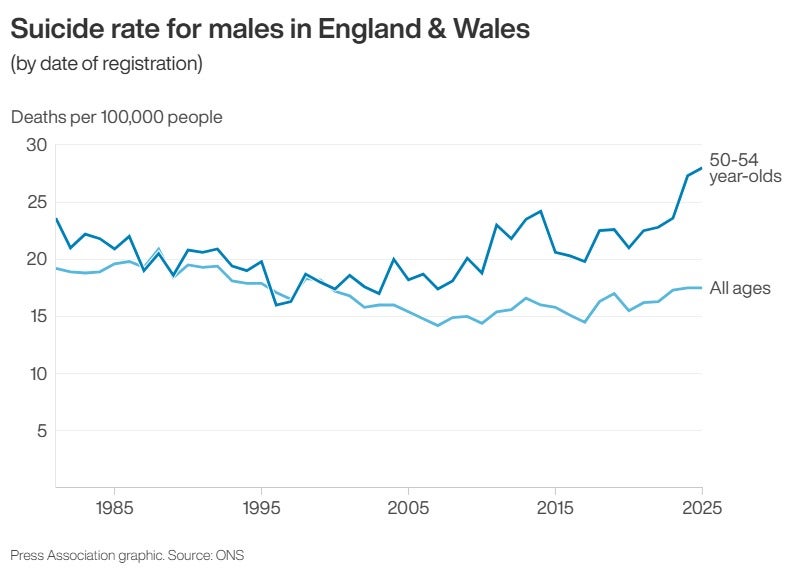
A total of 532 suicides were recorded among men aged 50 to 54 in 2025, equating to 28.0 deaths per 100,000 people.
This rises from 27.3 per 100,000 in 2024, marking the highest level for this age demographic since contemporary data collection began in 1981, according to the Office for National Statistics (ONS).
The figure also represents the highest rate recorded across any age category for both men and women.
The ONS highlighted that higher rates of suicide have "followed" Generation X men over recent decades.
Typically defined as individuals born between 1965 and 1980, Generation X reached adulthood from the mid-1980s to the late 1990s.
Male suicide registration records show a distinct pattern of elevated mortality rates for age brackets comprising Generation X from the 1990s onwards.

Increased rates can be seen among males who were aged 25-29 and 30-34 in the mid-late 1990s; then among the 35-39 and 40-44 age groups in the late noughties and early 2010s; and continuing into the 45-49 and 50-54 groups in recent years.
The 50-54 age group has accounted for the highest suicide rate among males in three of the past five years, the ONS data shows.
Figures continue to be lower among women, where the highest rate in 2025 was for the 45 to 49 age group, at 7.7 deaths per 100,000 people, similar to 7.9 per 100,000 in 2024.
A total of 6,162 suicide deaths were registered in England and Wales in 2025, the equivalent of 11.3 per 100,000 people and close to the recent peak of 11.4 in 2024.
David Mais, head of mortality statistics at the ONS, said: “Sadly, today’s figures show that suicide rates in England and Wales remain elevated, with the overall rate among the highest recorded this century.
“Men in their early 50s are at most risk, reflecting a pattern of increased rates that has followed Generation X men over the past few decades.”
Sonya Trivedy, an executive director at the suicide support charity Samaritans, said middle-age “can be a particularly challenging stage of life”, often characterised by long-term relationship breakdown, money worries, worsening physical health and caring responsibilities for both children and older parents.

She added: “These pressures can be compounded by factors we know are more prevalent for men than women, like alcohol or substance abuse and problem gambling, as well as issues like social isolation.
“We’ve heard from men that they’re told ‘to talk’ but when they do, they’ve had a negative experience. They describe stigma, shame and feeling rushed or unheard.
“We need to see gender-informed care and a wider range of support that reaches men from all walks of life, not just one stereotype of a ‘man’.”
Across all age groups, there were 17.5 male suicides registered per 100,000 people last year, unchanged from 2024, while there were 5.5 female suicides per 100,000, down slightly from 5.7.
There are often long delays between the date of a death by suicide and its registration.
The median average time taken to register a suicide in 2025 was 188 days in England and 249 days in Wales, the ONS said.
This means not all the suicides registered in 2025 will have taken place that year.
A suicide prevention strategy published in 2023 under the then-Conservative government aimed to reduce the suicide rate “over the next five years – with initial reductions observed within half this time or sooner”.
Ms Trivedy of the Samaritans described the latest statistics as “a wake-up call” for government, adding that the “current approach is not working; we need meaningful action and proper funding if lives are to be saved”.
Mental health charity Sane said it was “saddened but not surprised” that figures remain high, “despite the interventions and three years after the launch of the strategy”.
Its chief executive Marjorie Wallace said: “We are calling for more available support and treatment locally so people who feel that they are no longer safe in the community can be given a chance of early intervention with risks identified, and not be sent away from a hospital A&E and most likely onto a long waiting list.”
If you are experiencing feelings of distress, or are struggling to cope, you can speak to the Samaritans, in confidence, on 116 123 (UK and ROI), email jo@samaritans.org, or visit the Samaritans website to find details of your nearest branch.
If you are based in the USA, and you or someone you know needs mental health assistance right now, call or text 988, or visit 988lifeline.org to access online chat from the 988 Suicide and Crisis Lifeline.
This is a free, confidential crisis hotline that is available to everyone 24 hours a day, seven days a week.If you are in another country, you can go to www.befrienders.org to find a helpline near you
KioskNews shows a cleaned-up reading view extracted from the publisher’s page — the original always lives on their site, not ours.