Feast on ‘old-fashioned’ Lebanese food in this chef’s own quirky backyard garden
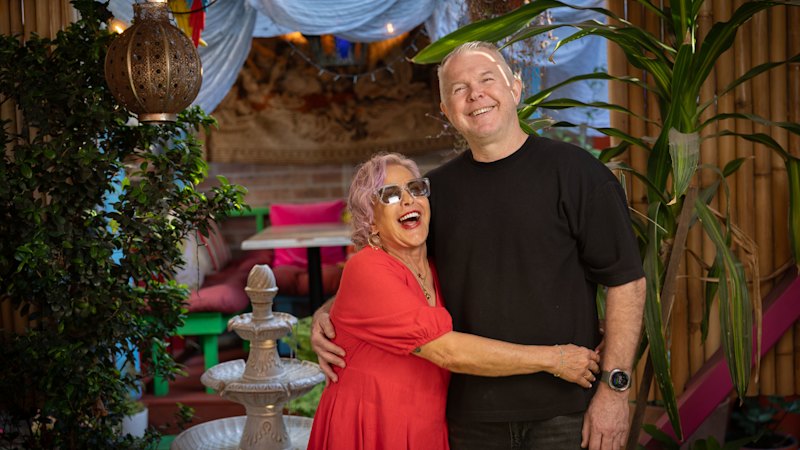
This is no ordinary dining room. At Salwa’s Garden, the best seats in the house are under a sprawling lemon tree, heavy with fruit, soon to be squeezed into lemonade and garnished with mint, picked a few metres from your table. If that spot is taken, slip into a shaded nook with cushioned timber seating, framed by sheer drapes and lush ferns, with a stained glass lantern that glints in the sun – the perfect spot for a long mezze lunch.
When chef-owner Salwa Loghmji and her husband and business partner, Ian Ballingall, took over this 110-year-old Oatley cottage in 2020, the backyard was shabby and overgrown. Salwa’s green thumb transformed it into a garden restaurant, in full bloom with customers on weekends (book ahead).
Her cooking needed no such makeover. Salwa and Ian made a name for themselves at Almustafa, the restaurant they opened in the ’90s on Cleveland Street in Surry Hills, neighbouring Lebanese institutions such as Fatima’s and The Prophet.
When Almustafa closed in 2016, the original menu and recipes carried over to Oatley, where Salwa works the kitchen and Ian is on the pass. Regulars followed, some claiming the fattoush is the best they’ve ever had.
Restaurant reviews, news and the hottest openings served to your inbox.
Perhaps the secret is that it’s always mixed to order: a bright jumble of cucumber, tomato and onion at their peak, with fried Lebanese bread tossed in pomegranate molasses and zesty sumac. Or maybe it’s the herbs, grown and picked by Salwa herself, or her strict-yet-slightly-cryptic lettuce ratio: “Just a bit of lettuce,” she said. “Not too much, or else it’s not fattoush”.
Salwa’s standards are just as exacting for the exceptional kibbeh nayyeh, a cold mezze of ultra-lean, finely minced raw lamb from the same butcher she’s trusted for more than 30 years. She kneads the lamb with burghul soaked in a paste of pureed onion, herbs, and kamouneh – an earthy spice blend, fragrant with rose petals, sourced from her family in Lebanon.
The meat mixture is pressed and smoothed onto a platter, slick with olive oil and paired with radish, white onion and fresh mint. Refreshing and beautiful, it’s a testament to the couple’s dedication to quality. Call ahead to pre-order.
Ask about their pastry chef and the answer gets a laugh: it’s Salwa, who makes nearly every dessert herself (including the must-try sfouf, a warm, fluffy semolina cake tinted gold with turmeric and scattered with slivered almonds and crushed pistachios).
Clearly, Salwa is particular, but she trusts her memory over any written recipe. She cooks and trains her staff by touch, smell and taste, the “old-fashioned way” she learned from her grandmother in their hometown of Sour in southern Lebanon.
“The way my dishes go on the plate is exactly how we did it back then … but when I tried to write a cookbook, I just couldn’t do it,” she said. “I don’t measure.”
Nor will she rush, said Ian: “[The process involves] soaking ingredients overnight, followed by hours of preparation by hand, and hours of cooking.”
Take the mloukhieh – a hearty stew of jute mallow leaves with slow-cooked lamb, served with baked rice, onions and chilli sauce, made with homegrown peppers. The leaves are slowly simmered until they release a natural mucilage, giving the dish a rich, gelatinous body. But the work begins long before the pots go on the stove.
If you can, visit in early summer, when the mloukhieh is made with a fresh harvest.
“When our supplier brings us dozens of bunches in the summer, we have friends and family come over and we sit, five of us around the table, picking each leaf off,” says Salwa.
“They sit there talking for hours,” said Ian. It’s a ritual for the couple’s relatives, and for their staff too, many of whom are family in all but name. After the leaves, they turn to other matters – pinching every shish barak (dumpling) and stuffing every zucchini.
The time, the care, the dedication to tradition – it’s all the more impressive when shortcuts are so tempting, and so often necessary, to keep a restaurant afloat. “I don’t like shortcuts in anything,” said Salwa.
From garden to plate, everything good here has taken its time – so pull up a seat among the flowers and take yours.
Good Food reviews are booked anonymously and paid independently. A restaurant can’t pay for a review or inclusion in the Good Food Guide.
More:
KioskNews shows a cleaned-up reading view extracted from the publisher’s page — the original always lives on their site, not ours.