Behind bars, beyond borders: Inside Lawrence Bishnoi’s crime empire
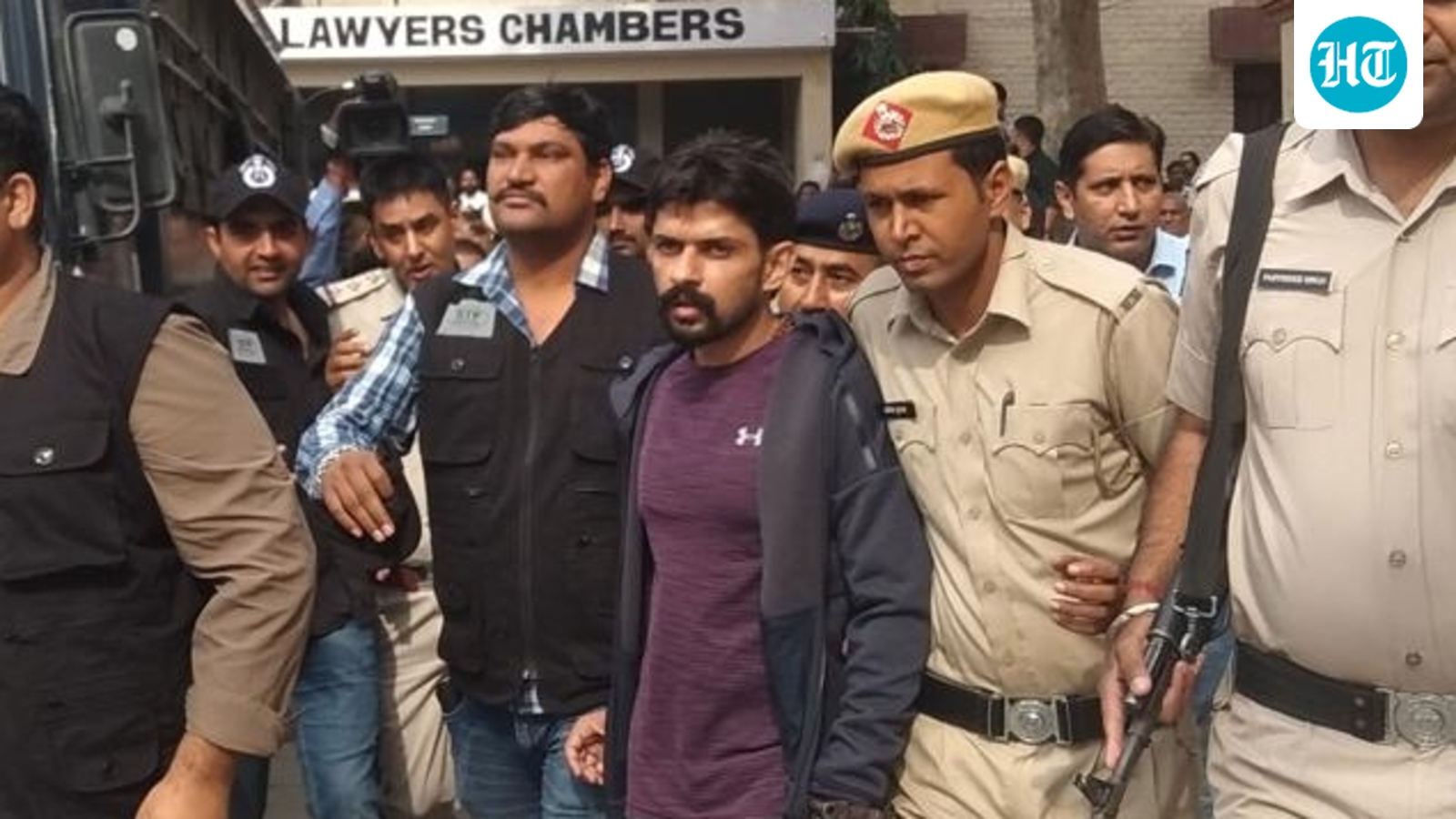
Bishnoi started his gang in the late 2000s and ran it for just a few years before being arrested and jailed, a fact that both adds to the mystique about him.

 Prefer HTon Google

A popular young actor plays a game of football on a Sunday evening in a ground in Juhu, Mumbai. He finishes the game and jumps into his chauffer-driven luxury sedan to go home. As the car heads out, three men step in and from close quarters fire seven shots, injuring the driver and a bystander. The actor is injured by the breaking glass, but has a miraculous escape. The shooters are apprehended 15 hours later from Kota, Rajasthan. In an audio recording posted on X soon after the shooting, a man identified as Anil Pandit takes credit for the attack.
Pandit is a member of a gang headed by Lawrence Bishnoi, 33, who has been incarcerated in Gujarat’s Sabarmati jail since 2023, and whose name has surfaced, time and again over the past few years, in connection with multiple murders, including those of singer Sidhu Moosewala in May 2022, politician Baba Siddiqui in October 2024, and attacks on the houses of actors Salman Khan and Disha Patani. The gang has also been identified by Indian agencies and the Federal Bureau of Investigation (FBI) as being behind the June 2023 killing of Sikh separatist Hardeep Singh Nijjar.
Also Read | Lawrence Bishnoi’s rise: Student politics, first murder and a sprawling crime network
Pandit, 32, has become the face of the group in recent years, along with another man he named in his message, Harman Sandhu. Investigators in India believe that this is aimed at keeping the heat off Satwinder Singh alias Goldy Brar in the US; Bishnoi’s deputy Brar is being hunted by the FBI, which has named Bishnoi’s criminal organisation an Organised Crime Group (OCG).
Once a resident of Rair Kalan village in Haryana’s Panipat, Pandit fled India in 2023, say investigators. They believed he travelled to the US via Canada and Thailand. According to the investigators, Pandit works closely with Randeep Malik and the Canada-based Ravinder Singh Dhanda, also part of the Bishnoi syndicate, according to a US federal indictment in July this year. The investigators, who asked not to be named, said Pandit operates from California and is in touch with Brar as well.
Pandit’s name surfaced in several firing and extortion-related incidents this year –– including an incident where shots were fired at a gym owner associated with singer Guru Randhawa in west Delhi, another at a jewellery showroom in Pune, and two attacks in Bhiwadi and Sonipat. The Delhi Police and Haryana Police are investigating these incidents.
The other man named by Pandit, Sandhu, aka Harmanveer Singh, was also put on the wanted list by the FBI in June this year. It is believed that Sandhu is already in FBI custody in California.
But, at the centre of the web is Bishnoi, who has watched his Indian and overseas empire grow even as he himself has shuttled between jails across Delhi, Punjab, Rajasthan and Gujarat since 2015. Bishnoi started his gang in the late 2000s and ran it for just a few years before being arrested and jailed, a fact that both adds to the mystique about him, and encourages conspiracy theories.
The roots of Bishnoi’s criminal career
Sometime in 2020, when the Delhi Police’s Special Cell prepared a dossier on Lawrence Bishnoi after questioning him, it quotes him as saying he wanted to “leave the world of crime and live peacefully”. According to that document, Bishnoi expressed a desire to do something in the area of sports because he had always been interested in sports, citing his ambitions as a miler in the 2000s.
Investigators now say Bishnoi may have been misleading his interrogators. For since then, his gang and influence have only grown.
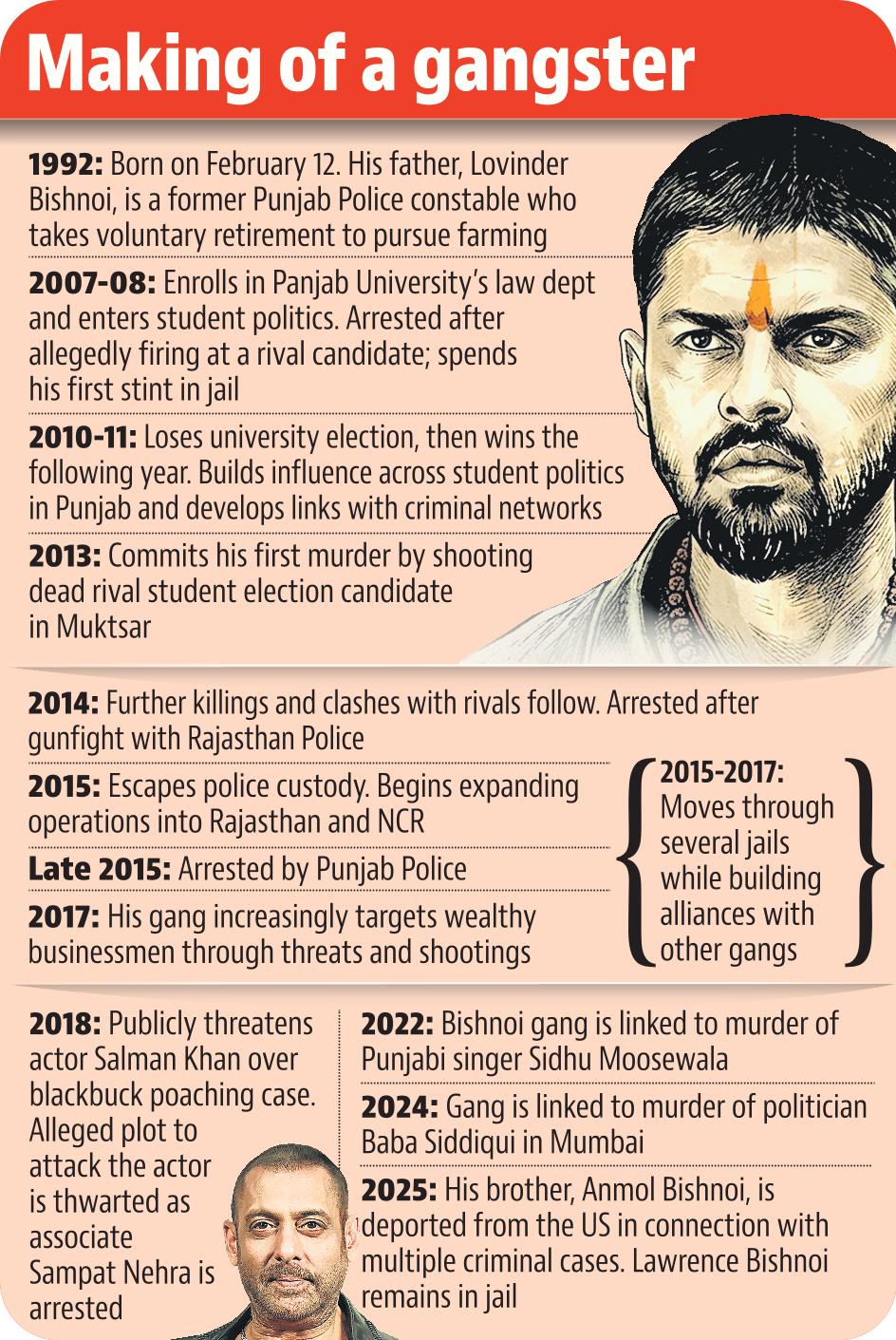
It isn’t clear why Bishnoi quit sports and entered the world of crime, but police records show he was sucked into university politics around 2008. Sometime, in 2008, Bishnoi was jailed when he assaulted a candidate of the Panjab University Students Union (PUSU). Bishnoi was a member of the rival Students of Panjab University (SOPU) union. The two groups were arch rivals. The dossier on Bishnoi’s first crime lists a failed murder attempt when he shot at PUSU’s candidate. He spent a couple of months in prison.
Also Read | ‘If Tiger isn’t safe, none of us are’: Bollywood fears underworld’s return after Juhu attack
According to the Special Cell’s dossier, it was during those two months that Bishnoi met a man named Ranjeet Dupla, who had lived in the US before and was arrested in Punjab for smuggling arms. “Dupla helped buy weapons for Bishnoi and his friends Sampat Nehra (a jailed gangster arrested for attempting to kill Salman Khan) and Kala Rana (who would go on to become one of NCR’s most wanted gangsters and later deported from Bangkok in 2022). After coming out of jail, Bishnoi then bought his first car, a Mahindra Bolero.”
He took control of SOPU, even contested the 2010 university president elections but failed to win. After the election, he was jailed for the second time after he attacked his rival and broke the man’s leg. His friend Goldy Brar was also arrested in the same case.
Bishnoi and Co. remained active in student politics till 2013. That year, ahead of an election at a government college in Muktsar, Bishnoi, Brar and four others shot a student leader dead. That was their first murder.
How social media fuelled the rise of Bishnoi gang
Many police officers who have tracked criminal gangs in North India believe Bishnoi’s meteoric rise started post-2013, and that the gang used social media to expand its influence to even recruit members.
“If you look at it closely, Bishnoi has been in jail for more than 10 years now. But, he continues to be in the news because of social media. Look at the number of fan pages he has on Facebook or Instagram. In fact, the Bishnoi gang was the first to confess their hits on Facebook. While Bishnoi was in prison, his aide Goldy Brar used Facebook and later Instagram to issue threats, claim hits and share videos of Lawrence Bishnoi during court visits. These and the attempted attacks on actor Salman Khan made the gang fashionable in North India, especially Punjab,” said one of the investigators.
Also Read | Tiger Shroff attack: How Lawrence Bishnoi gang’s overseas network operates
One FIR, dated August 26, 2022, against Bishnoi and his gang members by the National Investigation Agency (NIA) specifically talks about their use of social media. Indeed, some of the gangster’s moves seemed made for the medium.
In 2023, when he was in Delhi’s Tihar jail, for instance, Bishnoi claimed to have embraced freedom fighter Bhagat Singh as a hero. At court appearances and photos leaked on social media, Bishnoi wore Bhagat Singh t-shirts.
Then, according to a second investigator, he claimed to have given up rice “for spiritual reasons”. He took to “praying many times a day”, this person added. Bishnoi also claimed he wanted to target actor Salman Khan for allegedly hunting and killing a blackbuck, a species considered holy by the Bishnoi community.
“All this was just a smoke screen for his criminal activities. The gang’s only real job is to make money through extortion or contract killing and expand their criminal network,” said the second investigator. Indeed, Bishnoi has been accused not only of organised crime but also terrorism.
Since 2022, both the NIA and the ministry of home affairs (MHA) have said a conspiracy being hatched by Bishnoi and other members of his gang in India and abroad, to carry out terror acts in the UT of Delhi and other parts of the country.
The gang’s expanding international links
According to the investigators, the Bishnoi syndicate is a geographically dispersed network in which jailed gangsters, overseas handlers, local shooters, financiers and people accused of providing shelter or logistical support are involved. NIA, in a 2023 charge sheet, outlined how the gang had spread across Punjab, Haryana, Chandigarh, Rajasthan, Delhi, Uttar Pradesh, Madhya Pradesh, Gujarat, Maharashtra, Bihar and Jharkhand and that money generated through criminal activities by it was transferred to countries including Canada, the US, Thailand and Australia.
The agency compared the network’s reach and connections with the underworld model associated with Dawood Ibrahim’s D-Company in the 1990s.
The threat posed by the gang is being taken seriously even by the US.
In July, US authorities announced Operation Hard Ball, a coordinated law-enforcement action involving the United States, Canada and Europe in which 37 gangsters from India were charged across three federal indictments while 24 of them were arrested. These individuals are associated with Lawrence Bishnoi, Jaggu Bhagwanpuria and Canada-based Ravinder Singh Dhanda networks.
US prosecutors allege that Bishnoi runs his criminal operations from prison in India (Gujarat) using contraband mobile phones and voice-over-internet-protocol devices. They added that the gang is involved in targeted killings, shootings, extortion, kidnappings, drug trafficking and human smuggling.
Apart from Bishnoi, FBI also named Goldy Brar and Rohit Godara, saying they served as his senior lieutenants, and helped direct members and associates across countries. US authorities said that the gangs use high-profile violence and online claims of responsibility to cultivate fear, particularly in India and among Indian diaspora communities, and then exploit that fear to extort victims.
The attack on Shroff fits that pattern.
Handlers outside India, and local shooters, hired for a few tens of thousands of rupees. “The shooters, mostly jobless youth recruited online, know nothing about the whereabouts of the handlers and larger operation. They get their money and weapons and carry out attacks to make a name in the crime world,” said a senior police officer in Delhi, who asked not to be named.
This officer added that “establishing the chain of communication between the suspected handler and the people who execute an attack, identifying how weapons and money moved, and determining whether separate incidents are connected to the same criminal network becomes a challenge. Then the biggest challenge is access. We cannot reach these guys and the US, Europe and Canada don’t respond very often unless the crimes take place on their soil.”

Neeraj Chauhan is a senior journalist with Hindustan Times and an investigative reporter specialising in national security, terrorism, organised crime, narcotics, corruption, financial crime and complex investigations. With over 21 years of experience across Hindustan Times, The Times of India, The Indian Express and The Pioneer, he has built deep expertise in India’s internal security and law-enforcement landscape. Neeraj has extensively covered India’s principal investigative, intelligence and security agencies, including the NIA, CBI, ED, IB, R&AW, MHA and other central security forces. His work has included deeply reported investigations into terrorism, terror financing, cross-border crime, narcotics trafficking, cybercrime, financial fraud and political and corporate corruption. He has reported on some of the most significant terror attacks and security developments in India over the past two decades, including the Delhi serial blasts, the 26/11 Mumbai attacks, the 2019 Pulwama terror attack and the recent Pahalgam attack. His reporting has also chronicled the rise and decline of the Indian Mujahideen, the activities and subsequent crackdown on the Popular Front of India (PFI), Islamist extremist networks, the conflict in Jammu and Kashmir, insurgencies in the Northeast and Maoist violence. Some of Neeraj’s major breaking stories are in Aryan Khan drug case, Sushant Singh Rajput suicide, interception of a 3,000-kg Afghan heroin consignment worth about ₹21,000 crore at Mundra port, Sri Lanka easter bombings, Aarushi-Hemraj murders in Noida, 2G scam, coal block allocation scam, AgustWestland VVIP chopper deal and major bank frauds and extradition cases involving Mehul Choksi, Nirav Modi and Vijay Mallya. His reporting is marked by an ability to cultivate sources, analyse confidential and complex documents, and follow investigations over several years—from the initial breakthrough to chargesheets, trials and international legal proceedings. He specialises in making complicated security and investigative developments accessible while examining their wider implications for governance and public policy. A Chevening South Asia Journalism Programme Fellow at the University of Westminster, Neeraj also spent time at the Financial Times as part of the fellowship. He was also a Robert Bosch Media Ambassadors India-Germany Fellow, studying at the University of Tübingen and working with Der Tagesspiegel in Berlin. He has previously taught investigative journalism and crime reporting as a guest faculty member at the Times School of Journalism. Over more than two decades, Neeraj has established himself as an authoritative voice on India’s national security and investigative landscape, with his reporting closely followed by officials, investigators, lawyers, policymakers and readers seeking insight into some of the country’s most complex and consequential developments.Read More
Prawesh Lama, an Associate Editor at Hindustan Times with nearly two decades of frontline reporting experience across India’s conflict zones, border regions, and disaster-hit areas. He writes on internal security, insurgency, the Northeast, and Left-wing extremism and has reported from India’s hinterland and some of the most sensitive and strategically critical regions.Read More

KioskNews shows a cleaned-up reading view extracted from the publisher’s page — the original always lives on their site, not ours.