Finland applying lessons from Ukraine to its own borders
Improved ammunitioning, precision strike and counterstrike, rapid industrial spin-up, physical anti-tank defenses and more would play a role in a defense of the border Russia has invaded in the past
By Kirsi Heikel / Bloomberg


Finland is studying Ukraine-style anti-tank defenses to reinforce its border with Russia as it works to build up defenses on NATO’s eastern flank against a rapidly rearming foe.
Lieutenant General Pasi Valimaki, commander of the Finnish Army, said in an interview that Russia has begun rebuilding its military capacity, even as its full-scale invasion of Ukraine grinds into a fifth year.
In that conflict, Kyiv’s forces have used extensive defensive lines and anti-tank obstacles to slow attackers. Neither side has found a reliable way to break through them and restore large-scale movement and maneuver, Valimaki said.
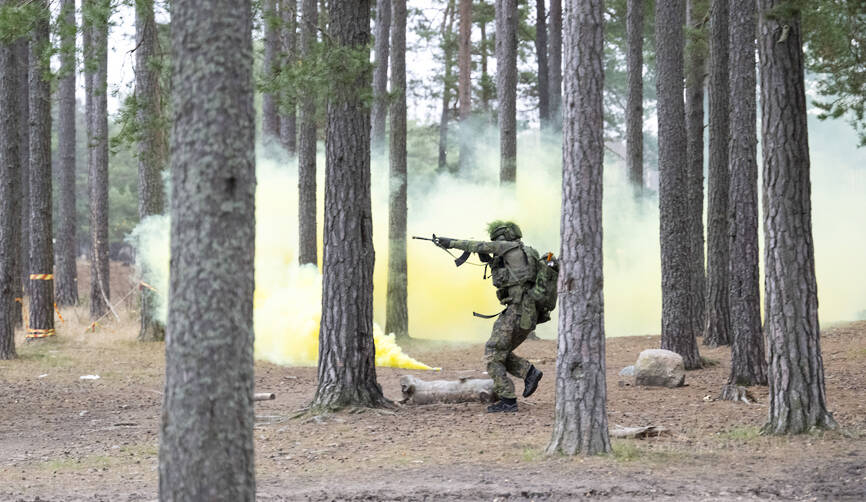
A Finnish soldier takes part in a drill at the Santahamina garrison in Helsinki, Finland, on Oct. 28.
Photo: EPA
Sharing a 1,340km border with Russia, about half of NATO’s land frontier with that country, Finland must determine how structures similar to those used in Ukraine would function in harsh northern weather.
“Conditions in Finland are more challenging,” Valimaki said. “If we build fortifications and dig anti-tank ditches or obstacles as deep as those in Ukraine, how long does it take before our environment turns them into artificial ponds?”
Russia’s efforts to replenish its weapons stockpiles are starting to show some returns, he said, with T-90 tanks, BMP-3 infantry fighting vehicles and 2S19 self-propelled howitzers being delivered to storage depots.
Finland lacks the ability to prevent that rearming. Rather, the goal is to deter Russia by convincing its military that an attack would fail, he said.
“Everything we are doing now is about creating a threshold so that Russia does not go any further, whether we are talking about [NATO] or Finland,” Valimaki said.
Finland continued conscription and maintained territorial defense reserves after the Cold War, even as many European nations reduced their forces. Despite a population of just 5.6 million, its military can call on about 280,000 troops in wartime.
“When the war in Ukraine began, we improved our readiness and put 60,000 people through refresher training over two years,” Valimaki said. “We also quickly began replenishing stocks of critical materiel.”
Finland is carrying out an overhaul of its land forces that should run through the end of the 2030s, covering equipment, force structure, readiness and the capacity to sustain combat operations. The basic approach — deterring an attack by being prepared — has not changed, Valimaki said. What has changed is the scale required.
“The scale of the ammunition, production systems and trained personnel that we need to have ready for use is different from what it was before 2022,” he said. “It has to be larger, more sustainable and technologically more advanced than before.”
Finland is spending at least as much on the overhaul of its land forces as on its ongoing strategic Navy and Air Force programs combined, the Defense Ministry said in a written statement. Funding those programs should cost at least 11.6 billion euros (US$12.93 billion).
As part of a much broader procurement drive, Finland is expanding its Hanwha Aerospace Co Ltd K9 self-propelled howitzer fleet, modernizing its heavy multiple-launch rocket systems to fire almost 500km, and preparing to replace its BMP-2 infantry fighting vehicles.
Attacks on Ukraine have shown the scale of the air and missile threat Finland could face. Under NATO’s Eastern Flank Deterrence Line concept, it is not enough to shoot down incoming missiles and drones — defenders must also be able to strike the launchers before they fire, Valimaki said.
“For Finns, this is a difficult issue, because it means hitting targets on the Russian side,” he said.
Finland has already begun replacing its F/A-18 Hornets with 64 Lockheed Martin Corp F-35A fighters, with the first aircraft delivered. It has ordered the David’s Sling missile-defense system, produced by Rafael Advanced Defense Systems Ltd, which has seen extensive action in the Iran war.
Valimaki rejects the idea that new technology has made traditional weapons obsolete. Drones have become a major part of the battlefield, Valimaki said, adding that they are only one element to consider.
Ukraine has underscored the need to replenish equipment and ammunition during a prolonged conflict, and Valimaki wants domestic production that can expand rapidly.
“What I would like Finland to have is the ability to scale for mass-production in large volumes — production for readiness and daily training consumption that can be maintained in peacetime and scaled up tenfold in crisis and conflict,” he said.
The push reflects a fundamental constraint on how Finland can fight a much larger opponent on NATO’s eastern flank.
“We do not want a war of attrition,” Valimaki said. “We are a country of five million people, and we cannot operate on that logic.”
KioskNews shows a cleaned-up reading view extracted from the publisher’s page — the original always lives on their site, not ours.